The Regulars Who Quietly Stopped Coming In
They didn’t complain. They didn’t say goodbye. They just stopped rebooking — and you barely noticed. Here’s why salon client retention, and owning your own client data, is the quiet key to a stylist’s income.
Every stylist and barber has lost clients this way, usually without realising it. Not the dramatic kind who complain and storm out — those you remember. The quiet kind: a good regular who came every six weeks like clockwork, then came a little less often, then somehow you realise you haven’t seen them in months. They didn’t complain. They didn’t say goodbye. They just… drifted. And because it happened silently, one client at a time, you never noticed the slow leak draining your income. Salon client retention — specifically, catching those quiet drifters before they’re gone — is one of the most valuable and most neglected parts of running a chair. Here’s why it matters so much, and how to fix it.
Why losing regulars hurts more than you think
The economics here are stark. A loyal regular is worth a fortune to a stylist. They come back again and again, they often spend more (add-ons, retail, upgrades), they refer friends, and — crucially — they cost you nothing to acquire. You already have them. Compare that to a new client, who you have to attract through marketing, referrals, or luck, and who may or may not become loyal.
So keeping an existing regular is dramatically cheaper and more valuable than replacing them with a new client. Which means every regular who quietly drifts away is a serious loss — not just one appointment, but a stream of future appointments, spending, and referrals, gone. Lose a handful of regulars a year without noticing and you’ve created a real hole in your income that you’re constantly running to fill with new clients, like bailing a boat instead of fixing the leak.
The problem is that the leak is silent
Here’s what makes lost regulars so insidious: there’s no moment of loss. Nobody tells you they’re not coming back. There’s no event, no alert, no empty chair with a name on it. A client simply doesn’t rebook, and life is busy, and you don’t notice — because noticing would require you to be tracking, in your head, when every single client is due and flagging the ones who’ve gone quiet. Across a full book of clients, that’s impossible to do from memory.
So regulars slip away in your blind spot. Not through any failure of your work — they may have loved their cut — but through the simple fact that nothing prompted them to rebook and nothing prompted you to reach out. The relationship faded through pure inattention, on both sides, because there was no system watching for it.
The fix: flag the drifters automatically
The solution is beautifully simple: track when you last saw each client, and automatically flag anyone who’s overdue. If a client normally comes every six weeks and it’s been longer, they should surface as someone to follow up with — before they’ve fully drifted away.
This turns silent loss into a visible, actionable list. Instead of vaguely hoping your regulars keep coming, you have a clear prompt: here are the people who are overdue, reach out to them. And reaching out is genuinely powerful, because these aren’t cold leads — they’re people who already know and (usually) like you. A warm, simple message — “Hi, it’s been a while, would you like to book your next appointment?” — is the cheapest, warmest, highest-return marketing a stylist has. It often brings someone straight back in who had simply forgotten to book, or drifted without meaning to. You’re not chasing strangers; you’re reminding friends.
The stylists who do this consistently keep clients that others lose. Not because their work is better, but because they have a system that stops good relationships from quietly dying of neglect.
This only works if you own your client data
There’s a catch that’s worth taking seriously: you can only do this if you actually have your client data — and many stylists don’t, not really. If your entire client history lives inside a booking app, your relationship with your own clients is mediated by, and dependent on, that platform. The app owns the data. If you leave, switch tools, or the app changes its terms or its fees, your client book — the single most valuable asset you’ve built — can be difficult to take with you.
Owning your own record of clients, their visit history, their preferences and formulas, and their contact details means that asset is yours. You can run your follow-ups, understand your patterns, and take your book with you wherever your career goes. For an independent stylist or booth renter especially, your client relationships are your business, and having them in your own hands rather than locked in someone else’s platform is a form of security worth a great deal. (Owning that data also means handling it responsibly — client information is personal data, and keeping it private and secure is part of the deal.)
Consistency plus notes makes it warmer
Two things make follow-up land even better. First, consistency — a regular rhythm of checking who’s overdue and reaching out beats occasional bursts. Second, good client notes: remembering someone’s usual, their formula, their preferences, the detail they mentioned last time, makes every reconnection feel personal rather than transactional. “Hi, ready for your usual? I’ve got that colour noted” is worlds away from a generic blast. The combination — a system that flags the drifters, plus notes that make the outreach personal — is what turns retention from a chore into a relationship.
An important note
To be clear: this is about organising and understanding your own business — it is not financial, tax, accounting, legal, or business advice, and it guarantees no result. When you keep client data, you’re responsible for handling it properly and securely, including any privacy laws that apply to you (such as GDPR). Always follow the licensing, insurance, and health-and-safety requirements that apply where you work, and consult a qualified professional for tax and accounting decisions.
If you want a client book that watches for drifters
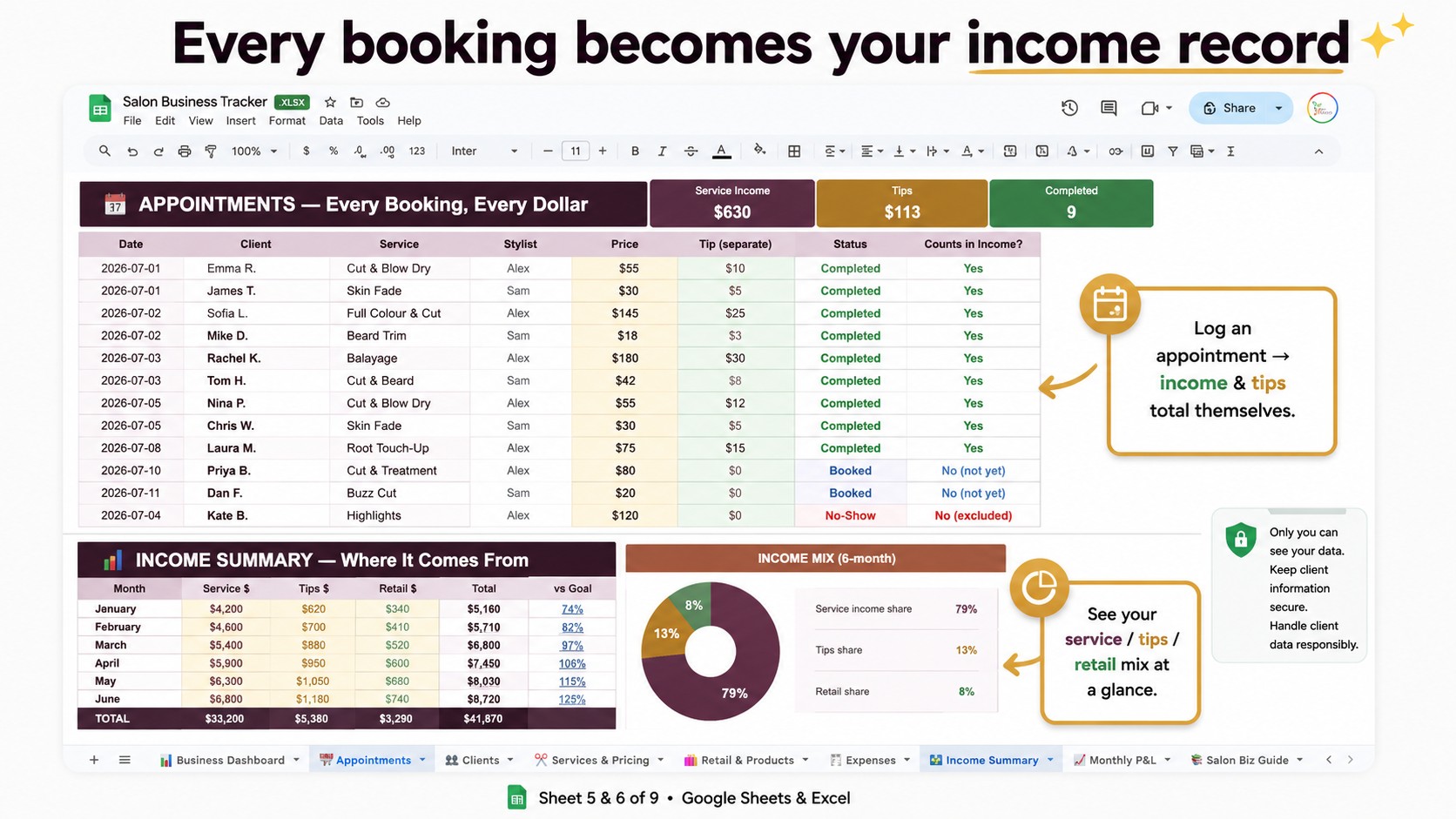
I built a client book with automatic six-week follow-up flags into my salon and barber business tracker in Google Sheets — it flags anyone you haven’t seen recently, keeps formula and preference notes, and stays entirely yours, alongside appointments, service profitability, and a full P&L:
👉 Salon & Barber Business Tracker for Google Sheets & Excel
Whether you use mine or a notebook, start tracking when you last saw each client and reaching out to the ones who’ve gone quiet. The regulars who drift away silently are your biggest hidden loss — and they’re the easiest to win back, because they were never really unhappy. Catch them before they’re gone, keep your client book in your own hands, and watch how much of your income was leaking away where you couldn’t see it.
This reflects my own perspective and is an organising tool — not financial, tax, accounting, legal or business advice, and it guarantees no result; you’re responsible for handling client data properly, including any privacy laws that apply. Stylists: what’s your go-to message for winning back a client who’s drifted? Share it in the comments.