

The One Number That Shows How Close You Are to Financial Independence
Forget vague goals. There’s a single, motivating metric that tracks your progress to freedom: what percentage of your expenses your passive income already covers. Here’s why it matters.
Financial independence can feel like a distant, abstract dream — a someday when you no longer need to work. The problem with abstract dreams is that they’re hard to work toward, because you can’t tell if you’re making progress. What changed everything for me was reframing financial independence around a single, concrete, trackable number: the percentage of my expenses that my passive income already covers. That one metric turned a vague someday into a progress bar I could watch fill. If you’re chasing financial independence, this is the financial independence number I think matters most day to day. Here’s why.
Financial independence, defined simply
Strip away the complexity and financial independence has a beautifully simple definition: it’s the point where your passive income covers your living expenses. When the money flowing in — from investments, rentals, royalties, whatever — meets or exceeds what you spend to live, you’re financially independent. Work becomes optional, because you no longer depend on a paycheck to cover your life.
That definition is powerful because it’s measurable. It’s not “have enough money someday.” It’s a clear equation: passive income versus expenses. And any clear equation can be turned into a progress metric — which is exactly what makes the next idea so useful.
The coverage percentage: your progress bar to freedom
Here’s the number: what percentage of your monthly expenses does your passive income currently cover? If you spend $4,000 a month and your passive income is $1,000 a month, you’re at 25% coverage. That single percentage is, in my view, the most motivating metric in the entire financial independence journey.
Why? Because it turns an abstract, far-off goal into a progress bar. 100% coverage is financial independence. Every percentage point you climb is measurable progress toward it. Instead of “I’m saving toward some distant number,” it’s “I’ve gone from 25% to 30% covered — I’m getting closer.” That reframe is enormously motivating, because humans are wired to respond to visible progress toward a clear goal. A progress bar filling is compelling in a way that a vague aspiration never is.
Why coverage beats a single big target
You might wonder how this differs from the classic financial independence target you may have heard — the idea of needing a certain-sized nest egg. Both are valid, but they answer different questions and serve different purposes.
A big lump-sum target (“I need $X invested”) is useful for long-range planning, but it’s a distant, intimidating number that can feel discouragingly far away, and it doesn’t obviously move day to day. The coverage percentage is a here-and-now progress metric. It reflects your actual income covering your actual expenses right now, and it ticks up as you build. One is the destination; the other is the odometer showing how far you’ve traveled. For staying motivated through a years-long journey, watching the odometer climb is far more sustaining than staring at the distant destination.
The coverage percentage is also more actionable on a monthly basis. Want to raise it? Two levers: increase your passive income, or decrease your expenses. Both immediately move the number. That makes it a metric you can actively influence and watch respond, which keeps you engaged in the process rather than passively waiting to arrive.
Milestones make the journey feel real
One reason the coverage percentage works so well is that it creates natural milestones to celebrate along the way. Hitting 25% coverage — a quarter of your life funded by passive income — is a real achievement worth marking. 50% is a massive psychological milestone: half your expenses covered means dramatically more freedom and security even before full independence. These waypoints turn a long, potentially demoralizing journey into a series of achievable, motivating steps.
Without a coverage metric, the journey to financial independence is just a long slog toward a far-off finish line. With it, it’s a climb with clear, celebrable milestones, each one a genuine improvement in your freedom and security. That structure is what keeps people going for the years these journeys take.
An honest caveat
As always with money and investing: this is a way of framing and tracking your progress — not financial or investment advice, and not a guarantee. Your passive income can fluctuate, investments carry real risk and can lose value, and the coverage percentage is based on your own estimates of income and expenses. Use it as a motivating personal metric, but do your own research and consult a qualified financial professional for actual financial and investment decisions. The number is your progress bar; it isn’t a promise.
If you want to track your coverage
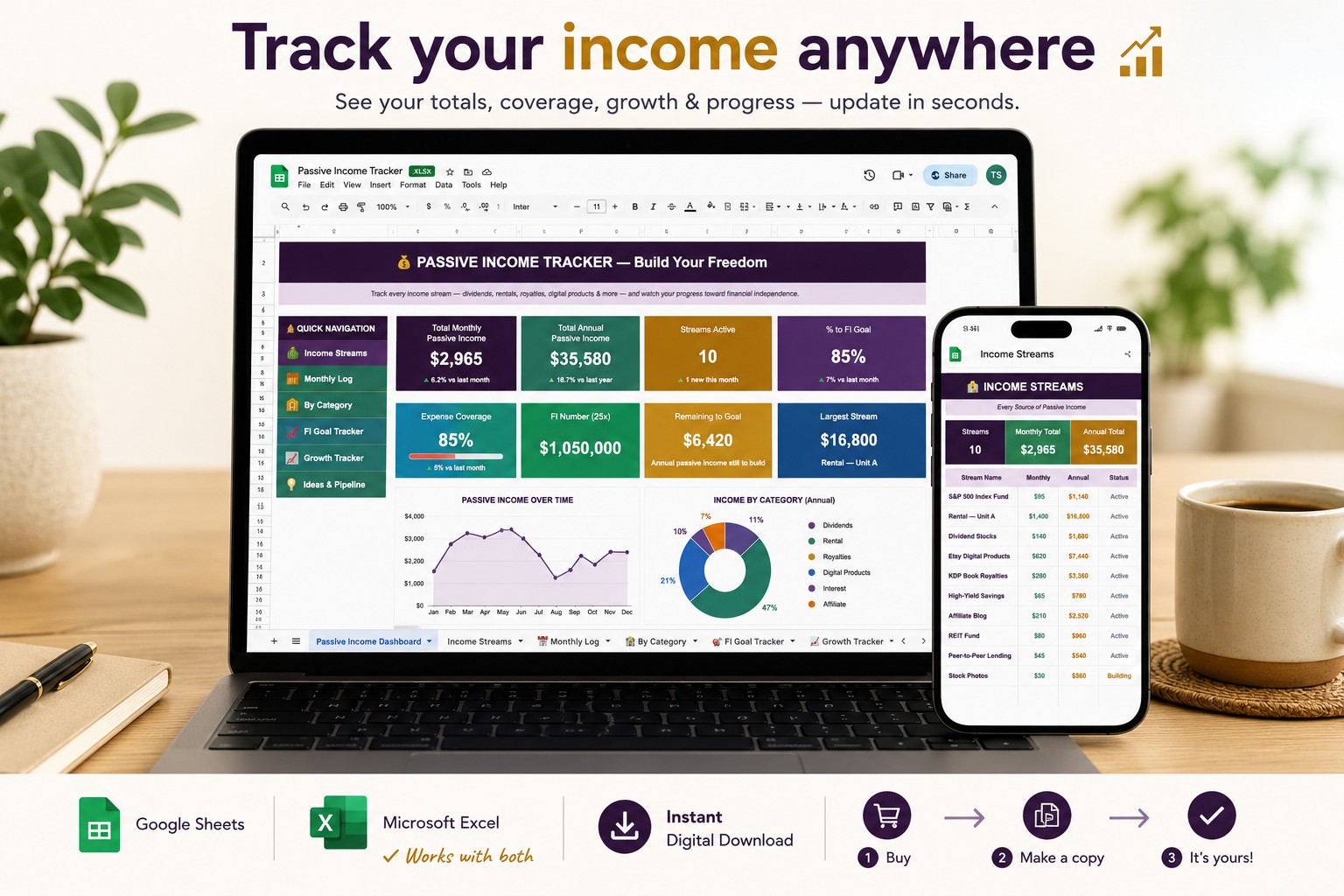
I built expense-coverage tracking into my passive income tracker in Google Sheets — enter your income streams and your expenses, and it shows the percentage of your expenses your passive income covers, so you can watch your progress bar to financial independence fill over time:
👉 Passive Income Tracker for Google Sheets & Excel
Whether you use mine or calculate it yourself, start tracking what percentage of your expenses your passive income covers. It turns the abstract dream of financial independence into a concrete number you can watch climb — and that visible progress, milestone by milestone, is what carries you all the way to 100%.
This is a way of framing progress and my own perspective — not financial or investment advice. Investments carry risk; figures are estimates; do your own research and consult a qualified professional. What’s your current coverage percentage? Share it in the comments — every percent is progress worth celebrating.

