Annual Goals Are Too Big to Act On — Break Them Into Quarters
A yearly goal is a distant abstraction you can’t act on today. Quarterly planning turns it into targets you can actually hit. Here’s why breaking goals down changes everything.
Here’s a mistake I made for years with business goals: I set them annually and tried to act on them annually. “Grow revenue to a certain number this year.” “Launch a certain number of products this year.” Big, yearly targets. And they mostly failed — not because they were wrong, but because a whole year is too long a horizon to act on. A yearly goal feels distant and abstract in January, so you don’t feel urgency; then suddenly it’s Q4 and you’re way behind with no time left. The fix that transformed my results was quarterly planning — breaking every annual goal into quarterly targets. Here’s why it works so well.
The problem with the yearly horizon
A year is simply too long a timeframe to drive action. When a goal is due “by the end of the year,” there’s no pressure in January, February, or March — the deadline is comfortably far away, so you deprioritize it in favour of urgent daily work. This continues, month after month, until the deadline suddenly isn’t far away. By the time a yearly goal feels urgent, it’s often too late to hit it, because you’ve squandered most of the year assuming you had time.
This is a universal pattern with distant deadlines: they generate no urgency until they’re nearly upon you, at which point the required pace is impossible. A yearly goal, acted on yearly, is almost designed to be procrastinated on for three quarters and panicked over in the fourth. The horizon itself is the problem.
Quarters create urgency and clarity
Breaking a yearly goal into four quarterly targets fixes this by shrinking the horizon. Now, instead of one distant annual deadline, you have four near-term ones. A quarterly target is close enough to feel real — you can’t comfortably ignore something due in a few weeks the way you can something due in twelve months. Each quarter brings its own deadline, its own sense of urgency, its own “am I on pace?” check.
Quarters also bring clarity. “Grow revenue by a big number this year” is vague and overwhelming. “Hit this specific number this quarter” is concrete and manageable. Breaking the big goal into quarterly chunks tells you what you need to achieve right now to stay on pace — which turns an intimidating annual mountain into four achievable hills. You always know your near-term target, so you always know what to focus on.
Quarters give you four checkpoints to course-correct
Maybe the biggest benefit: quarterly targets create built-in checkpoints. At the end of each quarter, you can see whether you hit your target, and therefore whether you’re on pace for the year. If Q1 fell short, you know in March — with three quarters left to adjust — instead of discovering in December that you were behind all along.
This is the difference between goals you can manage and goals that just happen to you. Four checkpoints a year means four opportunities to notice you’re off track and do something about it: increase effort, adjust the approach, or revise the target if circumstances changed. A single annual deadline gives you zero chances to course-correct — you either hit it or you don’t, and you find out too late. Quarterly checkpoints turn goal achievement from a year-end verdict into an ongoing, adjustable process.
Quarters make big goals feel achievable
There’s a motivational dimension too. A big annual goal can feel so daunting that it’s paralyzing — the gap between where you are and where you want to be is intimidating. Breaking it into quarters makes it psychologically manageable. You’re not trying to climb the whole mountain at once; you’re just trying to reach the next quarter’s target. That feels doable, and doable goals get acted on. Each quarter you hit builds confidence and momentum toward the next.
Hitting quarterly targets also gives you regular wins to celebrate, rather than one distant year-end payoff. Those wins sustain motivation across the long year. Four moments of “I hit my target!” is far more encouraging than one deferred hope.
How to break it down
The practical approach is straightforward: take each annual goal and divide it into what needs to happen each quarter to reach it. Sometimes that’s a simple split (a revenue target divided across four quarters, adjusted for seasonality); sometimes it’s a sequence of milestones (Q1 build, Q2 launch, Q3 grow, Q4 optimize). Either way, the point is to translate the distant annual number into a near-term quarterly target you can act on now — and then track your actual progress against it each quarter.
An honest note
As always: quarterly planning is a tool for structuring and pacing your goals — it doesn’t guarantee you’ll hit them, and it’s not business or financial advice. Achieving your targets still takes the real work and depends on factors within and beyond your control. Breaking goals into quarters gives you urgency, clarity, and chances to course-correct — a much better shot — but the shot is still yours to take. Use your own judgement and consult a professional for important business decisions.
If you want the quarterly breakdown built in
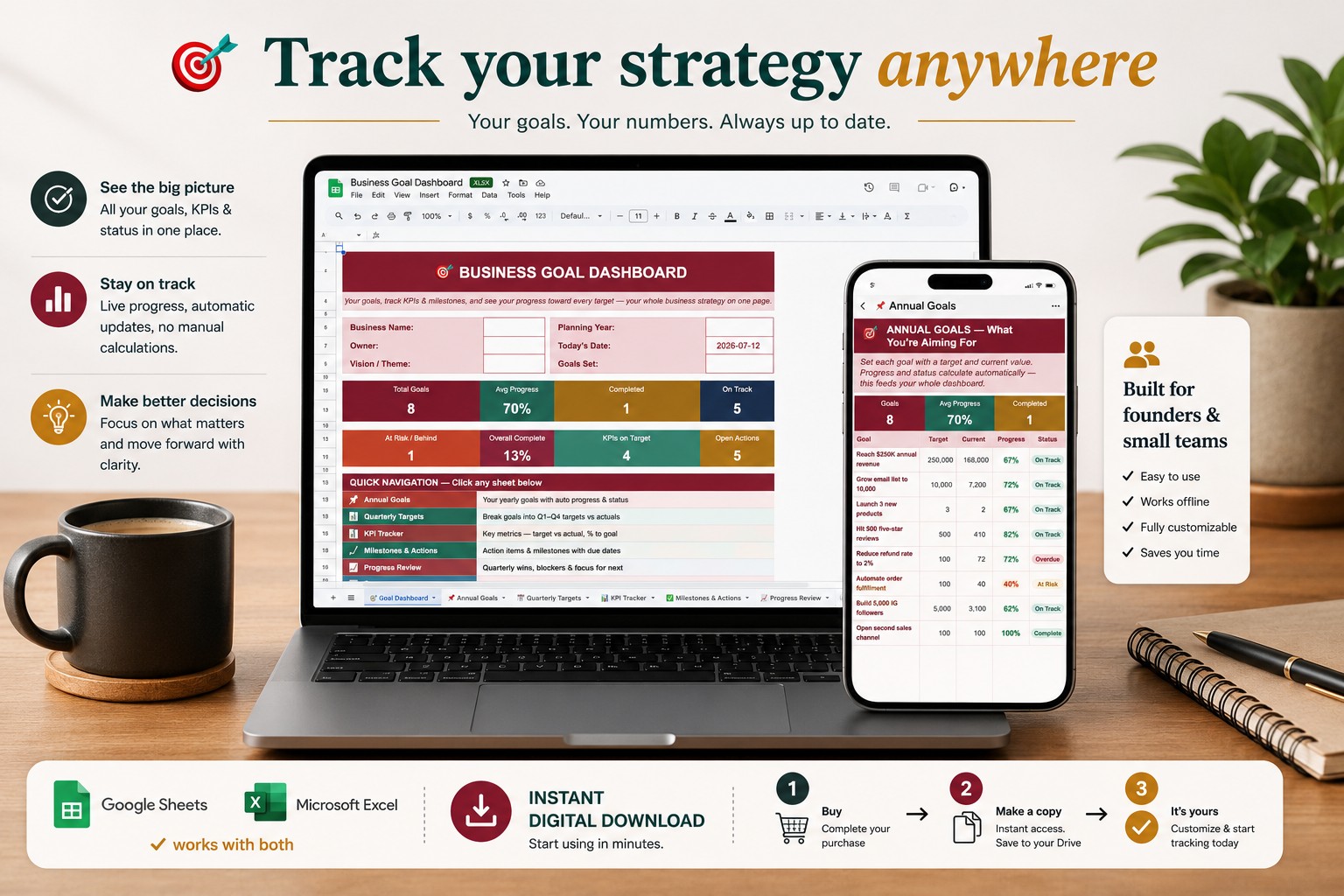
I built quarterly planning into my business goal dashboard in Google Sheets — break each annual goal into Q1–Q4 targets, track your actuals against them, and see your progress per quarter, alongside your KPIs and action steps:
👉 Business Goal Dashboard for Google Sheets & Excel
Whether you use mine or plan it yourself, stop trying to act on yearly goals yearly. Break them into quarters, give yourself near-term targets and regular checkpoints, and watch how much more achievable your big annual goals become. The goal doesn’t change — but broken into quarters, it goes from a distant wish to something you can actually hit.
This reflects my own experience and is a planning tool — not business or financial advice, and it doesn’t guarantee results. Use your own judgement and consult a professional for important decisions. Do you plan by quarter or just by year? Tell me in the comments.