I could stare at a task for hours, wanting to do it, unable to begin. Shrinking the start to one tiny step broke the freeze. Here’s how.
There’s a particular kind of stuck that’s hard to explain to people who haven’t felt it. You have a task. You want to do it. You know how to do it. And yet you sit there, completely unable to start, sometimes for hours, while a fog of dread grows. It’s not laziness — you’re trying, and failing, to begin. This is ADHD task paralysis, and for a long time it ran my life. The thing that finally broke it wasn’t willpower or a productivity hack. It was learning to shrink the start down to one tiny, almost laughably small step. Here’s how it works.
Task paralysis isn’t a willpower problem
First, the reframe that matters most: task paralysis is not a character failure. When an ADHD brain freezes in front of a task, it’s usually because the task feels too big, too vague, or too undefined to start. The brain looks at “write the report” or “sort out the finances” and sees an enormous, shapeless mountain — and it flinches. The freeze is a response to overwhelm, not a lack of caring.
This is why “just do it” is useless advice, and often makes things worse by adding guilt on top of the paralysis. You can’t “just do” something your brain has classified as an insurmountable blob. What you can do is change how the task is presented to your brain — shrink it until it stops looking like a mountain.
The fix: name the first tiny step
Here’s the whole trick. Instead of facing the big task, I define one tiny, concrete, physical first step — small enough that it feels almost silly to resist.
Not “write the report.” Instead: “open a blank document and type the title.” Not “do my taxes.” Instead: “find the folder with my receipts.” Not “clean the kitchen.” Instead: “put one cup in the sink.”
The step has to be small enough that the resistance melts. If a step still feels hard, it’s not small enough — shrink it again. The goal isn’t to do the task; it’s just to start. And starting is the entire battle. Once I’ve done the tiny first step, I’m in motion, and motion is dramatically easier to continue than to begin. The report that felt impossible often gets half-written, simply because I opened the document.
Why “first physical action” beats “first task”
The detail that makes this work is that the tiny step should be a concrete, physical action, not another abstract to-do. “Start the report” is still vague — your brain can’t grip it. “Open the document and type the title” is a specific physical thing your hands can do without deliberation. The more concrete and physical the step, the more it bypasses the paralysis. You’re not asking your brain to tackle the mountain; you’re asking your hands to do one small, obvious thing. That’s a request the frozen brain can say yes to.
It works because motion creates motion
There’s a reason this is so effective, and it’s worth understanding. Starting is where ADHD brains get stuck — but continuing is far easier than initiating. Once you’re moving, a kind of momentum takes over. The tiny first step isn’t valuable because it accomplishes much; it’s valuable because it gets you past the freeze and into motion, where the rest of the task becomes possible. You’re essentially tricking the hardest part — initiation — into being trivially easy.
Be gentle when it still doesn’t work
One honest, kind note: some days, even the tiny step feels impossible, and that’s okay. Task paralysis can be tied to energy, overwhelm, and things going on beneath the surface. On those days, shrinking the step even further — or simply being gentle with yourself and trying again later — is the right move, not forcing and shaming yourself. This approach is a tool to make starting easier, not another stick to beat yourself with. Self-compassion is part of the system, not separate from it.
If you want a system built around this
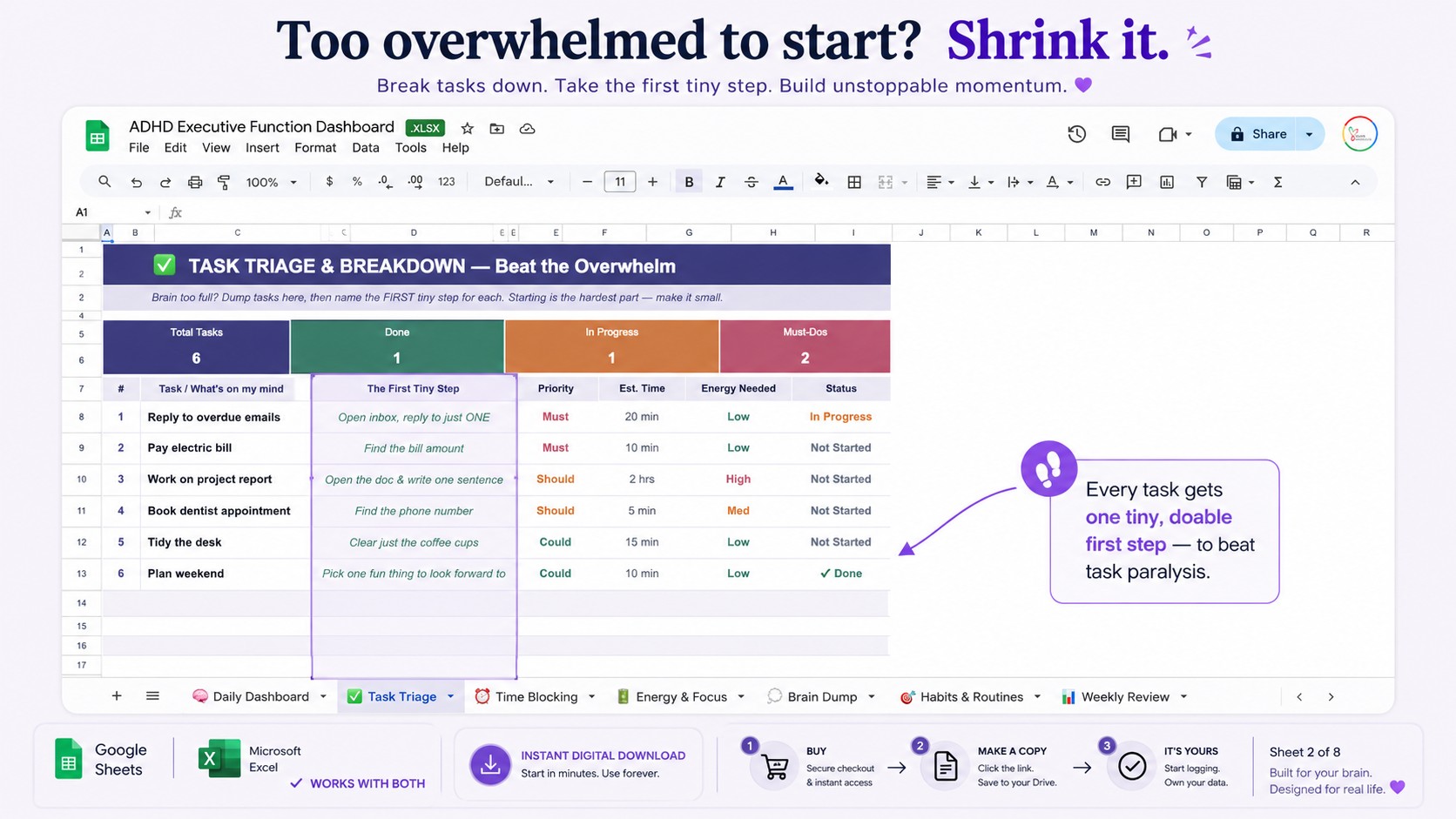
I built my ADHD executive-function dashboard around exactly this — a task triage sheet where every task gets a small, doable first step named for it, so starting stops being the wall it used to be, alongside a one-thing daily focus, energy tracking, and shame-free habits:
👉 ADHD Executive Function Dashboard for Google Sheets & Excel
Whether you use a tool or a scrap of paper, the next time you’re frozen in front of a task, don’t try to do the task. Name the tiniest possible first step, and just do that. Getting started is the whole battle — and shrinking the start is how you win it.
I’m sharing what helps me — this is a supportive approach and personal experience, not medical advice, diagnosis or treatment. If you’re struggling, please reach out to a qualified professional or someone you trust. What task are you frozen on right now — and what’s the tiniest first step? Share it in the comments.