Introduction: Why Success Rarely Moves in Straight Lines
After years of analyzing the trajectories of individuals and institutions—tracing the arcs of career development, the mechanics of capital allocation, and the evolution of intellectual mastery—I have been struck by a recurring structural paradox. Most people intuitively assume that progress is a linear phenomenon. We are socially and cognitively conditioned to believe that a unit of effort today should yield a proportional unit of result tomorrow. We visualize success as a staircase: a steady, predictable climb where each step is equal in height to the last.
However, the empirical reality of long-term outcomes reveals a far more complex architecture. When we examine the lives of founders who built generational companies, investors who achieved decadal outperformance, or thinkers who achieved profound depth in their fields, we rarely find a straight line. Instead, we find a hidden geometry—a series of curves, feedback loops, and compounding cycles that defy linear intuition.
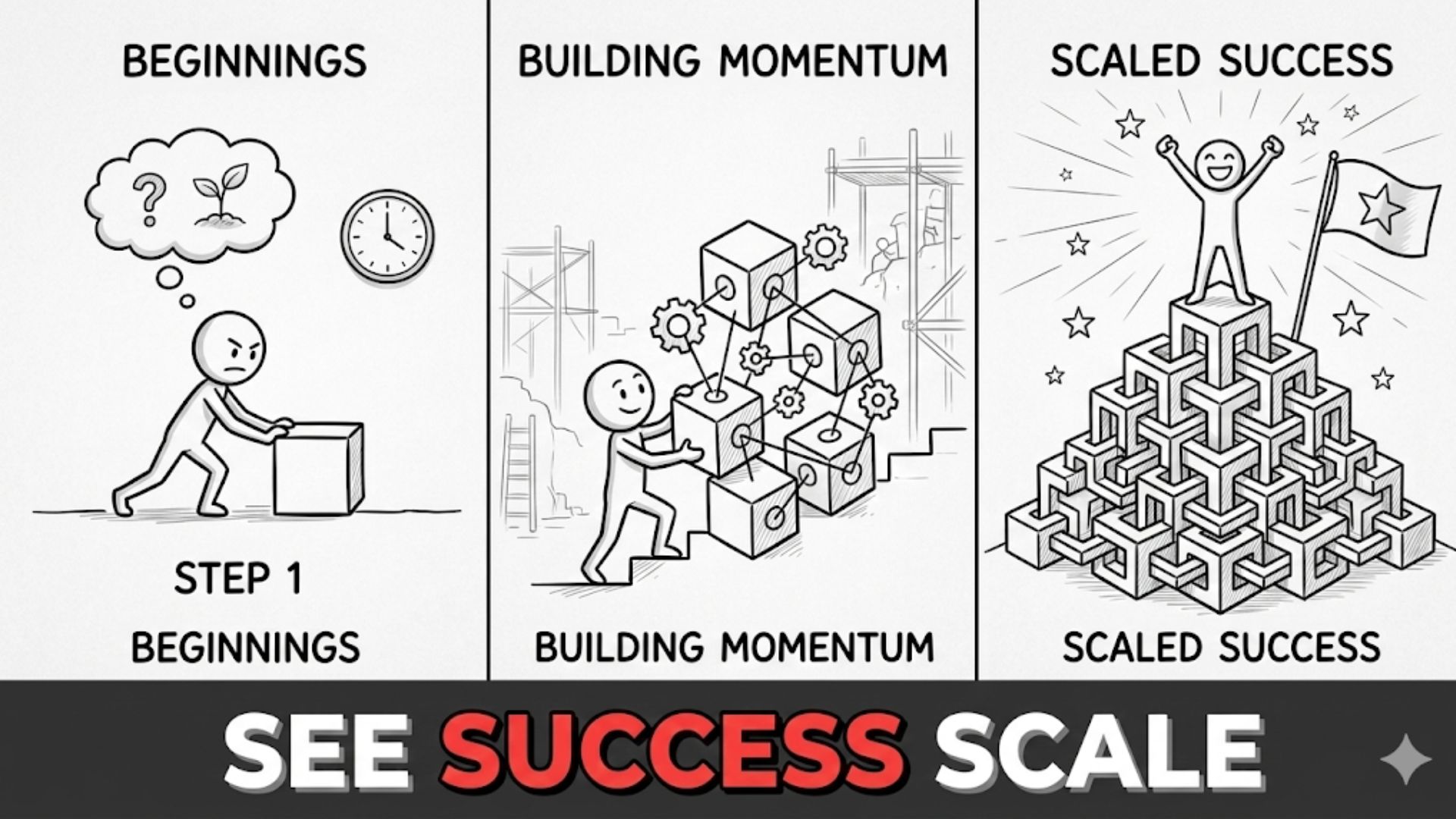
Success is not a staircase; it is a geometric progression. It is a system where progress often appears slow, stagnant, or even invisible for long periods before hitting a critical threshold and accelerating at a rate that appears sudden and disproportionate to the casual observer. Understanding this geometry is not merely an academic exercise; it is a structural necessity for anyone navigating complex, long-term systems. Without a clear conceptual map of these nonlinear patterns, the human mind is prone to misinterpreting the “loading phase” of compounding as failure, leading to the premature abandonment of strategies that were otherwise mathematically sound.
Read also: The Power of Small Financial Advantages Over Time
Linear Thinking vs. Geometric Reality
The human brain is an evolutionary product of a linear world. In the ancestral environment, most cause-and-effect relationships were direct and immediate. If you traveled for two hours, you covered twice the distance of one hour. If you gathered food for a day, the yield was proportional to the labor. Our intuitive physics and social heuristics remain calibrated to these 1:1 relationships.
This linear bias deeply informs our modern expectations. In our careers, we expect that each year of experience should correlate with a predictable increase in seniority and income. In our investments, we look for steady, monthly growth. In our learning, we expect that reading a book should provide a visible, immediate increment of wisdom.
Yet, real-world systems of high value—wealth, reputation, knowledge, and network influence—behave in fundamentally nonlinear ways. They are governed by the laws of physics and biology, yes, but also by the laws of mathematics and information. In these systems, the relationship between input and output is decoupled by the presence of compounding. A linear system is additive ($1 + 1 + 1$); a geometric system is multiplicative ($1 \times 1.1 \times 1.1$). Over the short term, the difference between these two is negligible, often obscured by environmental noise. Over the long term, the divergence is total.
The Curve of Compounding
Compounding is the process by which the returns on an asset are reinvested to generate their own returns. While this is the bedrock of finance, it is equally the bedrock of intellectual and professional development.
In a compounding system, the “interest” we earn on our initial effort becomes part of the “principal” for the next round. Consider knowledge accumulation. When you learn a new concept in a field where you already possess a deep lattice of mental models, that new concept is not merely one more fact. It is a connector that increases the utility of everything you already know. The “return” on that learning is geometric because it multiplies your existing intellectual capital.
Similarly, reputation growth follows a compounding curve. In the early stages of a career, you must “push” for every opportunity; you are operating at a linear 1:1 ratio. However, as your reputation for excellence and reliability grows, it begins to act as an automated system. Your reputation precedes you, lowering transaction costs and attracting opportunities that you did not actively seek. You have moved from a “push” system to a “pull” system.
The structural challenge of the compounding curve is that the early stages often appear stagnant. Because the growth is a percentage of a small base, the absolute gains are microscopic. This is the “Valley of Disappointment”—the long duration where the effort invested feels higher than the visible progress. Patience in this context is not a moral virtue; it is a mathematical requirement for allowing the exponent to reach its vertical phase.
Read also: The Math of Scaling Without Burning Out
Cumulative Advantage and Unequal Outcomes
One of the most powerful geometric forces in success systems is cumulative advantage, often referred to in sociology as the Matthew Effect: “For to everyone who has, more will be given, and he will have an abundance.”
This is a system where a small initial advantage is amplified over time. Consider two individuals starting their careers with nearly identical talent. If one individual receives a slightly better initial opportunity—perhaps a slightly more influential mentor or a role at a slightly more prestigious firm—that small delta creates a feedback loop. That initial advantage leads to better information, higher-quality peers, and more significant “proof of work.” These, in turn, lead to even greater opportunities.
Over a twenty-year horizon, these small, early advantages compound into massive outcome gaps. The person at the top of their field may not be 100 times more talented than the average professional, but they may capture 100 times the rewards because they were positioned on a steeper compounding trajectory from the outset. In geometric systems, outcomes are not distributed normally (the bell curve); they follow power laws.
Feedback Loops in Success Systems
Geometric growth is sustained by positive feedback loops. In a system with positive feedback, the output of the process serves as a stimulus for further growth of the same process.
In reputation building, the loop is clear: a high-quality reputation attracts high-quality partners. These partners provide high-leverage opportunities, which, when executed well, further enhance the reputation. Each turn of the loop increases the scale of the next.
In network effects, the value of a professional network increases exponentially with each new, high-value node added. As your network grows, your access to non-redundant information expands. This informational edge allows you to make better decisions, which attracts even more high-value nodes to your circle.
The presence of these loops explains why progress in the late stages of a career or a business often feels effortless compared to the early stages. The system is doing the work that labor used to do. Once the feedback loops are established, the primary role of the individual is no longer to provide the “push,” but to maintain the integrity of the loop and prevent “frictional leaks” like reputational damage or capital impairment.
Read aslo: A Structural Analysis of the Unseen
Path Dependency and Early Decisions
A fundamental concept in the geometry of success is path dependency. This describes how the set of decisions one faces today is limited and shaped by the decisions made in the past. Careers and businesses are not a series of independent events; they are a continuous branching tree.
Early career choices—industry selection, geographic positioning, and skill specialization—act as the “initial conditions” of the compounding engine. Once an individual has specialized deeply in a niche, the “switching costs” to move to another path become prohibitively high. They are “locked in” to a specific trajectory.
Consider the choice of a professional network. If a founder settles in a geographic hub with a high density of venture capital and technical talent, they are tapping into a network with higher “volatility” and “upside potential.” Their path is structurally different from a founder in a remote area. While the remote founder may work harder, the hub-based founder is on a path with higher geometric leverage. Understanding path dependency means recognizing that the most important decisions are often those that determine which “compounding game” you are playing in the first place.
Time Horizon as the Hidden Multiplier
In the formula for compounding, time ($t$) is the exponent. This makes time the most powerful variable in the geometry of success. A longer time horizon does not just allow for more growth; it fundamentally changes the nature of the growth.
When the evaluation window is short—months or quarters—the dominant force is “noise” (randomness and volatility). On a short horizon, it is impossible to distinguish between a genius strategy and a lucky one. However, as the time horizon extends to decades, the noise cancels itself out, and the “signal” of the underlying geometric system becomes visible.
Individuals who can extend their time horizon gain a massive strategic advantage because they are competing with fewer people. Most market participants are optimized for the immediate: the next paycheck, the next quarterly report, the next social media mention. By thinking in decades, a professional can afford to invest in “boring” structural advantages—such as deep foundational knowledge or long-term trust—that the short-termist dismisses as too slow. The “mathematics of patience” dictates that the person who stays in the game the longest wins, not necessarily the person who runs the fastest.
Read also: A Structural Analysis of Systemic Fragility
The Illusion of Sudden Success
To an outside observer, success often appears sudden. We see the “overnight success” of a startup or the “breakthrough” of an artist. However, from the perspective of the geometric system, there are no breakthroughs—only inflection points.
Because compounding curves are so flat in the beginning, the transition from the “loading phase” to the “acceleration phase” is jarring. A professional may spend ten years building a skill set with marginal recognition. In year eleven, their accumulated expertise reaches a critical mass, they are “discovered,” and their career goes vertical. Observers see the spike in year eleven and call it “luck” or “sudden talent.” They fail to see the ten years of invisible accumulation that made the spike mathematically inevitable. The “suddenness” is a byproduct of our linear brains trying to interpret a geometric event.
Why Humans Misinterpret Nonlinear Progress
The structural power of geometric systems is frequently undermined by psychological biases that prevent individuals from staying on the curve long enough to reach the vertical phase.
- Present Bias: We are evolutionarily wired to overvalue immediate rewards and undervalue future ones. The “dopamine hit” of a small, linear gain today feels more real than the promise of a massive, geometric gain in ten years.
- Impatience and Uncertainty: Because the early stages of compounding are quiet, we interpret the lack of immediate feedback as a sign that the system is broken. We become “impatient under uncertainty,” leading us to abandon the compounding path just as it was beginning to gain momentum.
- Availability Heuristic: We are bombarded with stories of rapid success, which distorts our “internal map” of how long things should take. When our own geometric progress doesn’t match the fictionalized linear narratives we consume, we conclude that we are failing.
These biases act as a “tax” on long-term success. The ability to override these biological and cultural impulses with a structural understanding of nonlinear progress is perhaps the ultimate competitive moat.
Opportunity Cost in Geometric Systems
In a linear world, the cost of switching directions is minimal. If you stop digging one hole and start another, you’ve only lost the time spent digging. In a geometric world, the cost of switching is catastrophic.
Abandoning a compounding path resets the exponent to zero. When you switch industries, professional networks, or investment strategies frequently, you are constantly restarting the “flat phase” of the curve. You spend your entire life paying the “entry fee” of compounding without ever staying long enough to collect the “interest.”
Consistency, therefore, is not a moral imperative; it is a capital allocation strategy. Strategic durability—the ability to stay on a single trajectory for decades—is often more important than the magnitude of the effort applied. The person who works 40 hours a week on the same path for thirty years will almost always outperform the person who works 80 hours a week but switches paths every three years.
The Uneven Distribution of Success
Geometric systems naturally produce highly unequal distributions of outcomes. This is not necessarily a reflection of a “rigged” system, but a reflection of how compounding and network effects function.
When success is driven by power laws, a tiny fraction of the participants will capture the vast majority of the rewards. This is visible in venture capital, where a few companies provide the entire return for a fund, and in careers, where the “stars” of a field earn orders of magnitude more than the “average.”
This unevenness is a byproduct of Positive Feedback and Cumulative Advantage. Once an individual or an idea reaches a certain threshold of “mass,” the geometric forces take over, pulling in more resources and attention and widening the gap between the “leaders” and the “rest.” In these systems, being “slightly better” can result in being “massively more successful” because of how the geometry of the market amplifies that small difference.
Read also: The Strategic Calculus of Long-Term Compounding
Viewing Life Through Geometric Systems
When we begin to view our professional and personal lives through the lens of geometric systems, our interpretation of “events” changes.
In investing, we stop chasing the “next big thing” and start protecting the “uninterrupted compounding” of our existing capital. We realize that the most important factor is not the “rate” but the “duration.”
In intellectual growth, we stop seeking “tips and tricks” and start building foundational “mental models” that compound across disciplines. We value depth over breadth because we understand that depth is where the nonlinear insights reside.
In entrepreneurship, we move away from “growth hacks” and focus on building feedback loops and network effects—the structural engines that will eventually drive “pull” growth.
By identifying the geometric structures beneath the surface, we move from being “reactive” to being “strategic.” We stop fighting the “slow” parts of the curve and start leaning into the logic of the system.
Conclusion: The Geometry Beneath Long-Term Outcomes
Reflecting on the wide disparities in outcomes among individuals with similar talent and effort, it becomes clear that the differentiating factor is rarely “hard work” in the linear sense. Instead, it is the alignment with geometric systems.
Long-term success is the result of slow, cumulative processes that operate beneath the threshold of immediate visibility. It is the structural outcome of staying on the curve, protecting the compounding engine, and allowing the logic of duration to unfold. When we strip away the myths of “overnight success” and “linear ladders,” we find a hidden geometry—a world of exponents, loops, and path dependencies.
To master this geometry is to accept that the most profound results are back-loaded. It is to recognize that the quiet accumulation of today is the vertical acceleration of tomorrow. In the final analysis, the most successful people are not those who moved the fastest, but those who built the most durable systems and had the structural discipline to stay out of their own way while the mathematics of time did the work.