“What Can You Afford a Month?” Is the Wrong Question
It’s the first thing you get asked on a forecourt, and it’s the wrong frame — because stretch the term far enough and any car fits any budget. Here’s what to ask instead.
Walk onto a car lot and, before you’ve discussed a single vehicle, you’ll be asked what you can afford a month. It sounds helpful. It sounds like someone trying to find you something suitable. But it’s the wrong question, and it produces a predictable outcome: you end up in a more expensive car than you intended, at a monthly figure that sounded fine. The mechanism is simple — a monthly payment isn’t a price. It’s a price divided by a number of months, and that number is adjustable. Stretch it far enough and almost any car fits almost any budget. If you’re trying to work out how much car can I afford, the monthly figure is the last thing you should be looking at. Here’s the better frame.
Why the monthly payment hides the price
Think about what a monthly payment actually contains: the amount borrowed, the interest rate, and the term. Change any one and the payment moves. So a payment on its own tells you nothing about whether a car is affordable or a deal is good — it only tells you what one particular combination of those three produces.
That’s why extending the term is such an effective sales move. It reduces the payment without reducing the price, so an unaffordable car becomes an affordable-sounding payment. Nothing about the car changed. Nothing about what you’ll ultimately pay improved — in fact it got worse, because you’re paying interest for longer.
The uncomfortable part is that this works on almost everyone. We’re bad at intuitively converting a monthly figure into a total, and the total is deliberately not the number in front of us. So the frame does the persuading before any negotiation starts.
What a longer term actually costs
The honest way to see it is to compare the same loan over several terms side by side — the monthly payment and the total interest for each. When you do, the pattern is stark and consistent: as the term lengthens, the monthly payment falls comfortingly while the total interest climbs, often steeply.
Seeing the “extra interest versus a shorter term” spelled out in currency is what changes decisions. A lower payment feels like a saving; the same choice expressed as “this costs you an extra [amount] in interest” feels like what it is. Same decision, completely different framing — and the second one is the true one.
There’s a related figure worth knowing that almost nobody calculates: interest as a percentage of the car’s price. When you see that the finance is adding a meaningful fraction on top of what the vehicle actually costs, the deal stops being abstract. It’s one line, and it’s sobering in a useful way.
None of this means long terms are always wrong — sometimes cash flow genuinely matters more, and that’s a legitimate choice. The point is to make it knowing the cost, rather than being steered into it by a question designed to hide the cost.
Negative equity: owing more than it’s worth
There’s a second consequence of long terms that rarely gets mentioned on the forecourt. Cars lose value fastest early on, while a long loan pays down the balance slowly at the start. Combine the two and there’s often a period — sometimes a long one on the longest terms — where you owe more than the car is worth.
That’s fine if nothing happens. It becomes a real problem if something does: you want to sell or change car, or the vehicle is written off and the insurance payout doesn’t cover the loan. You’re then paying off a car you no longer have.
Knowing whether, and for roughly how long, a deal puts you in that position is genuinely useful information — and it’s a direct consequence of the term you choose. It’s one more reason the term deserves to be a decision you make deliberately, rather than a lever someone else adjusts to make a payment look comfortable.
The question to ask instead
So what’s the better frame? Two things.
First: what’s the total cost of this loan? Not the payment — the amount borrowed plus all the interest, over the whole term. That’s the number you’re actually agreeing to, and it’s the only one you can compare fairly between offers.
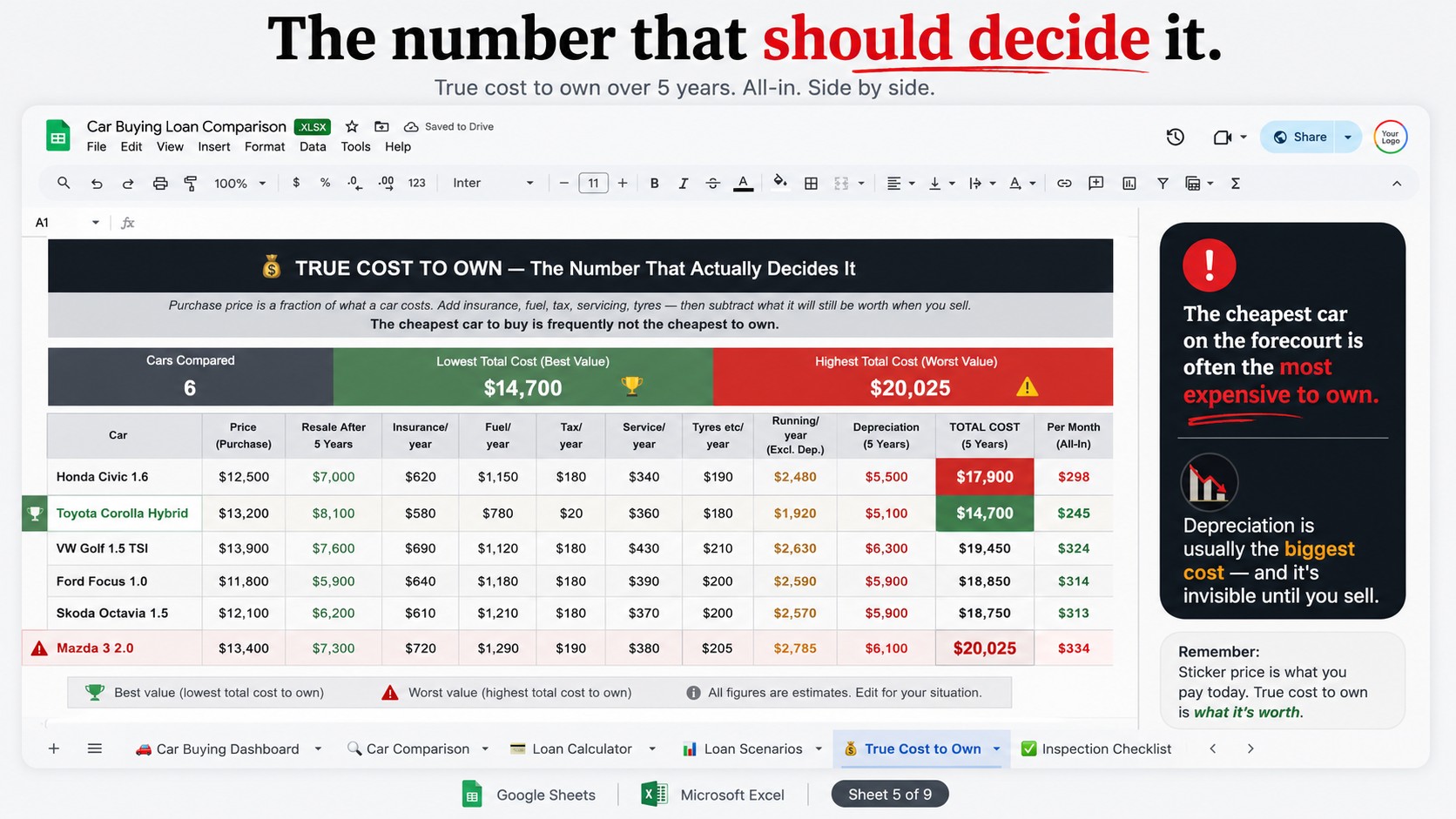
Second — and more importantly: what does owning this car cost me per month, all in? Because the loan payment isn’t the cost of a car. Insurance, fuel, tax, servicing, tyres and depreciation are all part of it, and together they often exceed the finance. A payment you can afford on a car whose running costs you can’t is a trap that closes slowly.
Work out your limit as a total monthly cost of motoring, and you arrive with a number that can’t be gamed by adjusting a term. When you’re then asked what you can afford a month, you have a real answer — and one that already accounts for everything the question was designed to leave out.
Get the real numbers before you commit
A few practical things worth doing before signing anything:
- Get an actual insurance quote for the specific car. Not an estimate — a quote. It’s the running cost that surprises people most, and it varies enormously between cars that look similar.
- Get finance quotes in writing, and check what’s included. Arrangement fees, payment protection and balloon-payment structures can all change the picture, and they don’t always appear in a headline rate.
- Compare offers on total cost, not payment. Including any offer from your own bank or credit union, not just the one on the forecourt.
- Never let the term be chosen for you. Pick it deliberately, having seen what each one costs.
An important note
To be clear: this is a general explanation of how car finance maths works and how to organise your own comparison. It is not financial, credit, insurance, legal, or tax advice, it is not a loan offer or quotation, and it guarantees no outcome. Any figures are illustrative; your real numbers depend on your credit, your lender, your insurer, the specific vehicle and where you live. Standard amortisation calculations may differ from a lender’s own quote, which can include fees and charges not modelled. Always obtain written quotes and consult a qualified adviser before committing to finance.
If you want the comparison built for you
I built a car buying spreadsheet in Google Sheets around exactly this — a loan calculator that shows total interest and interest as a percentage of the price, the same loan compared over six terms from 24 to 84 months with the extra cost of each spelled out, a negative-equity note, and a true-cost-of-ownership page that ranks your shortlist on what each car really costs to run:
👉 Car Buying Spreadsheet for Google Sheets & Excel
Whether you use mine or a calculator and a notepad, work out your numbers before you go. The monthly-payment question isn’t asked to help you; it’s asked because it’s the frame in which a price disappears. Arrive with a total cost limit and the term already decided, and the conversation changes completely. Walk in knowing the numbers. 🚗
This reflects my own perspective and describes an educational comparison tool — NOT financial, credit or insurance advice, not a loan offer, and it guarantees no outcome; figures are illustrative and depend on your own circumstances. Always get written quotes and independent advice. What’s the sales line that nearly got you? Tell me in the comments.