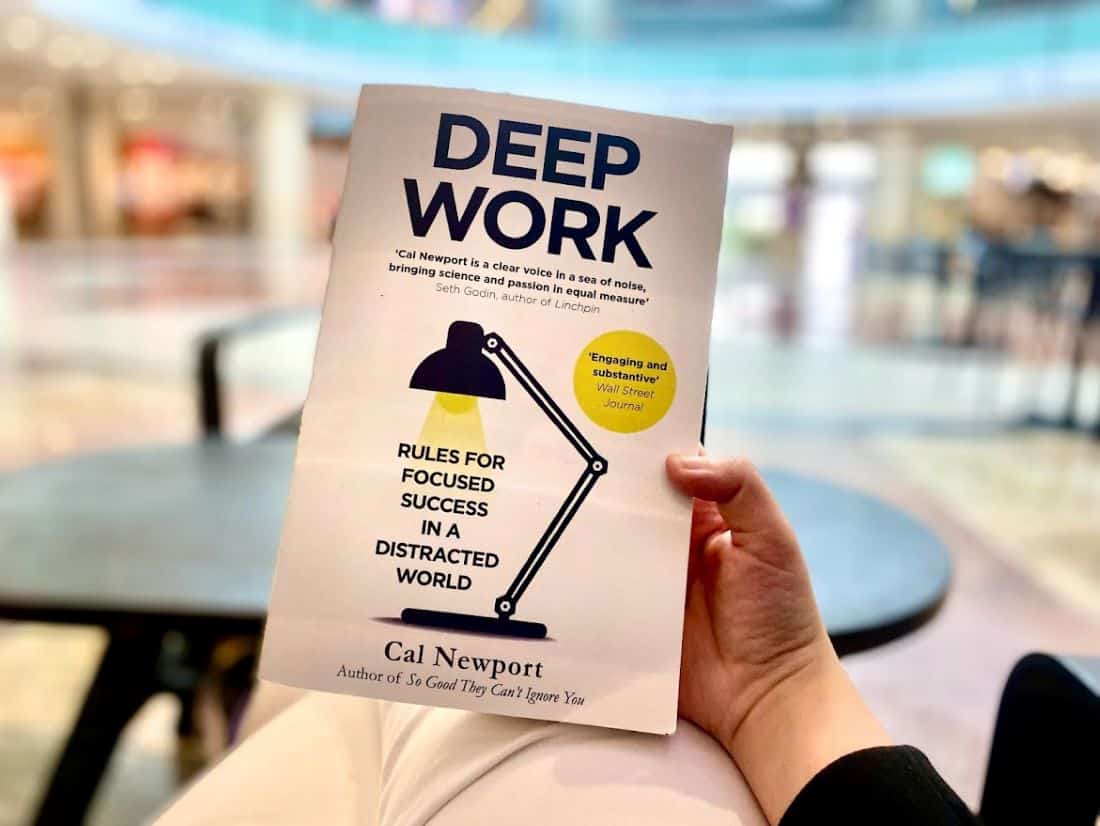
The Modern Knowledge Worker’s Paradox
The 21st-century professional landscape is defined by a staggering cognitive contradiction. While we are paid for the value of our intellectual output, our workdays have devolved into a “pinprick onslaught of small obligations.” According to a 2012 McKinsey study, the average knowledge worker now spends over 60% of their workweek engaged in electronic communication and internet searching—with nearly 30% of their time consumed by email alone.
We have become “human network routers,” constantly processing shallow work: non-cognitively demanding, logistical tasks often performed while distracted. These efforts create little new value and are easily replicated. To find a competitive advantage, we must look to the concept of Deep Work—professional activities performed in a state of distraction-free concentration that push our cognitive capabilities to their limit.
This is not a modern trend, but a practiced skill. In 1922, psychiatrist Carl Jung built his “Böllingen Tower” on the banks of Lake Zurich—a stone retreat without electricity where he spent hours in his private office in undistracted thought. Jung recognized that to challenge the established ideas of his time, he required a level of depth that his hectic city life in Zurich could not provide.
Takeaway 1: Depth is the “Superpower” of the 21st Century
We are currently enduring a “Great Restructuring” of the economy. As digital technology advances, the rewards are increasingly concentrated among those who can master hard things and produce at an elite level. This economy favors three specific groups:
1. High-Skilled Workers: Those with the ability to work creatively with complex machines (e.g., data scientists like Nate Silver).
2. Superstars: Those at the absolute peak of their field who leverage digital networks to reach a global market.
3. Owners: Those with the capital to invest in the technologies driving this restructuring—personified by venture capitalists like John Doerr, whose net worth exceeds $3 billion through early investments in Google and Amazon.
To secure your place among the winners, you must master the ability to quickly learn complicated systems. This capacity depends entirely on depth.
The Deep Work Hypothesis: The ability to perform deep work is becoming increasingly rare at exactly the same time it is becoming increasingly valuable in our economy. As a consequence, the few who cultivate this skill and then make it the core of their working life will thrive.
Takeaway 2: The Biological Mechanics of Mastery (Myelin and Attention Residue)
Mastery is a biological imperative, not just a matter of “trying harder.” When you focus intensely on a specific skill, you force the relevant neural circuit to fire repeatedly. This repetitive firing triggers cells called oligodendrocytes to wrap layers of myelin—a fatty tissue—around the neurons. This insulation allows the circuit to fire faster and cleaner, effectively “cementing” the skill. If you are distracted, you fire too many circuits haphazardly, failing to isolate the specific neurons needed for myelination.
Furthermore, multitasking is a biological lie. Researcher Sophie Leroy identified a phenomenon called Attention Residue. When you switch from “Task A” to “Task B,” your attention does not follow immediately. A residue of your focus remains stuck on the previous task. Even a “quick check” of an email inbox slathers your brain in this residue, significantly dampening your cognitive performance on your primary task for a significant period afterward. To produce at your peak, you must remain on a single task for an extended duration.
Takeaway 3: The “Metric Black Hole” and the Myth of Busyness
If depth is so valuable, why do corporations prioritize open offices and Slack? The answer is the Metric Black Hole: it is notoriously difficult to measure the bottom-line impact of distraction in knowledge work. Without clear data, firms default to the Principle of Least Resistance, favoring behaviors that are easiest in the moment (like constant connectivity) over those that are most productive.
In this vacuum, workers adopt Busyness as a Proxy for Productivity. Lacking clear indicators of value, they use visible activity—endless meetings and rapid email responses—to prove their worth.
Strategic Directive: If you are operating within a corporate hierarchy, you must navigate this by detaching your self-worth from visible “activity.” Focus on your “lead measures” (Deep Work hours) and let the quality of your finished output—which should dwarf that of your distracted peers—be your shield against the pressure of performative busyness.
Takeaway 4: You Need a Depth Philosophy (Not Just Willpower)
Willpower is a finite resource that depletes throughout the day. You cannot simply “will” yourself to be focused. You must adopt a specific Depth Philosophy to automate the transition:
• Monastic: Eliminating shallow obligations entirely (e.g., computer scientist Donald Knuth, who has no email).
• Bimodal: Dividing time between monastic stretches and open time (e.g., Jung’s retreats).
• Rhythmic: Creating a daily habit of depth. This is the gold standard for standard office jobs. An exemplar is Brian Chappelle, a busy doctoral candidate with a full-time job and a new child, who produced a thesis chapter every few weeks by writing from 5:00 a.m. to 7:30 a.m. every morning without fail.
• Journalistic: Shifting into deep work at a moment’s notice (e.g., Walter Isaacson hammering out his 900-page biographies in any 20-minute gap).
Takeaway 5: The “Any-Benefit” Mindset vs. The Craftsman Approach
Most people adopt the Any-Benefit Mindset: they use a tool if it offers any conceivable advantage. The Craftsman, however, evaluates tools based on their impact on “vital few” goals. Consider sustainable farmer Forest Pritchard. He assessed whether to own a hay baler not on its utility, but on how it affected his baseline metric of soil fertility. He realized making hay was a net negative for soil health and sold the machine.
The 80/20 Tool Audit:
1. List your high-level goals (professional and personal).
2. Identify the “Vital Few”: The two or three activities that provide 80% of the progress toward those goals.
3. Audit your tools: For every network tool (Facebook, Twitter, LinkedIn), ask: “Does this have a substantially positive, substantially negative, or negligible impact on my Vital Few?” If it isn’t substantially positive, delete it.
Takeaway 6: Embracing Boredom to Rewire the Brain
Constant distraction rewires your brain. Clifford Nass’s research found that chronic multitaskers eventually lose the ability to filter out irrelevancy; they become “mental wrecks” who cannot focus even when they want to.
To fix this, don’t take breaks from distraction. Instead, take breaks from focus. Schedule your internet use in advance and avoid it entirely outside those blocks. To further train the mental muscle, practice Productive Meditation: focus your mind on a single, well-defined professional problem while occupied physically (walking, driving, showering).
The Next-Step Logic: Avoid “looping” over what you already know. Instead, identify the variables of the problem, store them in your working memory, and then pose a specific “next-step question” to move the solution forward.
Takeaway 7: The “Shutdown Ritual” for Psychological Restoration
To maintain long-term depth, you must embrace Systematic Idleness. As essayist Tim Kreider notes, idleness is as indispensable to the brain as Vitamin D is to the body.
The primary obstacle to rest is the Zeigarnik Effect: the tendency of incomplete tasks to dominate our attention. You must combat this with a strict Shutdown Ritual at the end of the workday:
1. Check your inbox one last time.
2. Ensure every incomplete task is captured in a trusted system or has a plan for its completion.
3. Say a set phrase to signal the end (e.g., “Shutdown complete”).
By convincing your brain that your obligations are accounted for, you free your mind to recharge for the next day’s deep work.
Conclusion: The Deep Life is the Good Life
The argument for depth is ultimately philosophical. As scholars Dreyfus and Kelly note in All Things Shining, craftsmanship provides a portal to meaning in a post-Enlightenment world. Whether you are a blacksmith or a programmer, the act of honing a skill and applying it with care creates a sense of sacredness.
In an age of digital noise, those who cultivate depth find “shining things” in their work—satisfaction and purpose that the shallow life cannot offer. Depth is a competitive advantage for the individual, even if work culture currently ignores it.
In a world that rewards those who can build the systems rather than just use them, are you a builder or just a human network router?