Your Best-Paying Genre Probably Isn’t the One You Think
Weddings bring the biggest single fees in most photographers’ businesses — and frequently the lowest hourly rate. Here’s the comparison that changes what you sell.
If you shoot more than one kind of work, you almost certainly have an instinct about which genre pays best. That instinct is usually built on fee size, because fee size is what you see: a wedding invoice is a big number, a branding session is a smaller one, and the conclusion writes itself. But fee size and hourly return are different things, and once you compare genres properly they frequently swap places. In one worked example, weddings return $22.71 an hour and branding work returns $45.59 — double, for a fraction of the effort and none of the pressure. Running a photography business well means knowing which of those numbers you’re actually optimising for.
Why the big fee misleads
The distortion comes from the same place as the pricing problem generally: the parts of a job that consume time aren’t proportional to the fee.
A wedding carries an enormous editing load, a long day, travel, and a uniquely heavy admin tail — timeline conversations, family group lists, pre-wedding meetings, questions for months in advance. A branding or commercial session may deliver far fewer final images, with a shorter shoot, less travel, and a client who communicates in three emails.
So the wedding fee is several times larger and the wedding hours are several times larger still. The ratio is what matters, and the ratio is invisible unless you calculate it per genre.
There’s also a pressure dimension that doesn’t show up in any spreadsheet but is worth naming: a wedding is unrepeatable and high-stakes. That carries a real cost in stress, in insurance, in backup equipment, and in the mental load of the week beforehand. A commercial shoot that goes slightly wrong can be reshot. A wedding cannot.
What the comparison actually gives you
The point of tagging every shoot by type and totalling fees and hours separately isn’t to produce a verdict. It’s to replace an assumption with a number — and then let you decide.
Because a low hourly rate on a genre is not automatically a reason to drop it. Weddings bring the biggest single fees, they fill a calendar efficiently, they generate referrals, and for a lot of photographers they’re the work they most want to do. Any of those is a legitimate reason to keep shooting them at a lower hourly return.
What changes is that you’re choosing knowingly. And once you can see it, useful options appear:
Raise the price on the heavy genre. The clearest lever, and the numbers make the case for you.
Cap the volume. Take eight weddings a year instead of eighteen, and fill the rest of the calendar with higher-return work. Same income, considerably less strain.
Cut the delivery. Two hundred images instead of four hundred halves the largest cost in the job.
Shift what you market. If one genre returns twice the rate, that’s a strong argument for where your website, your portfolio and your enquiries should point.
Most photographers who do this exercise don’t abandon anything. They adjust — usually a price rise and a delivery cap — and the business gets meaningfully healthier without a dramatic change of direction.
Reprice the packages, not just the genres
The natural next step is to turn the same logic onto your package list. For each package, work out the hours it really takes — shoot, travel, editing, admin — and then ask what it would need to cost at your target hourly rate.
The result is usually uncomfortable. In the worked example, eight of twelve packages come out underpriced. That’s not unusual, and it’s not a judgement on anyone: packages tend to be set once, early, by comparison with competitors, and then carried forward for years while the delivery creeps upward and the market moves.
Seeing the “should cost” figure beside the current price doesn’t force you to change anything. But it gives you a floor — the point below which a package is costing you money to sell — and a specific, defensible basis for a price rise, which is far easier to act on than a general sense that you’re too cheap.
And if a package’s honest price feels unsellable in your market, the productive response is usually to reduce what’s in it rather than to write off your own hourly rate. Fewer delivered images, a shorter session, fewer locations. The rate is the one variable that shouldn’t be the flex.
Delivery time is a business number too
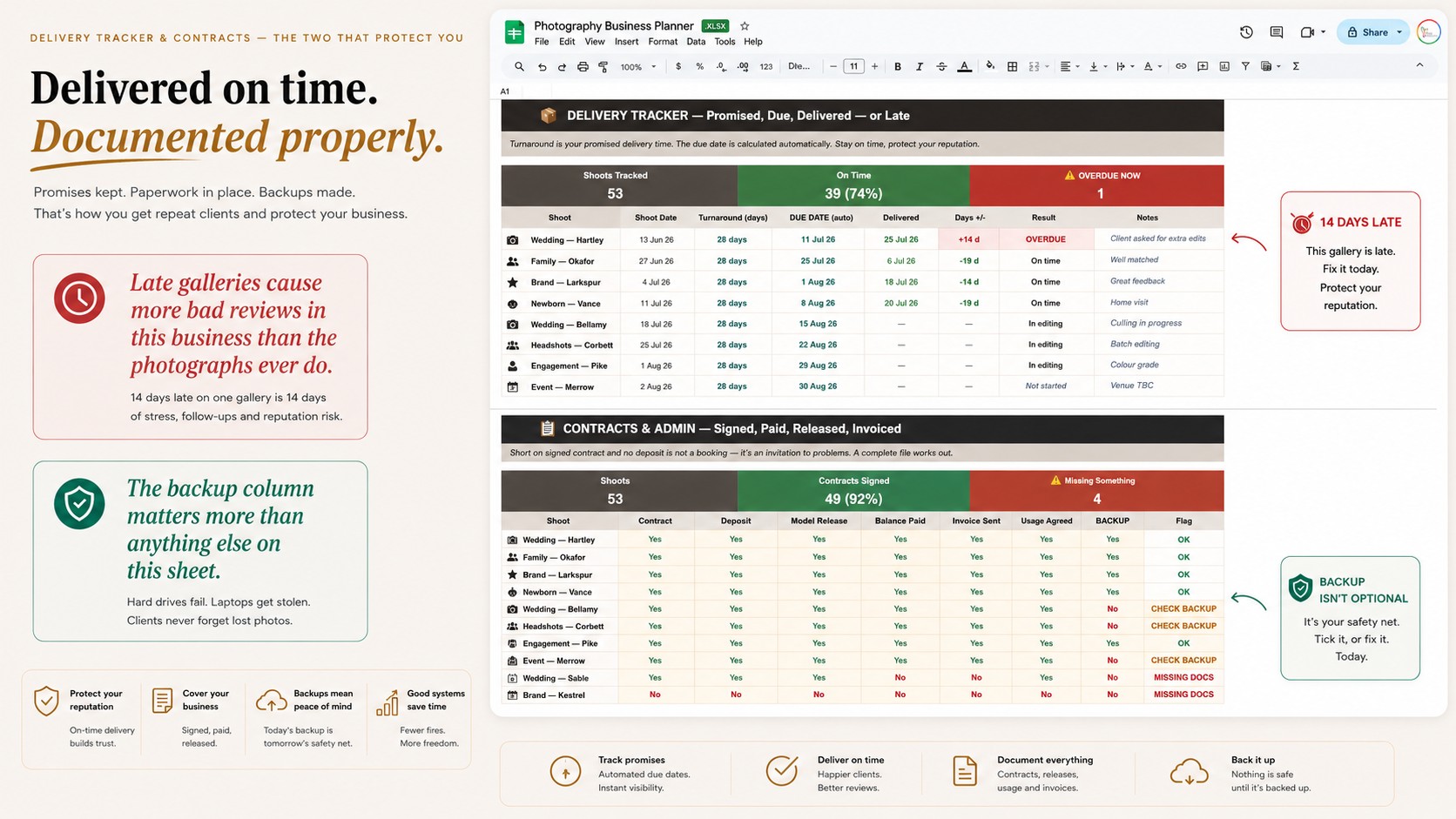
One last thing that’s easy to treat as an operational detail and isn’t. In this industry, late galleries cause more bad reviews than the photographs ever do.
Clients are, generally, delighted with the images. What they’re not delighted with is waiting six weeks past a promised four, hearing nothing, and having to ask. That experience colours the whole job retrospectively — and it’s entirely avoidable.
Two habits fix it. Set a turnaround you can actually meet, calculated from your real editing hours rather than optimism, and track the due date for every shoot so anything approaching or overdue is visible before the client has to chase. An on-time delivery percentage across a year is a genuinely useful number to hold yourself to.
There’s a connection back to pricing here, too: if your turnaround keeps slipping, that’s usually a sign the editing load per job is larger than the fee supports. The late galleries and the low hourly rate are frequently the same problem wearing different clothes.
An important note
To be clear: this is a general perspective on organising your own figures. It is not business, financial, tax, accounting, insurance, contractual, or legal advice, and it guarantees no outcome. All figures mentioned are illustrative examples — not benchmarks or recommended prices — and rates vary enormously by market, experience and location. Nothing here creates contracts, model releases, invoices or licences. Copyright, model and property releases, usage licensing, image rights and the rules on photographing children differ substantially by country and by whether work is commercial or personal — use properly drafted documents for your jurisdiction, and consult a qualified accountant, insurer and lawyer about your own business.
If you want it compared for you
I built the by-genre comparison into my photography business planner in Google Sheets — every shoot is tagged by type and the table totals fees and hours separately, so you can see which genre carries the business, alongside a package repricing sheet that shows what each would cost at your target rate, and a delivery tracker with due dates and an on-time percentage:
👉 Photography Business Planner for Google Sheets & Excel
Whether you use mine or a spreadsheet of your own, tag your shoots by type for a season and total the hours separately. You may find your instinct was right. You may find the genre you built your identity around is subsidising the one you barely mention on your website. Either way, you’ll be choosing rather than assuming. 📸
This reflects my own perspective and describes a costing tool — NOT business, financial or legal advice, and it guarantees no outcome; figures are illustrative, not benchmarks, and rates vary enormously by market. Photographers: which genre pays you best per hour — and were you surprised? Tell me in the comments.