

The Car Service Was Never an Emergency
Neither was Christmas, the insurance renewal, or the dentist. Not one of them was a surprise — so why does each one land like a small disaster? Here’s the arithmetic behind sinking funds.
Think about the last few “emergencies” that wrecked a month. The car service. The insurance renewal. Christmas. The dentist. The kids’ school uniforms in August. Every single one of them arrives at almost exactly the same time every year, and you knew about all of them. And yet each one landed on a credit card, or came out of money that was supposed to be for something else, and left you feeling like you’re bad with money. Here’s the thing that reframes it entirely: this is not a discipline problem. It’s an arithmetic problem — and sinking funds are the fix. You budget monthly, but you don’t spend monthly, and any budget that ignores that gap will fail in exactly the same months every single year.
The mismatch nobody points out
A monthly budget makes a quiet assumption: that spending arrives evenly. Rent, groceries, utilities, transport — those genuinely do repeat every month, so a monthly budget handles them beautifully.
But a large slice of household spending doesn’t behave like that at all. It arrives annually, or twice a year, or unpredictably-but-inevitably. Insurance renewals. Car servicing, tires, registration. Taxes. Christmas and birthdays. Dentist and optician. Annual subscriptions. Back-to-school costs. School trips. Vet bills. Home maintenance.
None of these fit in a monthly budget, because they don’t happen monthly — so most budgets simply don’t contain them. Which means the budget balances beautifully in the quiet months and collapses in the months when two or three of these land. And because it collapses in the same months each year, people conclude they’re hopeless at budgeting, when actually their budget was built on a model that doesn’t match how they spend.
That’s a really important reframe. The failure isn’t yours. It’s the method’s.
The number almost nobody calculates
Here’s the exercise that changes how people see their money, and it takes about twenty minutes.
List every single thing you spend money on in a year that doesn’t arrive monthly. Be thorough and be honest — insurance, car costs, taxes, Christmas, birthdays, dentist, optician, uniforms, annual subscriptions, holidays, home repairs, the pet, the gifts you always forget you buy. Add up the annual cost of all of it.
Then divide by twelve.
That figure is the amount of monthly spending your monthly budget cannot see. For a lot of households it’s a startlingly large number — the kind of number that makes the difficult months finally make sense. It isn’t new spending; you were always spending it. You just never counted it as monthly, so it never appeared in the plan, and it kept showing up as a series of “unexpected” hits that were entirely expected.
Seeing that one number is usually the moment the whole thing clicks. It’s arguably the single most useful calculation in ordinary personal finance, and almost nobody has ever done it.
What a sinking fund actually is
A sinking fund is just a pot you fill gradually for a specific expense you know is coming. Instead of one painful month, it becomes twelve small planned ones.
Car insurance due in March? Put aside a twelfth of it each month from now, and in March the money is simply there. Christmas in December? Same. The tax bill in January? Same.
Notice what does and doesn’t change. Your total spending is identical — you’re not saving money in the sense of spending less. What changes completely is your ability to absorb it. The expense stops being an event and becomes a routine transfer. No credit card, no raiding other money, no month that quietly falls apart.
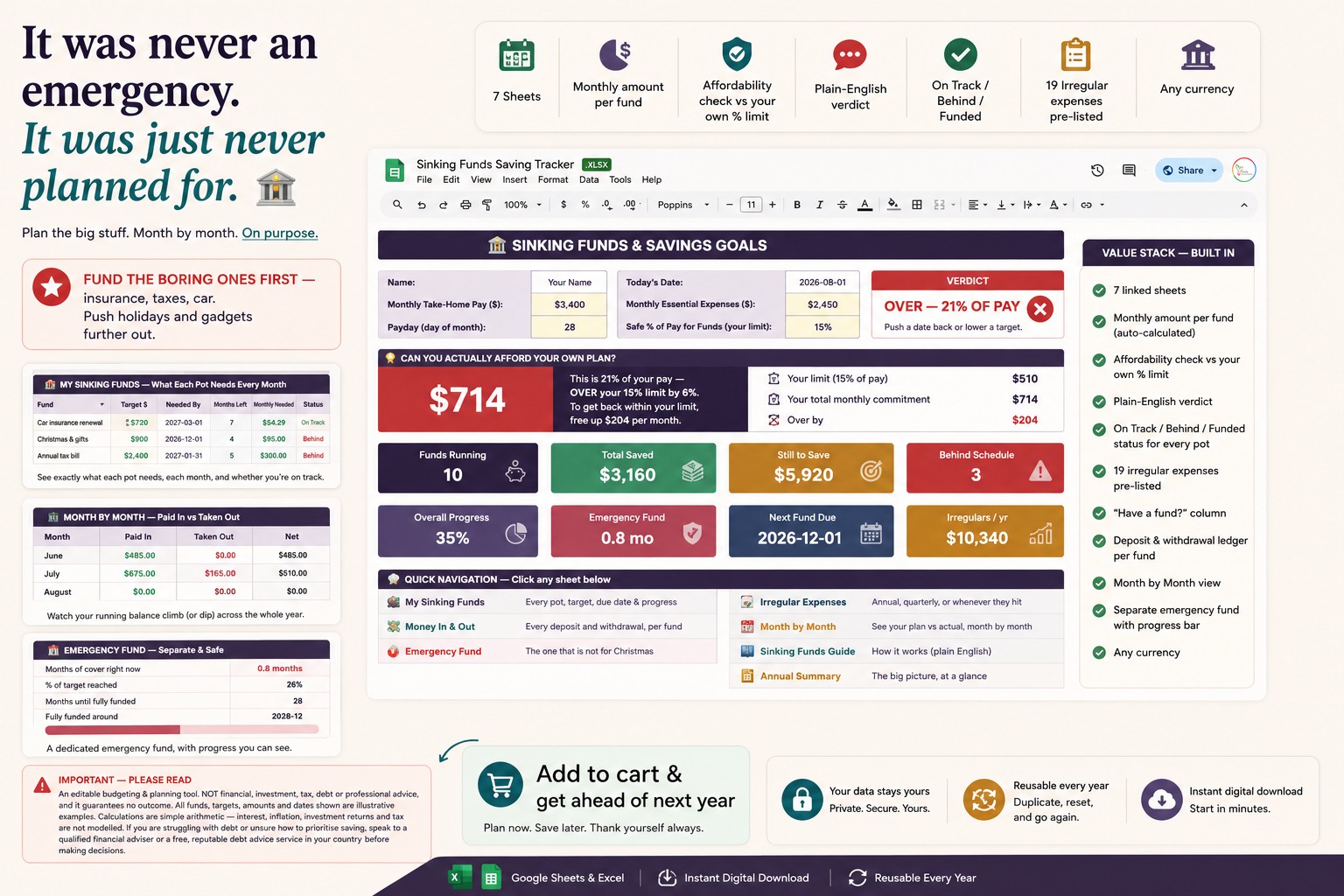
The mechanics are simple: for each expense, you need a target amount and the date you need it by. From those two things comes the number that matters — how much per month, from now, to be ready in time. Do that for each irregular expense and you have a plan instead of a series of ambushes.
A practical note on where to keep it: separate accounts or “pots” make it much harder to accidentally spend a fund, and many banks now offer them. But one savings account with a spreadsheet tracking who owns what inside it works perfectly well. The important thing is knowing which money is already spoken for.
Spending from a fund is a success
One mindset shift worth making explicitly, because it trips people up: taking money out of a sinking fund is not a failure. It’s the entire point.
People sometimes feel a pang of loss watching a fund they’ve built up drain away when the bill arrives. But that’s the fund working exactly as designed. The money was always going to leave; you just arranged for it to leave from a pot that was ready rather than from a month that wasn’t.
What does matter is logging it, because funds empty quietly. If you take from a fund without recording it, the plan drifts out of sync with reality and you get caught out anyway. A simple ledger of what went in and what came out keeps the numbers honest.
Start with the boring ones
If you can’t fund everything at once — and most people can’t — the priority order is worth being deliberate about. Fund the boring, unavoidable ones first: insurance, taxes, car costs, anything that turns into debt or a penalty if you miss it. Push the discretionary things — holidays, gadgets, upgrades — further out.
That’s not a moral judgement about fun. It’s about which expenses cause real damage when they’re unfunded. A missed holiday is a disappointment. A missed insurance renewal or tax bill is a problem that compounds.
Making that trade-off visible is more useful than pretending you can fund everything. And it’s far kinder than the usual approach, which is to fund nothing, get hit by all of it, and feel bad about it in January.
An important note
To be clear: this is a general explanation and a way of organising your own figures. It is not financial, investment, tax, debt, or professional advice, and it guarantees no outcome. Any figures mentioned are illustrative; yours will differ entirely. Simple sinking-fund arithmetic doesn’t model interest, inflation, investment returns or tax. And if you’re struggling with debt, or unsure how to prioritise between saving and repaying, please speak to a qualified financial adviser or a free, reputable debt advice service in your country — that’s exactly what they’re there for, and it’s a sensible step rather than a last resort.
If you want the maths done for you
I built a sinking funds tracker in Google Sheets that handles exactly this — nineteen common irregular expenses pre-listed with a yearly total and the divided-by-twelve figure, and a fund page where you enter a target and the date you need it by, and the months remaining and monthly amount calculate themselves with an On Track or Behind status:
👉 Sinking Funds Tracker for Google Sheets & Excel
Whether you use mine or a notepad, do the twenty-minute exercise: list your non-monthly spending, add it up, divide by twelve. That one number explains more about your finances than any amount of budgeting advice — and once you can see it, you can plan for it. The car service was never an emergency. It was just never planned for. 🏦
This reflects my own perspective and describes a budgeting tool — NOT financial, tax or debt advice, and it guarantees no outcome; figures are illustrative and simple arithmetic only. If you’re struggling with debt, please speak to a free, reputable debt advice service. What’s the “surprise” bill that gets you every single year? Tell me in the comments.

