

Did the Garden Actually Pay for Itself?
Weigh what you pick, price it honestly, and spread the water butt over ten years. Here’s how to answer “does a vegetable garden save money” without either hype or gloom.
There are two dishonest answers to this question, and gardening content is full of both. One says a vegetable garden will slash your grocery bill and pay for itself in a season. The other says growing your own is a lovely hobby that costs more than it saves, so don’t kid yourself. Both are confident, and both are wrong in the same way — they’re guesses, made without weighing anything. The honest answer is that it depends entirely on what you grow, how you set up, and crucially which year you’re asking about. And the good news is you can just measure it. Here’s how to answer does a vegetable garden save money for your own garden, properly.
Weigh what you pick
The measurement is simpler than it sounds: when you harvest something, note roughly how much it was, and put a price beside it — what that amount would have cost you locally, at the quality you’d actually buy.
Two details make this honest rather than flattering.
Use your real local price, at comparable quality. Not the premium organic price if you’d normally buy standard, and not the cheapest possible if you’d normally buy better. The question is what you’d genuinely have spent otherwise.
Only count what you actually used or gave away. The courgettes that composted because there were forty of them aren’t savings. This one keeps people honest, and it also teaches a genuine lesson about growing quantities you can actually eat.
Do that through a season and the running total is usually a pleasant surprise — most gardeners substantially underestimate it, because harvests arrive in small handfuls that never feel significant. A few beans here, a bowl of salad there, and no sense at all of the total. Weighed and priced, it adds up considerably more than the impression it leaves.
Which crops actually earn their space
The far more useful output of this exercise isn’t the total — it’s the per-crop picture, especially per square metre.
Because crops differ enormously in value density. Salad leaves and herbs are expensive to buy, quick to grow, and can be cut repeatedly from a very small area. Maincrop potatoes are cheap to buy and occupy a lot of ground for a long time. Both can be worth growing — but for very different reasons, and if your goal includes saving money, knowing which is which changes what you plant.
This is where a harvest log earns its keep. It replaces the vague sense that “the garden produced quite a lot” with something specific: this bed produced a lot of value, that one produced very little for the space and time it took. Then you can decide deliberately — grow the low-value crop because you love the flavour of your own, or give the space to something that pays. Either is a good decision when it’s made knowingly.
And of course value isn’t only money. Flavour you can’t buy, varieties nobody sells, the pleasure of the thing, food with no packaging, knowing exactly how it was grown — those matter and don’t show up in a total. Measuring the money doesn’t diminish them; it just stops you having to guess about the one part that can be measured.
Costs: spread them over their real life
This is where most “is it worth it?” calculations go wrong, in both directions.
A first-year vegetable garden involves real setup costs — raised beds, netting, a water butt, tools, seed trays, compost. If you total those against one season’s harvest, the garden will very often show a loss. That’s not a failure of the garden; it’s an accounting error. Those items don’t belong to one season.
The fix is to note how long each thing will last and count only its share. A water butt spread over ten years costs almost nothing per season. Netting over five years, likewise. Tools over a decade or more. Only genuinely annual costs — seeds, compost, feed — belong entirely to this year.
Do that, and the picture changes completely. A garden that “lost money” in year one is often comfortably ahead by year three, because the setup was paid for once and the harvests keep coming. Judge a garden properly in year three, not year one — and if you’re in year one and the numbers look bad, that’s expected, not a verdict.
The honest net figure
Put the two sides together — harvest value against costs, with long-lived items spread — and you get an honest net. Not a marketing number, not a discouraging one: yours.
For many food gardens, once setup is behind them, the answer is genuinely positive, particularly if a good share of the space goes to high-value crops. For some, it’s roughly break-even and the real return is flavour, exercise and time outdoors. Both are perfectly good outcomes, and knowing which one you’re in is more satisfying than wondering.
It also makes decisions easier. If you can see the numbers, “should I build another bed?” or “is the greenhouse worth it?” becomes a question with evidence behind it rather than a hopeful guess.
And there’s a quieter benefit: tracking your time alongside your costs tells you the other thing worth knowing — what the garden asks of you. A garden that pays for itself but takes more hours than you have is worth knowing about too, before next season’s plan.
An important note
To be clear: this is about tracking your own figures — it is not horticultural, agricultural, financial, or professional advice, and it guarantees no result. Any example prices, yields, or figures are illustrative; yours will differ entirely by crop, climate, and local prices. Verify growing information for your own area, never eat a plant you can’t positively identify as safe and edible, and always follow the label on any product you use, checking it’s approved for edible crops where you live.
If you want it calculated for you
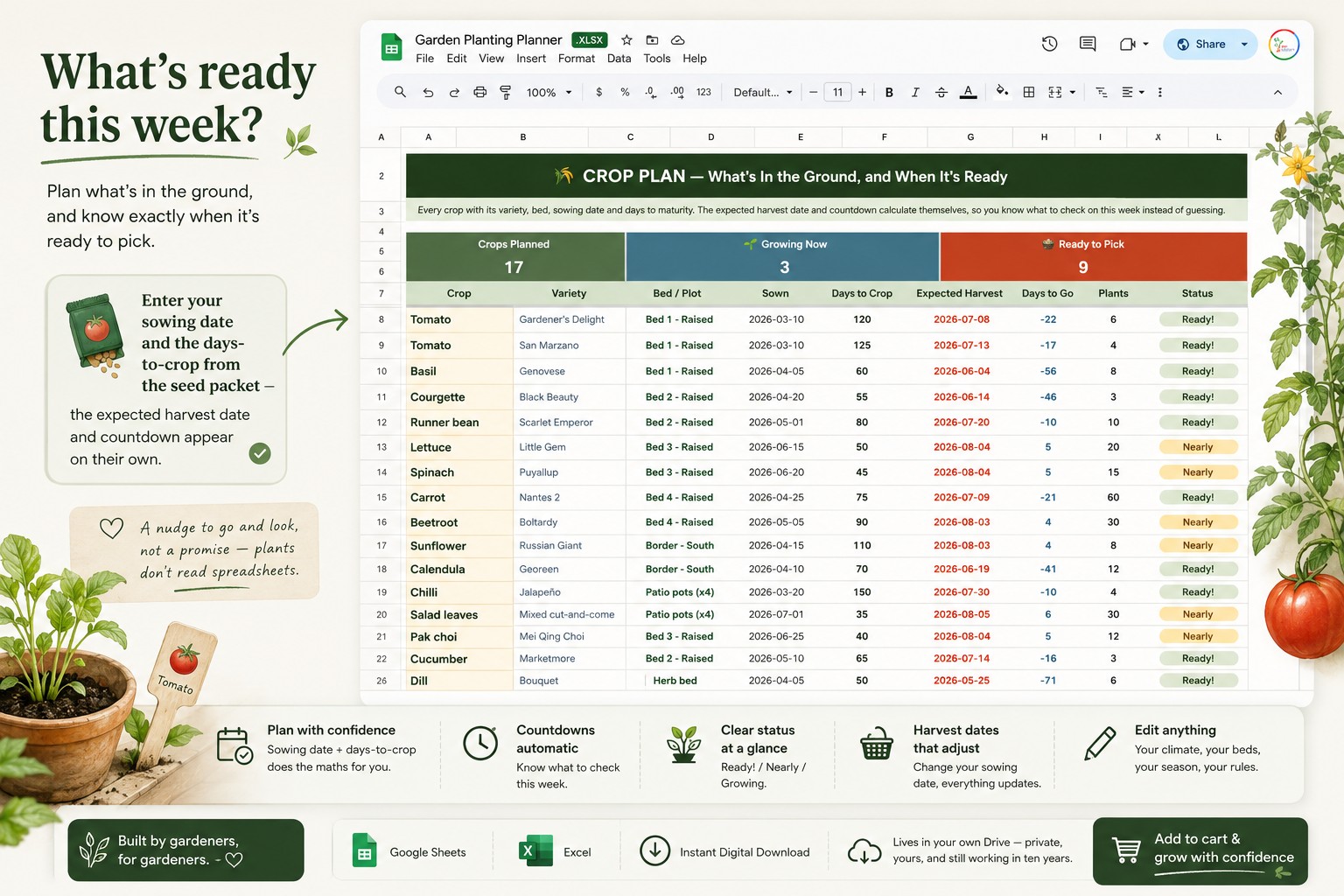
I built a harvest log and spend tracker into my garden planner in Google Sheets — weigh each pick, add your own local price and the total builds itself, while the spend page has a “Lasts?” column so long-lived kit is spread across its real life, giving an honest net figure:
👉 Garden Planner for Google Sheets & Excel
Whether you use mine or a notebook and kitchen scales, weigh what you pick this season. It takes seconds per harvest, it’s oddly satisfying, and it replaces two decades of confident internet opinions with an answer that’s actually about your garden. Just remember to judge it in year three. 🌱
This reflects my own perspective and is a tracking tool — not horticultural or financial advice, and it guarantees no result; example figures are illustrative and yours will differ. Have you ever totalled up a season’s harvest? Tell me what surprised you in the comments.

