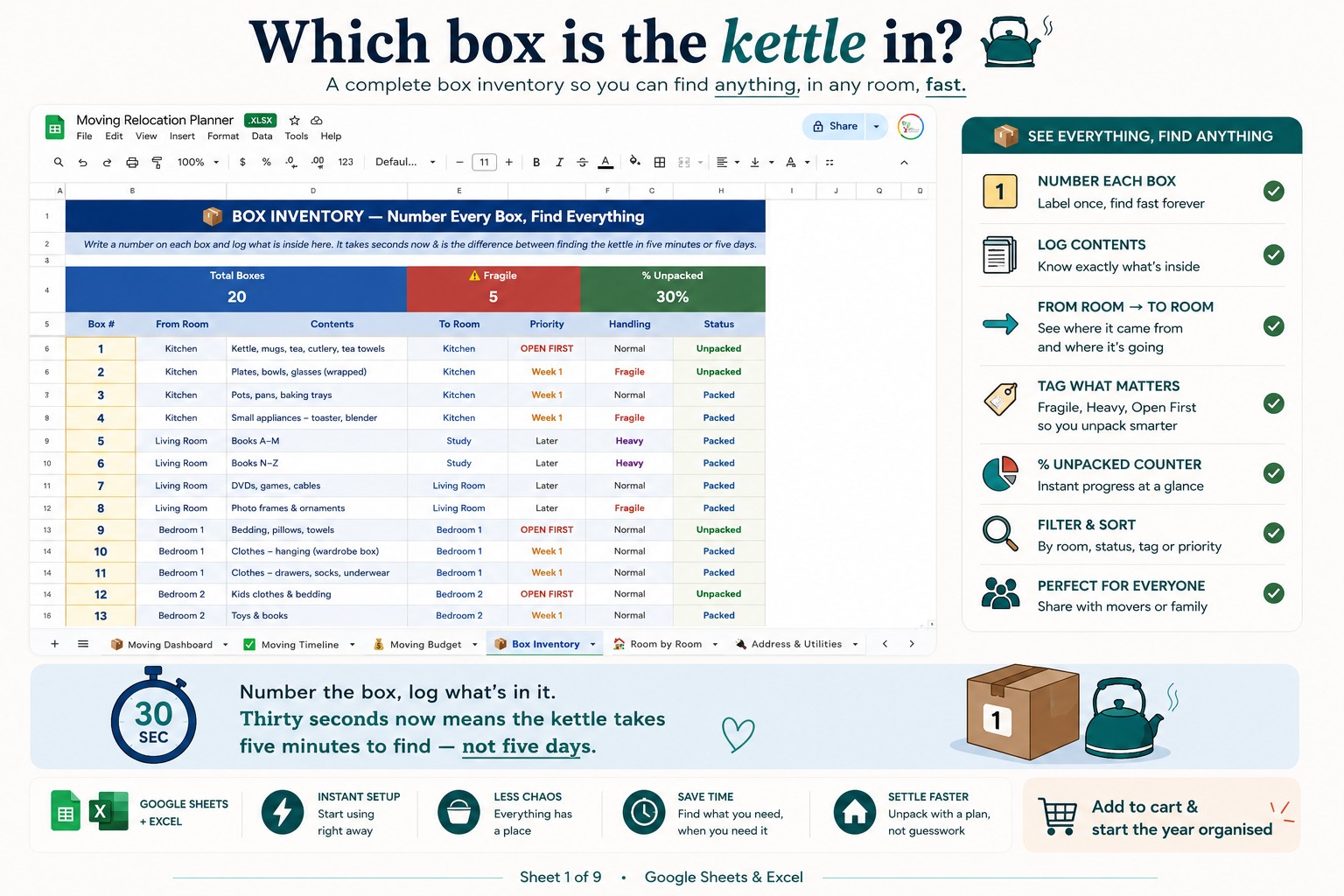
Which Box Is the Kettle In?
It’s 9pm in a new hallway, you’re surrounded by twenty identical brown boxes, and you need exactly one of them. Here’s why a moving box inventory is the thirty seconds that saves your first week.
Moving isn’t actually hard. Lifting things is tiring, but it’s not hard. What breaks people is remembering all of it — and the purest example arrives on the first night in a new home, when you’re exhausted, it’s late, and you need one specific thing from one specific box among twenty that all look exactly the same. So you open six of them, make a mess, don’t find it, and eventually give up and go without. Then you repeat that process for a week, because unpacking becomes a search operation. A moving box inventory — literally just numbering your boxes and writing down what’s in them — is one of the highest-return habits in moving, and almost nobody does it. Here’s why it works.
Why “labelling the room” isn’t enough
Most people do label boxes, sort of. They write “KITCHEN” on the side, feel organised, and move on. That’s better than nothing, but it fails at exactly the moment you need it, for a simple reason: knowing the room doesn’t tell you what’s inside.
You need the kettle. You have eleven boxes marked KITCHEN. You’re still opening boxes at random — you’ve just narrowed the search from twenty to eleven. And in practice, boxes rarely sort cleanly by room: the odds and ends from the last hour of packing end up wherever there was space.
Writing on the side of a box also has a physical problem — you can only see one or two faces of a stacked box, and the labelled one is invariably against the wall.
Numbering solves both. A number is visible in a small space, you can write it on multiple faces in seconds, and the number points to a list — which can hold as much detail as you like without being limited by what fits on cardboard.
The system, in about thirty seconds per box
It’s genuinely simple. As you seal each box, write a number on it, and log a line: the number, roughly what’s inside, which room it came from, and which room it’s going to.
That last distinction matters more than people expect. Moving is the natural moment when things change rooms — the books from the spare room are going in the new study, half the garage is going in the new loft. Recording the destination means movers (and future you) put boxes where they actually belong, which saves an entire second round of carrying heavy things up stairs.
Two more tags earn their keep enormously:
Fragile and Heavy. Practical information for whoever’s carrying it, and a reminder to yourself when stacking. Worth marking on the box itself as well as in the list.
“Open First.” This is the one that transforms the first few days. Some boxes contain the things you’ll need immediately — kettle, mugs, phone chargers, bedding, toilet roll, a knife to open other boxes. Marking those boxes as priority, and having them loaded last so they come off first, means your first evening is functional instead of a scavenger hunt.
The inventory has one more quiet benefit: a boxes-needed count. As you work room by room deciding what’s coming, you get a rough idea of how many boxes you actually need — instead of the usual pattern of guessing, running out on Saturday afternoon, and driving to find more.
The first-night box belongs in your car
Related and equally important: pack one box (or bag) of genuine first-night essentials and — this is the crucial part — put it in your own car, not the van.
The reason is timing risk. Vans get delayed. Loads arrive later than promised. Sometimes, on longer moves, your belongings arrive the next day. If your kettle, medication, bedding, toothbrush, and phone charger are somewhere in the van, a delay turns an inconvenience into a genuinely miserable night.
In your car, they’re guaranteed to arrive when you do. It’s a small piece of redundancy that costs nothing and covers the most likely thing to go wrong. Pack it last, so nothing gets forgotten out of it — and if you take any regular medication, that’s the first thing in.
Unpacking becomes a plan instead of a mess
There’s an unexpected psychological benefit to an inventory on the far side of the move. Unpacking is genuinely demoralising: it takes far longer than packing, progress is invisible, and you live in chaos throughout. Without any structure, you drift — opening whatever’s nearest, spreading half-unpacked contents across every room, and losing any sense of getting anywhere.
With an inventory, unpacking has an order. You can work box by box, room by room, and — if you track which boxes are done — actually see your progress as a percentage. That visible progress is a surprisingly strong motivator when you’re tired and surrounded by cardboard. The chaos shrinks measurably rather than mysteriously.
Decide before you pack, not after
One last thing that reduces the volume of everything above: sort before you pack, not after you arrive. Going room by room and deciding what to keep, donate, sell, or bin means you don’t pay to move things you don’t want, and you don’t unpack them into a new home either.
The selling part is worth taking seriously — the things you decide not to keep often add up to a meaningful amount, and plenty of people find decluttering substantially offsets what the move costs them. Tracking what you’ve listed and sold turns “we should get rid of some stuff” into an actual, funded part of the plan.
An important note
To be clear: this is a planning and organisation perspective — it isn’t legal, financial, insurance, or professional removals advice, and it guarantees no outcome. Always confirm arrangements, insurance cover, and liability for damage directly with your own removal company, landlord, and providers. And one practical security note: if you keep a moving file, don’t put full account or card numbers in it — moving files get shared with partners and sometimes with movers, and anything in there is visible to anyone with access. Partial references (last four digits) are enough to identify an account.
If you want it ready to go
I built a moving planner in Google Sheets with a numbered box inventory at its heart — contents, source and destination rooms, Fragile/Heavy/Open First tags, a boxes-needed count and a percent-unpacked tracker — alongside a pre-written first-night box checklist and a room-by-room declutter log:
👉 Moving Planner for Google Sheets & Excel
Whether you use mine or a notepad and a marker, number your boxes and write down what’s in them. Thirty seconds per box, at the moment you’re already handling it, buys you a first week where you can find things. Label every box, and your future self — standing in a new hallway at 9pm — will be extremely grateful. 📦
This reflects my own perspective and is a planning tool — not legal, financial, insurance or professional removals advice, and it guarantees no outcome; confirm cover and liability with your own removal company. What’s the thing you couldn’t find on your first night? Tell me in the comments.