Catch a Subject Drifting in October, Not April
Every homeschool year has one subject that quietly falls behind. Discovered in spring it’s a crisis; discovered in autumn it’s a small adjustment. Here’s how homeschool curriculum pacing makes the difference visible early.
There’s a pattern almost every homeschooling family recognises. The year starts well and everything moves. Then, without any decision being made, one subject starts slipping — maybe it’s the one nobody enjoys, or the one that keeps getting bumped when the day runs short, or simply the one that takes longer per lesson than you’d assumed. Nothing announces it. And then in spring you sit down to work out where you actually are, and discover you’re forty lessons behind in maths with eight weeks left. Homeschool curriculum pacing is the boring habit that prevents this — and the difference between finding out in October and finding out in April is enormous. Here’s why, and how to do it simply.
Why subjects drift invisibly
The slip happens quietly for three structural reasons.
Progress is measured in lessons, but felt in days. You know you did school today. You don’t know whether today’s work kept you on pace, because “on pace” requires comparing lessons completed against lessons remaining against weeks remaining — a calculation nobody does spontaneously.
Every subject has its own pace. You might be comfortably ahead in reading and quietly behind in maths, and the overall feeling of “the year is going fine” averages those out into something that hides the problem. It’s the same reason a company-wide average hides a struggling team: the aggregate feels reassuring while a specific part is in trouble.
The subjects that slip are the ones you avoid. Whatever’s hardest, dullest, or most likely to be dropped when the morning goes sideways — those are exactly the ones accumulating a deficit, and they’re also the ones you’re least inclined to examine closely.
Put together: the information needed to notice the drift is never in front of you, and the natural tendency is to look away from precisely the subject that needs attention.
The simplest useful measure: % complete
You don’t need anything sophisticated. Two numbers per subject: how many lessons are in the curriculum, and how many you’ve done. That gives a percentage complete — and that percentage, compared against how far through your school year you are, tells you almost everything.
If you’re 40% through the year and 40% through the book, you’re on pace. If you’re 40% through the year and 20% through the book, you now know, in October, that maths needs attention — with months of runway to fix it.
That’s the whole insight. It’s arithmetic a ten-year-old could do, and almost nobody does it, because the two numbers usually live in different places (the year in your head, the lessons in a book). Putting them side by side is what makes the comparison automatic instead of a task you’d have to remember to perform.
Why October beats April, concretely
The value of early detection is that it changes what your options are.
Spotted in autumn, a lagging subject has easy fixes available: add a lesson a week, do a couple of catch-up sessions, adjust the schedule so that subject stops being the one that gets bumped, or make a calm, considered decision to cover less of the book this year. All of these are small and undramatic.
Spotted in spring, none of those work. You’re facing an unpleasant choice between cramming (which tends to mean poor retention and a stressed child), abandoning a large chunk of the curriculum, or extending your school year. And it comes with the sinking feeling of having let something slide — which lands hardest on the parent, who’s usually already doing more than anyone gives them credit for.
Same underlying situation. Completely different set of choices, entirely because of when you looked.
Grades and the quiet signal of a struggling child
Pacing tells you about your progress through material; assessment tells you whether it’s landing. And here too, early is everything.
The pattern worth watching for isn’t a single bad score — everyone has bad days. It’s a cluster: several low results in the same subject, over time, which usually means the material moved past a point where understanding was solid. Caught early, that’s addressable — go back, reteach, slow down, try a different approach. Left until the end of the year, it means a whole topic built on shaky foundations.
A simple count of how many assessments came in low, per child, per subject, surfaces that pattern without you having to scan through everything. And to be clear: a child struggling with a subject is completely normal and says nothing about your teaching or their ability. It’s information about where support is needed, nothing more.
It’s also worth saying you don’t have to grade everything. Many families only formally assess tests and major projects, and that’s plenty. The purpose isn’t to replicate school; it’s to have enough signal to notice when something needs attention.
Adjust the plan, don’t punish yourself with it
One important framing note, because homeschooling comes with plenty of self-criticism already. Pacing data exists to inform decisions, not to grade you as a parent. Falling behind in a subject is extremely normal — illness happens, hard seasons happen, some curricula are simply optimistic about how long a lesson takes.
The right response to “we’re behind in maths” is a calm adjustment, and sometimes the correct adjustment is to change the target rather than the effort: deciding deliberately that you’ll finish this book next autumn is a legitimate, thoughtful choice, not a failure. Homeschooling’s real advantage is exactly this flexibility. Pacing information is what lets you use that flexibility deliberately rather than discovering in April that it’s been used for you.
An honest note
Please note: this is an organisation and record-keeping perspective — it is not legal, educational, curriculum, or compliance advice, and it can’t guarantee that any records will satisfy any authority. Requirements differ widely by country, state, and province and change over time, so verify what applies to you with your local education authority or a reputable homeschool organisation. Nothing here is guidance on what or how much your children should be learning — that’s between you, your chosen approach, and the rules where you live.
If you want pacing calculated for you
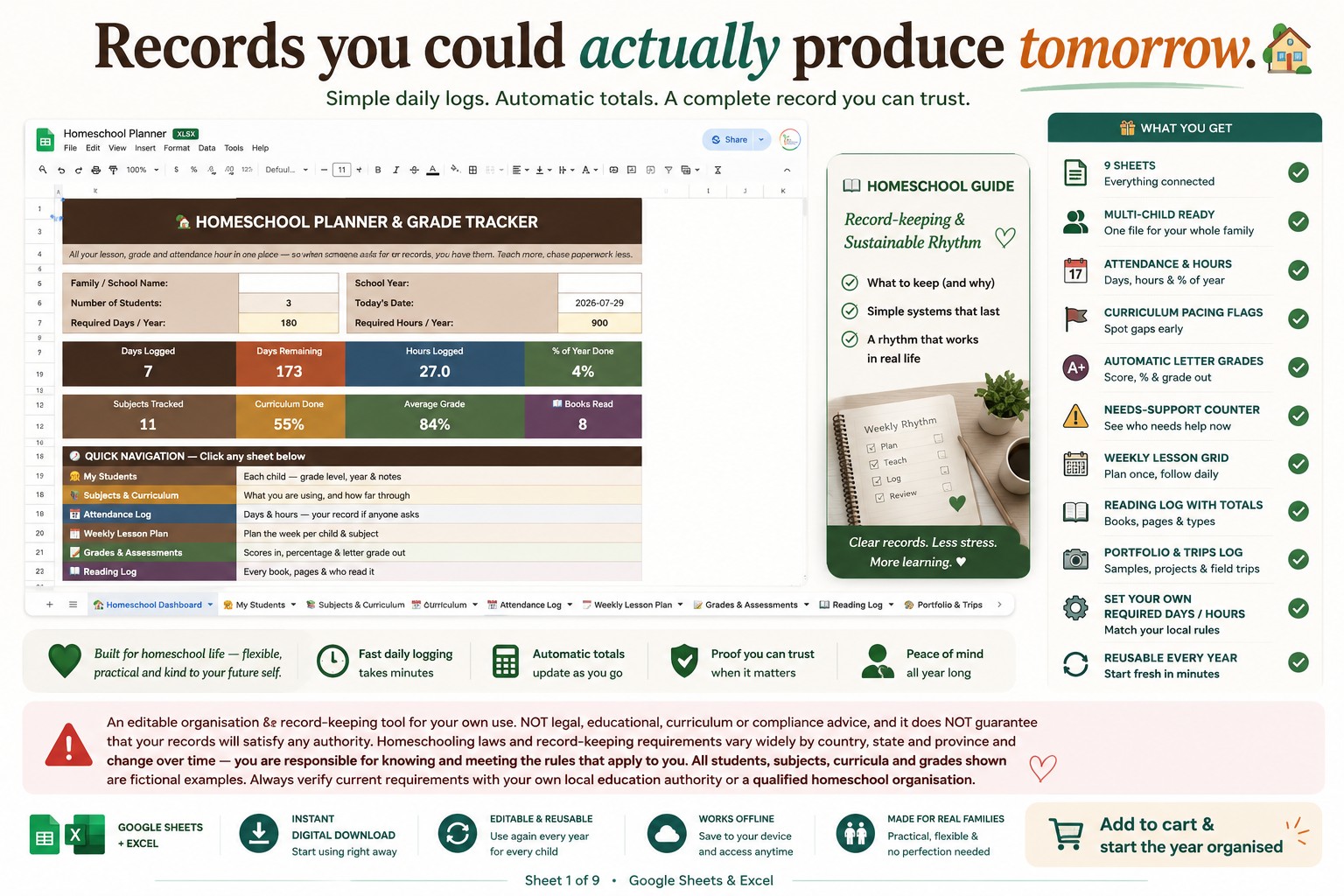
I built curriculum pacing into my homeschool planner in Google Sheets — enter total lessons and lessons completed per subject and it shows % complete with an on-pace status flag, alongside grades with automatic letter grades and a needs-support counter, attendance and hours, and reading and portfolio logs, all organised by child:
👉 Homeschool Planner for Google Sheets & Excel
Whether you use mine or a scrap of paper, write down two numbers per subject and glance at them monthly. It takes five minutes and it converts the most stressful discovery of the homeschool year into a small autumn adjustment. The drift is going to happen in some subject — the only question is whether you find out while it’s still easy to fix. 🏡
This reflects my own perspective and is an organisation tool — not legal, educational, curriculum or compliance advice; always verify current requirements with your local education authority. Which subject always drifts in your house? Tell me in the comments — I suspect there’s a pattern.