

Impulse Spending Is Data, Not a Moral Failing
Most money tracking fails because it doubles as a guilt diary. Here’s how to look at impulse spending with ADHD as information — and why an “oops buffer” works better than shame.
Here’s the reason most people with ADHD stop tracking their spending within about three weeks. Not because it’s hard — logging a purchase takes seconds. It’s because every entry starts to feel like a confession. You write down the impulse buy, and the act of writing it down comes with a small dose of I shouldn’t have. Do that thirty times and tracking becomes an unpleasant ritual of documenting your own failures, so you quietly stop. Then, with nothing recorded, nothing improves, and the story that you’re bad with money gets another data point. Breaking that cycle means changing what tracking is: not a moral ledger, but a source of information. Looking at impulse spending ADHD patterns as data rather than evidence against yourself is what makes the tracking survive long enough to be useful.
Why the shame framing backfires
It’s worth being clear about the mechanism, because “be kinder to yourself” can sound like a platitude when it’s actually a practical necessity.
Shame makes you avoid. If recording a purchase feels bad, you’ll skip recording the ones that feel worst — which are exactly the ones that would tell you the most. So a guilt-based system doesn’t just feel unpleasant; it systematically corrupts its own data, hiding precisely the spending you most need to see.
Shame also breaks systems entirely. Miss a few days, feel behind, feel bad, abandon it. The all-or-nothing pattern that follows a lapse is one of the most reliable ways ADHD people lose a working habit — and it’s driven by guilt, not by the difficulty of the task.
And underneath it: impulse spending with ADHD isn’t a character defect. It’s a predictable interaction between a brain that’s short on dopamine and a retail environment engineered to supply it in one click. Understanding that doesn’t excuse anything — it just correctly locates the problem, which is the first step to doing something useful about it.
Tag it neutrally, and let patterns appear
The practical version is simple: log purchases quickly, and tag them without loading the tags with judgement. Something like impulse, ADHD tax (the late fee, the duplicate buy, the express shipping because you left it late), and — importantly — small joy.
That third category matters more than it sounds. A system where every non-essential purchase is implicitly a failure is a system you’ll resent and abandon. Some spending is a small, deliberate pleasure and deserves to be recorded as exactly that, not filed under shame. Honouring it keeps the whole practice honest.
Then, after a few weeks, something genuinely useful happens: patterns surface on their own. You might notice impulse spending clusters at particular times — late evenings, after difficult days, when you’re bored or understimulated. You might see one specific category quietly dominating. You might see the total “ADHD tax” and realise it’s a meaningful amount of money lost to forgetting, not to choices.
None of that requires you to feel bad. It’s just information — and information suggests interventions. Boredom spending at 11pm points at a different fix (a competing source of stimulation, or removing saved payment details) than forgetting-driven costs (reminders, autopay where appropriate). You can only make those distinctions if the data is honest, and it’s only honest if logging is emotionally safe.
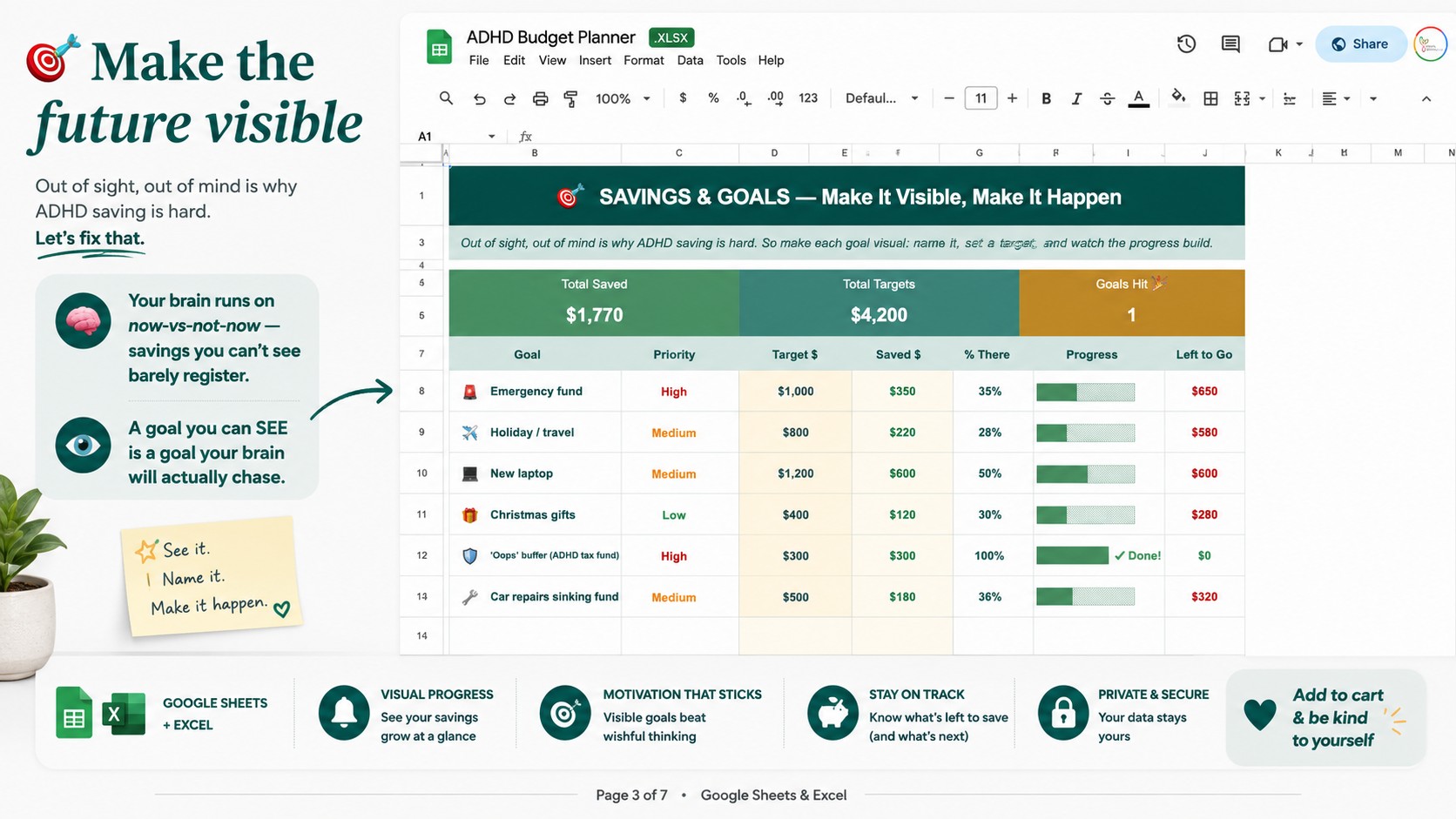
The “oops buffer”
The other idea worth stealing is a small fund set aside specifically for the mistakes you know you’ll make: the occasional late fee, the duplicate purchase, the thing you forgot to cancel.
At first this sounds like giving yourself permission to be careless. It isn’t. It’s realism about the fact that ADHD-related slips will happen sometimes, no matter how good your system is, and it changes what happens when they do.
Without a buffer, a slip is a small financial hit plus a large emotional one — a shame spiral that often takes the whole system down with it. With a buffer, it’s a shrug: that’s what the buffer was for, adjust and continue. The money cost is identical; the emotional cost, and therefore the survival of your system, is completely different.
That’s the real value. Not the money — the fact that you keep going afterwards. Planning for imperfection is what makes a system durable, and durable beats optimal by a wide margin.
Stop the loop with a brain dump
One last thing that quietly eats money-related energy: the loop. Did I pay that? Is that trial about to charge me? I should cancel the thing. These thoughts arrive at random, can’t be acted on immediately, and don’t leave — so they cycle in the background, generating anxiety without producing anything.
Somewhere to dump them the moment they arrive breaks the loop. Once it’s written down, your brain can release it, because the fear driving the loop is that you’ll forget. That’s a small mechanism with a disproportionate effect on how much mental space money occupies — and reducing money-related anxiety is worth as much as any specific saving.
An important, caring note
Please note: this is about organisation and self-compassion, not financial guidance. It is not financial, investment, tax, or debt advice, is not a treatment for ADHD or any condition, and guarantees no result. It doesn’t replace a qualified financial professional, accountant, or therapist. If money or debt feels genuinely unmanageable or distressing, please reach out to a qualified professional, a non-profit debt advice service, or someone you trust — support exists, and seeking it is a strength.
If you want tracking without the guilt
I built a spending log and ADHD-tax tracker into my ADHD budget planner in Google Sheets — ten-second logging, gentle tags for impulse buys, ADHD tax and small joys, a running total that reveals the pattern, and an “oops” buffer built into the approach:
👉 ADHD Budget Planner for Google Sheets & Excel
Whether you use mine or a notes app, log your spending as information rather than confession. Tag it neutrally, let the patterns show themselves, keep a small buffer for the inevitable slips, and treat a lapse as a shrug rather than a verdict. Tracking only helps if you keep doing it — and you’ll only keep doing it if it doesn’t make you feel terrible. 🧡
This reflects ADHD-friendly organising principles — not financial, investment, tax or debt advice, not a treatment for any condition, and it guarantees no result. If money or debt feels unmanageable, please reach out to a qualified professional or someone you trust. What pattern surprised you when you finally tracked your spending? Share it in the comments — no judgement here.

