Days on Market Is Trying to Tell You Something
A listing quietly ageing with no price conversation is a seller losing faith in you. Here’s how to use days on market and showing feedback to have the hard conversation early — with evidence.
Every agent knows the slow-motion version of a listing going wrong. It launches with enthusiasm. There are showings in the first week or two. Then things thin out. Nobody says anything, because nobody wants to be the one to raise it. The listing keeps ageing, the seller’s optimism curdles into frustration, and eventually the conversation happens anyway — except now it’s defensive, late, and the relationship is strained. Days on market is the number that would have warned you, and showing feedback is the evidence that would have made the conversation easy. Here’s how to use both.
DOM is an early warning system
Days on market is often treated as a passive statistic — something you notice on a listing sheet. It’s far more useful as an alert. A listing’s DOM climbing past what’s normal for your market and that property type is a signal that something isn’t working: the price, the presentation, the marketing, or the fit between what’s offered and what buyers want.
The value is entirely in the timing. Noticed early, a rising DOM is an opportunity — you can adjust price or presentation while the listing still has momentum and the seller still has confidence. Noticed late, it’s a problem: stale listings accumulate their own stigma, buyers start assuming something’s wrong with the property, and the eventual price reduction often has to be bigger than an early one would have been.
So DOM isn’t just a number describing the past; it’s an indicator you should be watching, with a rough threshold in mind for your market. Once a listing crosses it, that’s your prompt to act — not to wait and hope.
The conversation nobody wants to start
The reason stale listings persist isn’t ignorance. Most agents can see it happening. It’s that the price conversation is genuinely uncomfortable, and there are strong incentives to postpone it: you don’t want to upset the seller, you don’t want to look like you’re admitting the strategy was wrong, and there’s always the hope that next weekend brings the right buyer.
But postponing costs you twice. The listing continues to age, and — more damaging — the seller starts losing confidence in you. From their side, silence looks like passivity. They’re watching their property sit with no offers and no plan, and the absence of a conversation reads as an absence of expertise. The agents sellers trust are the ones who bring them the awkward news early, with a recommendation attached. Silence protects your comfort today and costs you the relationship, the referral, and often the listing.
Feedback turns opinion into evidence
Here’s what makes that conversation dramatically easier: showing feedback, collected systematically.
If you log what buyers actually say after each viewing, patterns emerge. If eight separate parties independently mention the same thing — it feels dark, the layout doesn’t work for them, it’s priced above comparable homes they’ve seen — that’s no longer your opinion versus your seller’s. It’s a body of consistent market feedback from real buyers who came, looked, and didn’t offer.
That completely changes the dynamic. “I think we should reduce the price” invites debate; it’s your judgement against their attachment to their home. “Every one of the last eight buyers said the same thing, here it is written down” is evidence, and it lets you and the seller face the market together rather than argue with each other. You’re not the person delivering bad news — you’re the person who gathered the information and is bringing a plan.
It also, incidentally, shows the seller you’re working. A log of showings and feedback is visible proof of activity, which matters enormously to someone whose main experience of the process is waiting at home.
Capture it at the time, or lose it
The catch: feedback is perishable. Agents hear it in passing at the end of a viewing, intend to remember it, and it’s gone within the day. A month later, “I think a few people mentioned the kitchen?” carries none of the weight of a dated list of specific comments.
So the discipline is simply to record it immediately — the date, who viewed, and what they said, in their words. It takes a minute per showing and it accumulates into the single most persuasive tool you have for a price conversation. The same log also helps you spot fixable issues early: if buyers keep mentioning something you can address (staging, lighting, clutter, photography), you may not need a price reduction at all.
Watch your deals as closely as your listings
The same principle applies past the offer. A deal under contract has stages — inspection, appraisal, financing — and each is a place where things quietly stall. A deal drifting past its expected close date rarely announces itself; it just doesn’t progress, while everyone assumes someone else is handling it.
Tracking each deal by stage, with its close date and a countdown, means you notice drift while there’s still time to chase a lender, a solicitor, or an inspector. Just as with DOM, the win is in noticing early. Deals that fall through often gave weeks of warning that nobody was watching for.
An important note
To be clear: this is about organising your own business and information — it is not legal, financial, tax, accounting, or brokerage advice, and it guarantees no result. Pricing, disclosure, and advertising in real estate are regulated, and how you record and use buyer feedback should comply with your brokerage’s policies and applicable law — including fair-housing requirements, which mean feedback should be about the property, never about buyers’ personal characteristics. Follow your brokerage agreement and local regulations, and consult your broker or a qualified professional where appropriate.
If you want DOM and feedback tracked for you
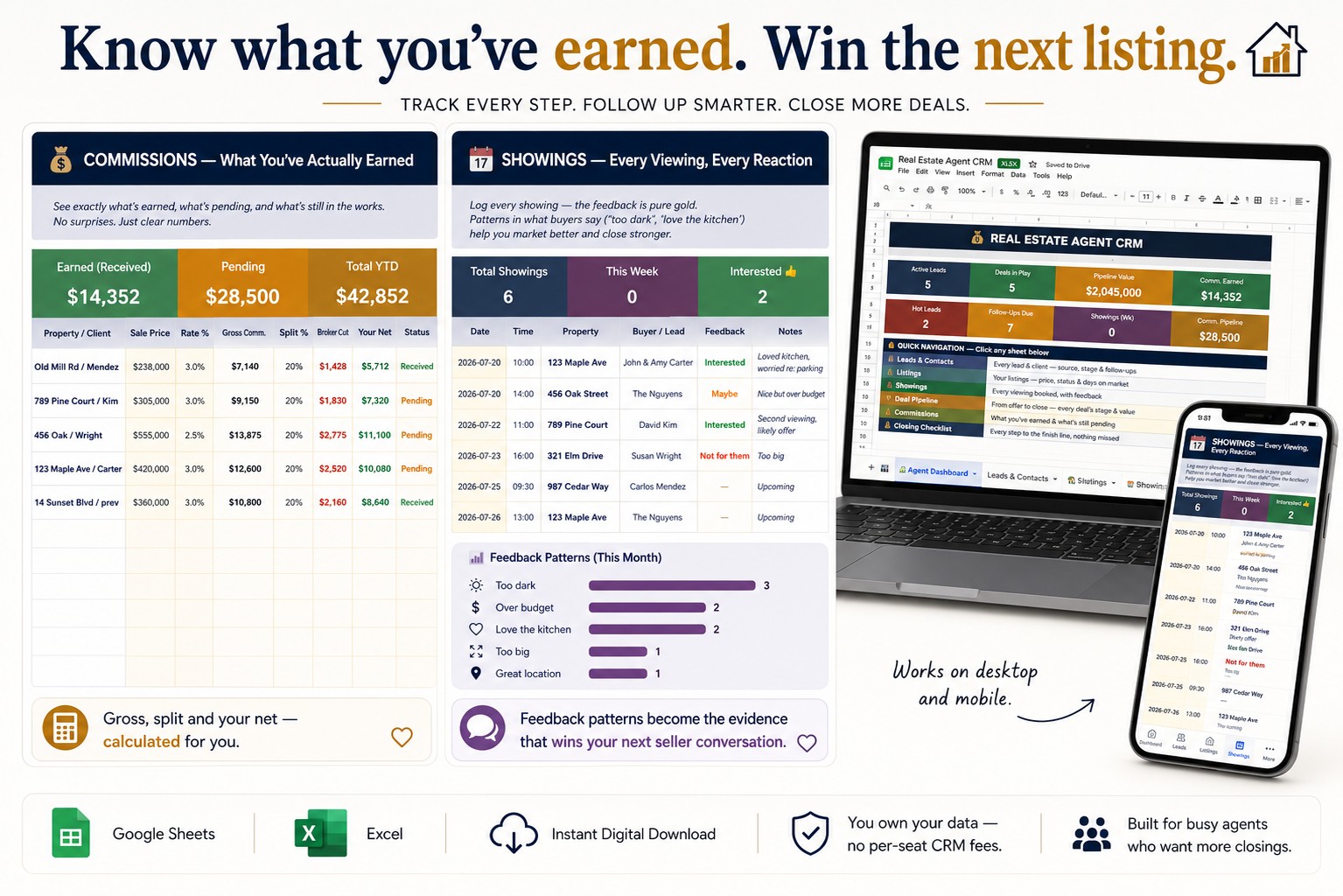
I built automatic days-on-market tracking and a showing feedback log into my real estate agent CRM in Google Sheets — every listing’s DOM calculates itself as an early warning, every viewing’s feedback is captured so patterns become visible, and the deal pipeline counts down to each close date:
👉 Real Estate Agent CRM for Google Sheets & Excel
Whether you use mine or a notebook, watch your DOM like an alarm and write down what buyers tell you. The price conversation is never fun — but held early, with real feedback in hand, it’s a conversation that builds trust instead of destroying it. Sellers don’t lose faith in agents who bring them hard news. They lose faith in agents who bring them silence. 🏡
This reflects my own perspective and is an organising tool — not legal, financial or brokerage advice, and it guarantees no result; follow your brokerage agreement, local regulations and fair-housing requirements. Agents: what’s your DOM threshold before you raise price? Tell me in the comments.