

The Markup-vs-Margin Mistake That Underprices Every Job You Send
A 20% markup feels like a 20% profit. It isn’t — it’s about 16.7%. This single confusion quietly costs contractors profit on every quote. Here’s markup vs margin, explained so it sticks.
There’s one pricing mistake that trips up more contractors than any other, and it’s expensive precisely because it’s invisible. You add what feels like a healthy amount on top of your costs, send the quote, win the job — and quietly make less profit than you thought, on every single job, forever. The culprit is the confusion between markup vs margin: two words that sound interchangeable, describe the same money, and mean genuinely different things. Getting them mixed up doesn’t cause a dramatic error you’d notice; it causes a small, systematic underpricing that bleeds your business slowly. Let’s clear it up for good, because once you see it, you can’t unsee it — and you’ll never underprice the same way again.
The two words, clearly
Here’s the distinction in plain terms.
Markup is how much you add on top of your cost. If a job costs you $1,000 and you add 20%, you add $200 and charge $1,200. The 20% is measured against your cost.
Margin is your profit as a share of the final price — the number you actually charged. On that same job, your $200 profit against the $1,200 price is about 16.7%. The margin is measured against your selling price.
Same job, same $200 profit — but “20% markup” and “16.7% margin” are both true descriptions of it, because they’re measured against different numbers. Markup uses your cost as the base; margin uses your price. And since your price is always bigger than your cost, your margin percentage is always smaller than your markup percentage. Always.
Why this quietly costs you money
Here’s where it hurts. Most contractors think in markup — “I add 20%” — but they want a margin. When someone says “I need to make 20% on my jobs,” they almost always mean margin: they want 20% of what they charge to be profit. But if they achieve that by applying a 20% markup, they only actually make about 16.7% margin. They’re falling short of their target on every job and don’t realise it, because the two numbers wear such similar clothing.
That shortfall compounds across your whole business. Every quote is a little underpriced relative to what you intended. Over a year of jobs, the gap between the margin you meant to make and the margin you actually made is real money — money you needed and quietly didn’t charge for. And because nothing looks obviously wrong (you did add a markup, the jobs did make some profit), the leak never announces itself. You just feel like you’re working hard for less than the numbers seemed to promise.
The conversion you need to know
The fix is simple once you know it: to hit a target margin, you have to mark up by more than that margin. A few reference points worth burning into memory:
- To make a 20% margin, you mark up by 25%.
- To make a 25% margin, you mark up by about 33%.
- To make a 30% margin, you mark up by about 43%.
- To make a 40% margin, you mark up by about 67%.
Notice how the gap widens as you go up — the higher the margin you want, the much higher the markup you need. This is why the confusion gets more expensive at exactly the profit levels you most want to hit. A contractor aiming for a healthy 30% margin who marks up 30% is dramatically underpricing — they’re making around 23% margin, not 30%, and giving away a big slice of intended profit on every job.
The safest habit is to decide your target in terms of margin (because margin is what actually determines whether your business is healthy), and then convert to the markup that achieves it. Don’t mark up by your target margin number and hope — the maths doesn’t work that way, and it never has.
Margin is the number that tells the truth
There’s a deeper reason to think in margin rather than markup: margin is the number that actually tells you whether your business is viable. Your margin is the share of your revenue that’s profit, which is what has to cover everything the direct job costs don’t — and ultimately pay you. Two contractors can quote the same job at the same price, and the one who understands their margin knows whether that price is healthy while the one thinking in vague markup terms is guessing.
This is why serious contractors track their actual margin per job — comparing what they quoted against what the job really cost, and seeing the real margin percentage that resulted. That’s the number that tells the truth, after the optimistic estimates and the markup-margin confusion have all played out. A job that felt fine can turn out to have run thin, or even at a loss, and only the margin — measured properly, after the fact — reveals it. Knowing your real margin per job is how you find out whether your pricing actually works, and it starts with not confusing markup for margin in the first place.
An important note
To be clear: this is a general explanation of a pricing concept — it is not financial, tax, accounting, legal, or professional construction advice, and it guarantees no result. The example percentages are illustrative; your own targets and numbers depend on your business and costs. Always work from your own real figures, comply with the licensing, permit, insurance, and building-code requirements in your area, and consult a qualified professional (such as an accountant) for pricing and financial decisions.
If you want the maths handled for you
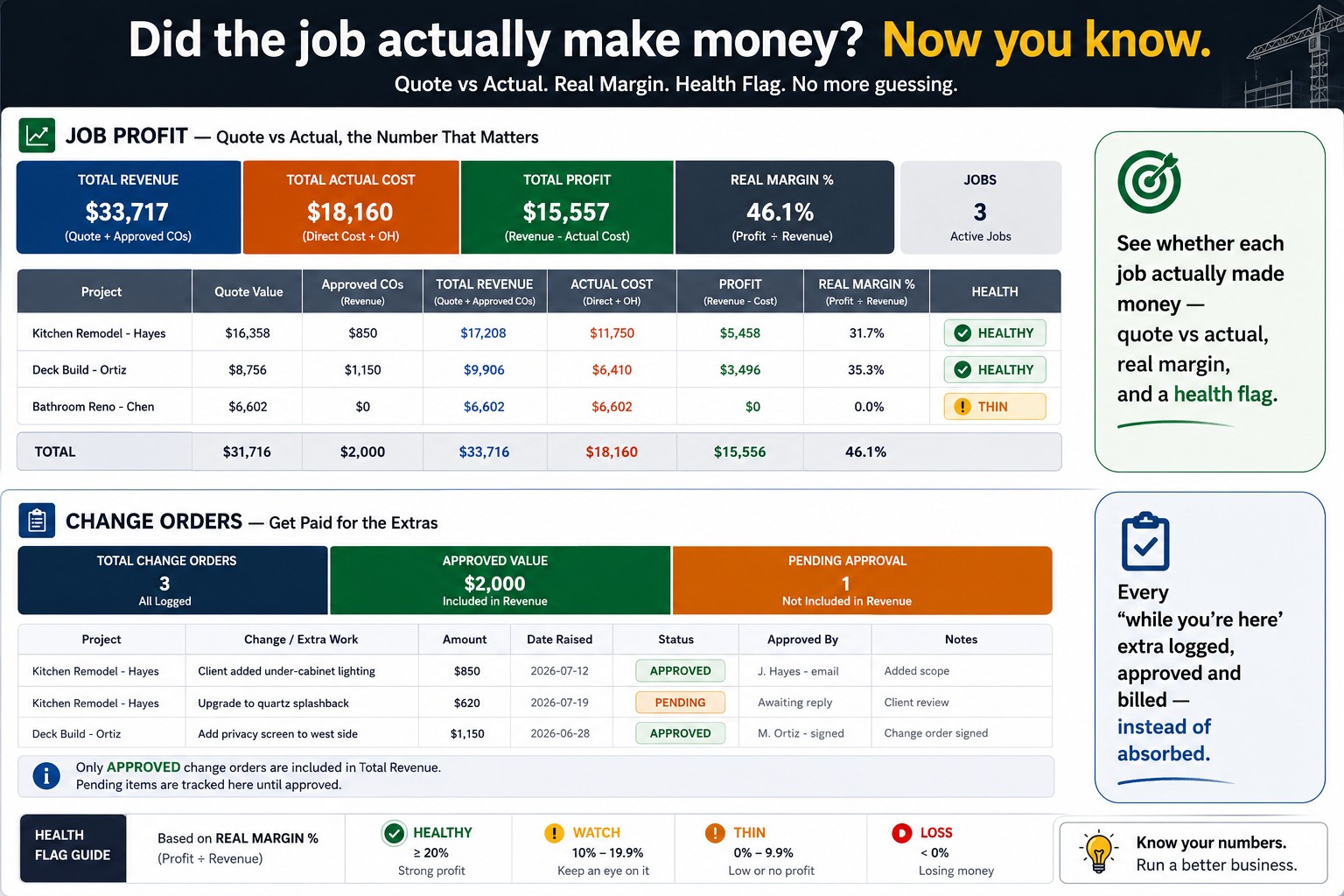
I built markup-and-margin handling into my construction estimate calculator in Google Sheets — set your overhead and markup and the client price calculates itself, then the job-profit sheet shows your real margin percentage per job with a health flag (Healthy, Watch, Thin, or LOSS), and there’s a built-in guide explaining markup versus margin:
👉 Construction Estimate Calculator for Google Sheets & Excel
Whether you use mine or a calculator, get this one distinction straight, because it’s costing you on every job you send. Decide the margin you need, mark up by enough to actually hit it, and track your real margin afterwards to check the maths held. Markup and margin sound like the same thing — and that resemblance is quietly the most expensive mistake in contracting. Fix it once, and you stop underpricing forever.
This reflects my own perspective and is a general explanation — not financial, tax, accounting, legal or professional construction advice, and it guarantees no result; work from your own figures and consult a professional. Contractors: did the markup-vs-margin gap catch you out early on? Tell me in the comments.

