

Most Jobs Don’t Lose Money on Site. They Lose It in the Quote.
You worked hard all year and somehow have little to show for it. The profit didn’t leak away on the job — it leaked away before you picked up a tool. Here are the four quiet leaks in construction estimating.
Every contractor knows the feeling. You’ve had the job — maybe the whole year — that felt busy the entire time. The crew worked hard, the clients were happy, the invoices went out. And when the dust settled and you looked at what was actually left, the profit wasn’t there. It’s a demoralising, confusing experience, because nothing obviously went wrong. There was no disaster, no single job that blew up. And that’s exactly the point: the money rarely leaks away on site. It leaks away in the quote, before you ever pick up a tool. Construction estimating is where most contracting profit is won or lost, and it’s lost through four quiet leaks that are almost invisible individually and devastating in aggregate. Here they are.
Leak #1: Labour estimated by gut
The first leak is labour, and it’s the biggest for most contractors. Labour is usually your largest and most variable cost, and it’s the one most often estimated by feel — “that’ll take a couple of days” — rather than calculated.
The trouble with gut estimates is that they’re optimistic, and they’re optimistic consistently in the same direction. Almost nobody overestimates how long a job will take; nearly everyone underestimates it. So you quote based on hours that were always going to run long, the job takes more crew-time than you priced, and the extra hours come straight out of your margin. Because you never compared your estimate to reality, you don’t even learn from it — you just make the same optimistic guess on the next job.
Costing labour honestly — crew size × hours × rate, worked out deliberately rather than felt — is the first plug. It forces you to think about the actual hours instead of a hopeful number, and over time, comparing estimated hours to actual hours teaches you how you really estimate, so your quotes get more accurate.
Leak #2: Materials priced with no waste allowance
The second leak is materials, and it’s subtle. You price the materials you need for the job — the square footage, the linear feet, the units. What you often don’t price is the waste: the offcuts, the breakage, the over-ordering that every job involves. You know perfectly well you’ll have offcuts. You just don’t put them in the number.
So you buy more material than you quoted for, and the difference — the cost of the waste you always knew you’d have — comes out of your profit. It’s not a huge amount on any single line, which is exactly why it’s ignored, but across every material on every job it adds up to a real, persistent leak.
The plug is a waste percentage allowance on every material line. Since the offcuts are certain, you price them in from the start, so the material cost you quote is the material cost you actually incur. It’s a small change that stops a guaranteed loss on every job.
Leak #3: Overhead that never makes it into the number
The third leak is the sneakiest, because the cost is real but invisible at quote time. Your business has overhead — insurance, vehicles, tools, phone, admin time, the cost of simply existing as a business — and every job needs to contribute to covering it. But when you quote a job by adding up its materials and labour, that overhead isn’t in front of you, so it often doesn’t get included.
The result is that you quote jobs based on their direct costs plus a bit of profit, while your overhead quietly eats that profit in the background. You feel like you’re making a margin on each job, but at the end of the year the overhead has consumed it, because it was never built into your prices. You were effectively pricing as if your business had no running costs — which no business does.
The plug is to build overhead into every quote as a deliberate percentage, so each job carries its fair share of keeping the business alive, and the profit you think you’re making is profit you actually keep.
Leak #4: The extras you did as a favour
The fourth leak is the “while you’re here, could you also…” problem. Once you’re on site, clients ask for extras — small additions, changes, one more thing. And because you’re right there and it feels awkward to nickel-and-dime a happy client, a lot of these get done as favours and never billed.
Each one is small. But they add up — real hours and materials, given away for free, across every job. A day of unbilled extras over a year is a serious amount of money handed over as goodwill. And the informality cuts both ways: without a record, disputes about what was and wasn’t included become messy.
The plug is a change-order process: every extra gets logged, priced, and approved before it’s done, so approved changes flow into the job’s revenue instead of your goodwill. This isn’t being difficult with clients — it’s being professional. Clear, written, approved extras protect both sides, and they stop your generosity from quietly funding your clients’ add-ons.
The four together
Individually, each leak feels minor — a few hours here, some offcuts there, overhead you’ll “cover somehow,” a favour or two. That’s precisely why they persist: none of them is alarming on its own. But add them up across every job across a year, and they’re routinely the difference between a real business and an exhausting hobby that keeps you busy for other people’s benefit. The good news is that all four are fixable at the same place they’re created — the quote — by estimating labour honestly, allowing for waste, building in overhead, and billing your extras. Fix the quote, and the profit that was leaking away silently starts staying in your business.
An important note
To be clear, because this is a real trade with real obligations: this is about organising and understanding your own numbers — it is not financial, tax, accounting, legal, or professional construction advice, and it guarantees no result. Any rates, prices, or percentages are examples only; your real numbers depend on your business. Always verify quantities and pricing with your own suppliers, comply with the licensing, permit, insurance, and building-code requirements in your area, and consult a qualified professional where appropriate.
If you want the leaks closed for you
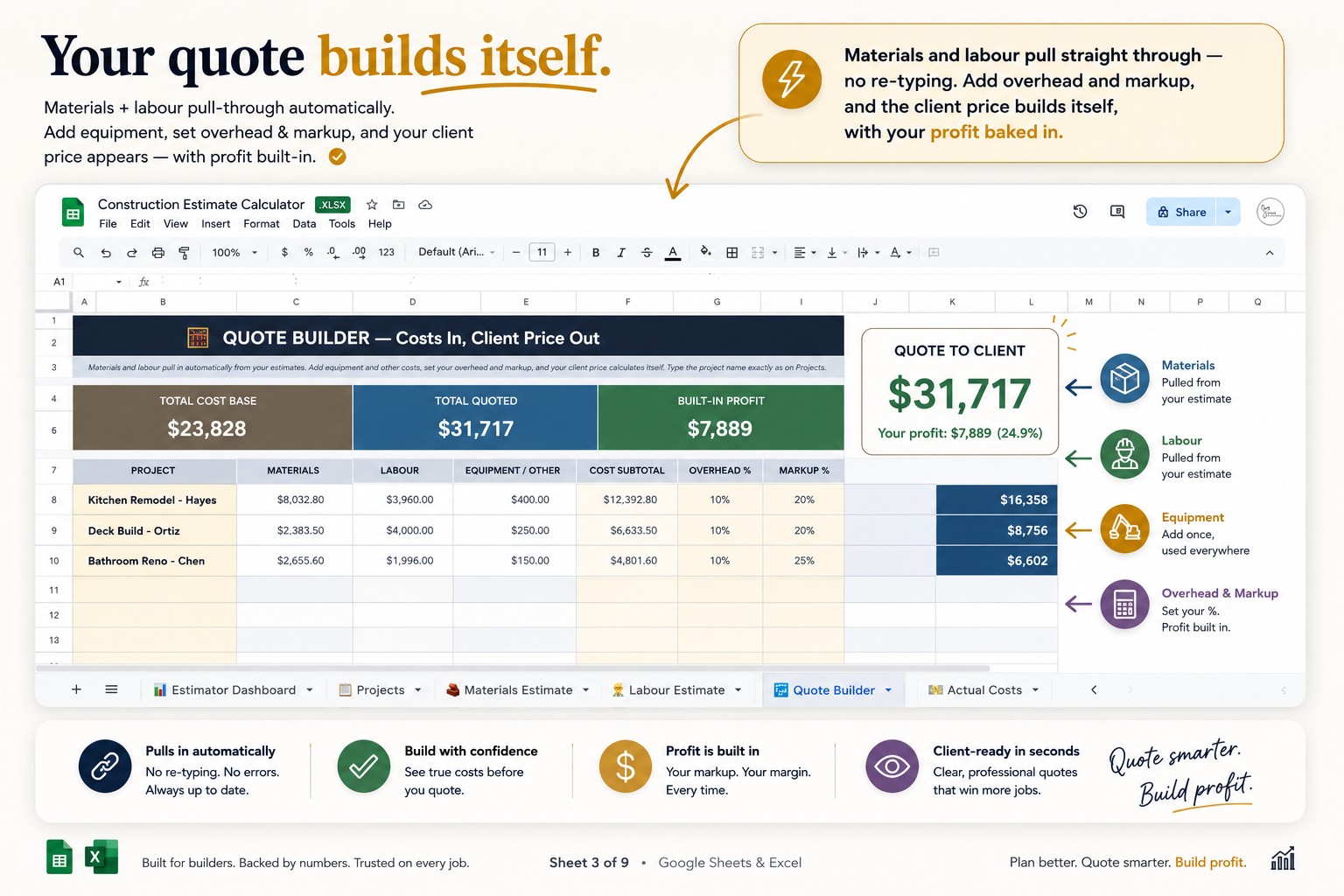
I built a construction estimate calculator in Google Sheets designed around exactly these four leaks — materials with a waste % allowance, honest labour costing, a quote builder that bakes in overhead and markup, and change-order tracking so extras get billed, plus a job-profit sheet showing quote versus actual and your real margin:
👉 Construction Estimate Calculator for Google Sheets & Excel
Whether you use mine or build your own, stop looking for where the money went on site — it went in the quote. Close the four leaks where they happen, and the busy year that left you with nothing becomes a busy year that actually pays. Price the job right, track every dollar, and know your real margin before the next quote, not after.
This reflects my own perspective and is an organising tool — not financial, tax, accounting, legal or professional construction advice, and it guarantees no result; verify pricing with your suppliers and comply with the requirements in your area. Contractors: which of the four leaks has cost you the most? Tell me in the comments.

