Your Sales Pipeline Is Lying to You
Adding up every open deal gives you a beautiful, useless number. Here’s how a weighted pipeline turns wishful thinking into a forecast you can plan around.
There’s a comforting ritual many freelancers and salespeople perform: adding up the value of every open opportunity and calling it “the pipeline.” It’s a wonderful number. It’s also, almost always, a fantasy — and planning your business around it is how you end up shocked when the money doesn’t arrive. The fix is a weighted pipeline, and it’s one of those small shifts in thinking that makes your forecast dramatically more honest and useful. Here’s how it works.
The comfortable lie of the raw pipeline
Here’s the problem with adding up all your open deals. That total treats a deal you’re about to sign and a deal you had one vague conversation about as exactly the same thing. Both go into the pot at full value. So a pipeline that’s mostly early-stage, long-shot opportunities looks identical to one full of near-certain closes.
That’s not a forecast; it’s a wish list with a dollar sign. And it’s dangerously seductive, because the number is big and it feels like evidence you’re doing well. People plan around it — their income, their spending, whether they need to do more prospecting — and then feel blindsided when only a fraction of it converts. The pipeline didn’t lie to them exactly. They just never asked it the right question.
Weighting: multiply by the odds
A weighted pipeline fixes this with one simple move: multiply each deal’s value by its likelihood of closing.
A $10,000 deal you think has a 50% chance of closing counts as $5,000. A $20,000 deal at 20% counts as $4,000. A $5,000 deal that’s basically agreed at 90% counts as $4,500. You add up the weighted values, and suddenly you have a number that reflects reality rather than hope.
The effect is clarifying, and often sobering. A raw pipeline that looked enormous can shrink dramatically once you weight it honestly — which is exactly the point. It’s better to know now that your realistic expected revenue is modest than to find out in three months when the deals didn’t land. And a weighted number is something you can actually plan around: it’s your genuine expectation, not your best-case fantasy.
Being honest about likelihood is the hard part
Of course, weighting only works if your probabilities are honest — and this is where people cheat, usually without noticing. It’s tempting to mark everything as “likely” because optimism feels good and a bigger weighted number is more comforting.
Resist that. The discipline of asking, honestly, “what are the odds this actually closes?” is uncomfortable but valuable. It forces you to think clearly about each opportunity: Have they actually got budget? Have they committed to anything? Am I talking to a decision-maker, or someone being polite? Often, simply assigning an honest probability reveals that a deal you’d been counting on is much shakier than you’d let yourself believe.
A useful anchor: tie probability to stage. Early conversations get low probabilities. Deals with a proposal out get moderate ones. Verbally agreed deals get high ones. That keeps you honest and consistent rather than assigning numbers by mood.
What the pipeline shape tells you
Beyond the total, there’s diagnostic value in seeing your deals by stage. That view tells you things a single number can’t:
- Where deals pile up. If everything is stuck at one stage, you have a specific problem to fix — proposals that don’t convert, or conversations that never progress.
- Whether you’re prospecting enough. A pipeline heavy on late-stage deals and light on early ones means good news now and a drought coming. That’s a warning worth having before it hits.
- Where deals go to die. Patterns in where opportunities stall show you exactly where your process is leaking.
A single pipeline number, even a weighted one, hides all this. Looking at the shape of your pipeline turns it from a score into a diagnostic tool.
An honest number beats a flattering one
The deeper point is that the purpose of a forecast is to help you make decisions — how hard to prospect, whether you can afford something, whether you need to worry. A flattering number that can’t be trusted is worse than useless for that; it’s actively misleading. An honest, weighted number, even when it’s smaller than you’d like, lets you act on reality: prospect harder now, before the gap becomes a crisis.
Everyone would rather look at the big number. The people who build stable businesses look at the honest one.
An important note
To be clear: weighting is a way of thinking about your pipeline, not a guarantee of anything. No forecasting method predicts the future, and a weighted pipeline is still an estimate built on your own judgment of probabilities. This is not business, sales, or financial advice — use it as a planning aid and apply your own judgment to your situation.
If you want it calculated for you
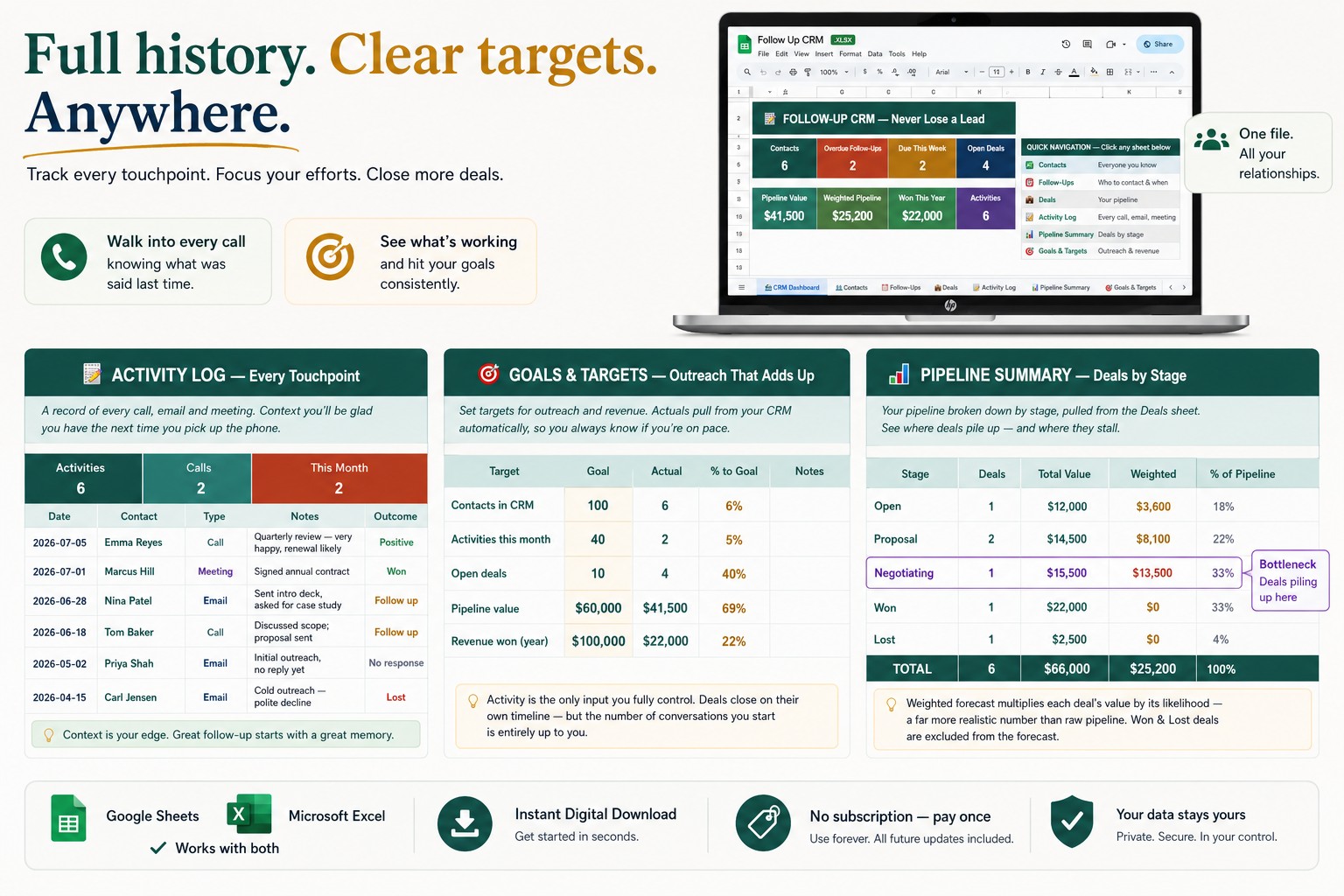
I built weighted forecasting into my follow-up CRM in Google Sheets — each deal’s value times its likelihood gives you a realistic pipeline number automatically (won and lost deals excluded), with a by-stage view so you can see where deals stall:
👉 Follow-Up CRM for Google Sheets & Excel
Whether you use a tool or a calculator, stop adding up your open deals and calling it a forecast. Weight them by honest probability, look at the shape of your pipeline, and plan your business on a number that tells you the truth. The comfortable number feels better; the honest one keeps you in business.
This reflects my own experience and is a planning tool — not business, sales or financial advice, and it guarantees no result. Forecasts are estimates. What probability do you assign a deal once the proposal is out? Tell me in the comments — I’d love to compare.