Most Deals Aren’t Lost to Rejection — They’re Lost to Silence
Nobody said no. You just never followed up. Here’s why sales follow up is where most opportunities quietly die, and how to make it actually happen.
When I lost work early in my freelance career, I used to assume it was because I’d been rejected — my pitch wasn’t good enough, my price was too high, someone else won. Then I went back through my old conversations and found something more uncomfortable. In most cases, nobody had ever said no. The conversation had simply… stopped. A proposal sat unanswered and I never chased it. A promising lead went quiet and I let it. A client I’d meant to check in with drifted away while I was busy. I hadn’t been rejected. I’d just gone silent, and so had they. That realization changed how I think about sales follow up entirely. Here’s what I learned.
Silence is the real killer
Here’s the uncomfortable truth about how opportunities die. Very few end in a clear, decisive “no.” Most just fade out. The prospect gets busy. Your proposal slips down their inbox. They meant to reply and forgot. You meant to chase and forgot. And gradually a live opportunity becomes a dead one, without either party ever making a decision.
The good news hidden in that is enormous: these aren’t losses to a competitor or a rejection of your value. They’re losses to inertia — which means they’re often entirely recoverable, if someone just picks the conversation back up. Most of the time, that someone has to be you. The prospect who went quiet isn’t offended; they’re just busy, and their silence means nothing more than that. Reading silence as rejection is one of the most expensive mistakes a freelancer or salesperson can make.
Why we don’t follow up
If following up is so valuable, why is everyone so bad at it? A few reasons, and it’s worth being honest about them:
- We forget. With multiple conversations at different stages, keeping track of who needs what and when — in your head — is impossible. Things simply fall through the cracks.
- We read silence as rejection. “They haven’t replied, so they must not be interested.” Usually wrong, but it feels true, and it gives us an excuse not to chase.
- We feel like a pest. Nobody wants to be the annoying person who keeps emailing. So we hold back — often far more than the prospect would find annoying.
The first reason is the biggest, and it’s the easiest to fix. Most missed follow-ups aren’t a choice not to follow up; they’re a failure to remember to. And forgetting is a systems problem, not a character flaw.
The fix: every contact gets a next step
The single most valuable habit I’ve adopted is this: every conversation ends with a scheduled next step.
Not “I’ll follow up sometime.” An actual next action with an actual date. Sent a proposal? The next step is checking in on a specific day. Had a good call? The next step is a follow-up with a date. Client went quiet? The next step is a check-in, scheduled.
When every contact has a booked next step, nothing can fall through the cracks — because nothing is left to memory. Your follow-ups become a list of dated commitments rather than a vague sense that you should probably chase some people. And when those dates arrive and something flags as overdue, you have a daily to-do list that writes itself: here’s exactly who to contact today.
That’s the whole system. It’s not clever, and it doesn’t need to be. Most follow-up failures are just forgetting, so a system that removes the forgetting solves most of the problem.
Watch who’s going cold
The other signal worth tracking is time since last contact. Relationships decay quietly. A client you haven’t spoken to in months isn’t lost yet — but they’re drifting. And you’d never notice, because nothing happens when a relationship goes cold. There’s no alert, no event; just a slow fade.
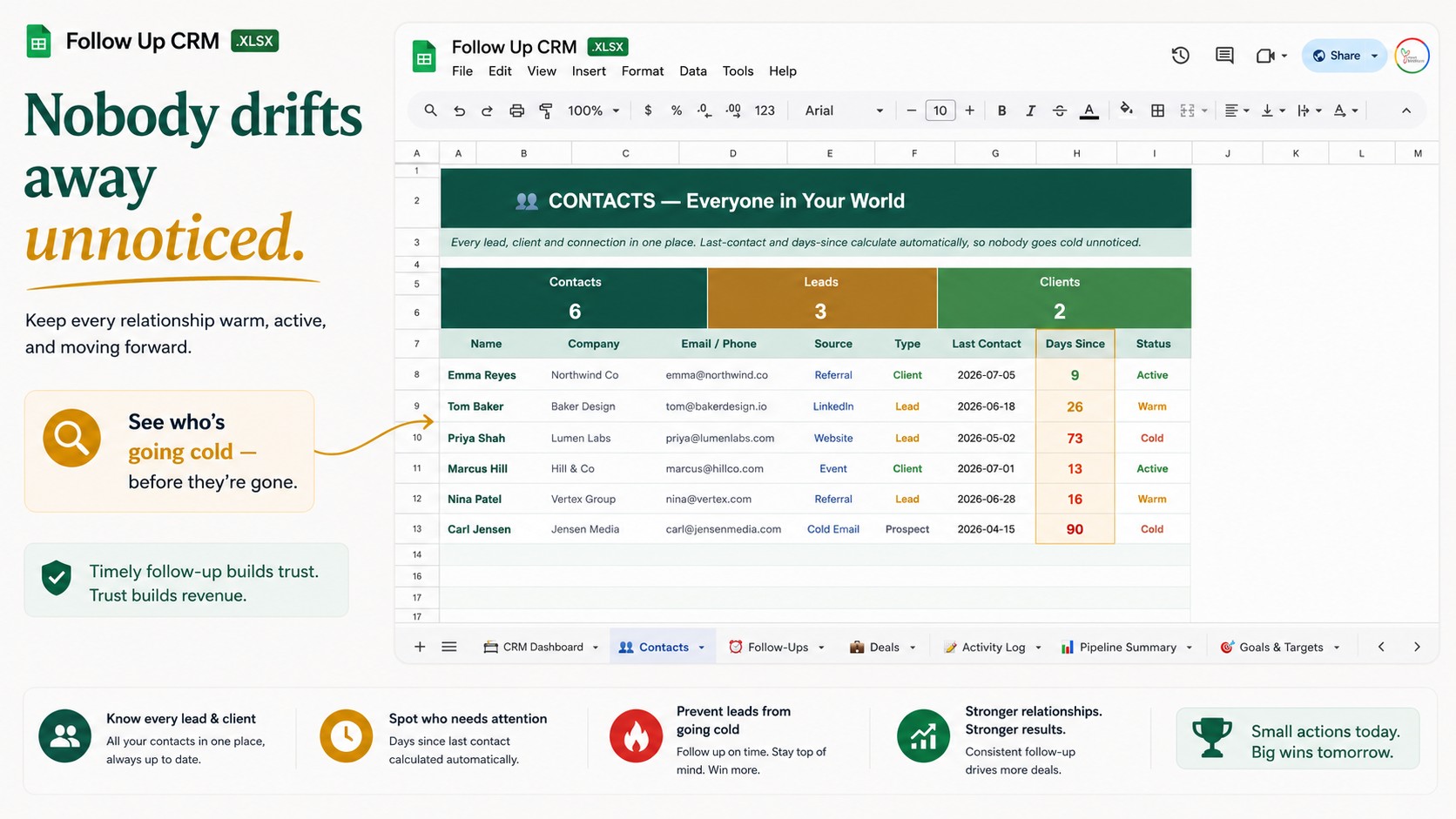
When you can see how long it’s been since you last spoke to each contact, the people quietly drifting away become impossible to miss. That visibility lets you reach out before they’re gone, rather than realizing months later that a good relationship went stale through pure neglect. Some of the easiest work you’ll ever win is from a warm contact you simply reconnected with in time.
Persistence, done respectfully
One honest note, because there’s a line here. Following up is not the same as hounding people. The goal is respectful persistence: helpful, spaced-out check-ins that add value or simply and politely ask where things stand — not a barrage of emails. And when someone does say no, or asks you to stop, respect that fully.
There’s also a legal and ethical dimension when you’re storing other people’s contact details and reaching out to them: make sure you’re complying with the privacy and anti-spam rules that apply to you (things like GDPR or CAN-SPAM, depending on where you and your contacts are). Good follow-up is a relationship practice, not a spam practice. Handle people’s data respectfully and lawfully.
If you want a system that remembers for you
I built a simple follow-up CRM in Google Sheets around exactly this — book a next step for every contact, and it flags who’s overdue, due soon, or upcoming, with days-since-last-contact so nobody goes cold, plus deals, activity history, and goals:
👉 Follow-Up CRM for Google Sheets & Excel
Whether you use mine or a notebook, start booking a next step for every conversation. Most of the work you’re “losing” isn’t lost to rejection — it’s sitting quietly in a silence that nobody has broken. Be the one who breaks it, politely and on schedule, and you’ll be astonished how much of it comes back.
This reflects my own experience and is an organizing tool — not business, sales, legal or financial advice, and it guarantees no result. When storing other people’s contact details, comply with the privacy and anti-spam laws that apply to you. What’s a deal you won simply by following up? Tell me in the comments.