Unstructured Interviews Reward Charisma, Not Competence
A free-flowing chat feels like good judgment. It’s usually just a charisma contest. Here’s why the structured interview changed how I hire.
I used to be proud of my interviewing. I’d have a relaxed, free-flowing conversation with a candidate, ask whatever felt right in the moment, and leave with a clear “gut feeling” about them. It felt like judgment, insight, an eye for talent. Then I looked honestly at who I’d hired that way — and noticed an uncomfortable pattern. I’d been consistently choosing the people who were most comfortable in an interview: the confident, the polished, the charming. Which is not at all the same thing as the people who’d be best at the job. Adopting a structured interview approach, with actual scorecards, fixed that. Here’s what I learned.
What an unstructured interview actually measures
Here’s the problem with the free-flowing chat. When every candidate gets a different conversation, with different questions, evaluated against nothing in particular, you’re not really assessing their ability to do the job. You’re assessing their ability to have a good conversation with you.
And that skill — being charming, confident, and quick on your feet in a high-pressure social situation — correlates with success in a small number of roles and is largely irrelevant to most. Meanwhile, the quieter candidate who’d be brilliant at the actual work but is nervous in interviews scores badly. You end up systematically selecting for interview performance rather than job performance. The “gut feeling” you’re so confident about is largely a measurement of charisma.
Worse, unstructured interviews are where bias flourishes. When there are no defined criteria, your evaluation drifts toward whoever feels familiar, likeable, or “a good fit” — vague notions that are notoriously vulnerable to unconscious bias. Without structure, you can’t even tell yourself why you preferred someone, which means you can’t check whether the reason was legitimate.
The fix: decide what matters BEFORE you interview
The core of a structured interview is beautifully simple: define the criteria you’re evaluating before you meet anyone.
What competencies actually matter for this role? What does good look like? Which of those criteria matter most? Deciding this in advance — before any candidate walks in and starts charming you — means you’re evaluating against the job, not against your in-the-moment impressions. It anchors your judgment to something real.
This is more powerful than it sounds. Once you’ve written down “these are the five things that matter for this role, and this one matters most,” you’ve protected yourself from the drift toward “I just liked them.” The criteria hold you accountable to what the job actually requires.
Score every candidate on the same things
The second half is consistency: ask every candidate about the same criteria, and rate them on the same scale. When everyone is scored on the same dimensions, you can actually compare them. When each interview was a different conversation, you can’t — you’re comparing vague impressions, which is how the most charming person wins by default.
Using a defined rating scale (with a clear sense of what each score means) matters too, so that a “4” from one interviewer means roughly the same as a “4” from another. Without that, even a scored process degrades into inconsistent noise.
The result is that a quieter candidate who demonstrates strong evidence on the criteria that matter can score above a charming one who doesn’t — which, in most roles, is exactly the right outcome. Structure gives the substance a chance to beat the style.
Weighting: not everything counts equally
One refinement that made a real difference: weighting. Not every criterion matters equally for every role. For one job, technical depth might be paramount; for another, communication might matter more. Weighting your criteria — so the important things count more toward the overall score — means your evaluation reflects the actual shape of the role rather than treating everything as equal.
This also forces a healthy conversation before you hire: what do we really need in this role? Getting a hiring panel to agree on the weights, up front, surfaces disagreements early — when they’re cheap to resolve — instead of during a messy debate about the final candidate.
Structure supports judgment; it doesn’t replace it
An important clarification, because “scorecard” can sound mechanical. Structured interviewing doesn’t mean handing your decision to a spreadsheet or hiring purely by number. Human judgment still matters enormously — you’re still evaluating people, weighing evidence, and thinking hard.
What structure does is make your judgment fairer and more accurate by anchoring it to the job and applying it consistently to everyone. The score isn’t the decision; it’s evidence that informs the decision, and a record of your reasoning. The best hiring uses structure to discipline judgment, not to abolish it.
A necessary note on fairness and the law
I have to be clear about this: hiring is a legally and ethically serious area. A scorecard helps you structure and record your evaluations, and structure genuinely helps reduce bias — but a tool is not a guarantee of fairness, and it is not legal, HR, or employment advice. The fairness and legal compliance of your hiring process are your responsibility. Make sure your criteria are genuinely job-related, ensure your process complies with the employment and equal-opportunity laws that apply to you, and consult a qualified professional where needed.
If you want a scorecard ready to go
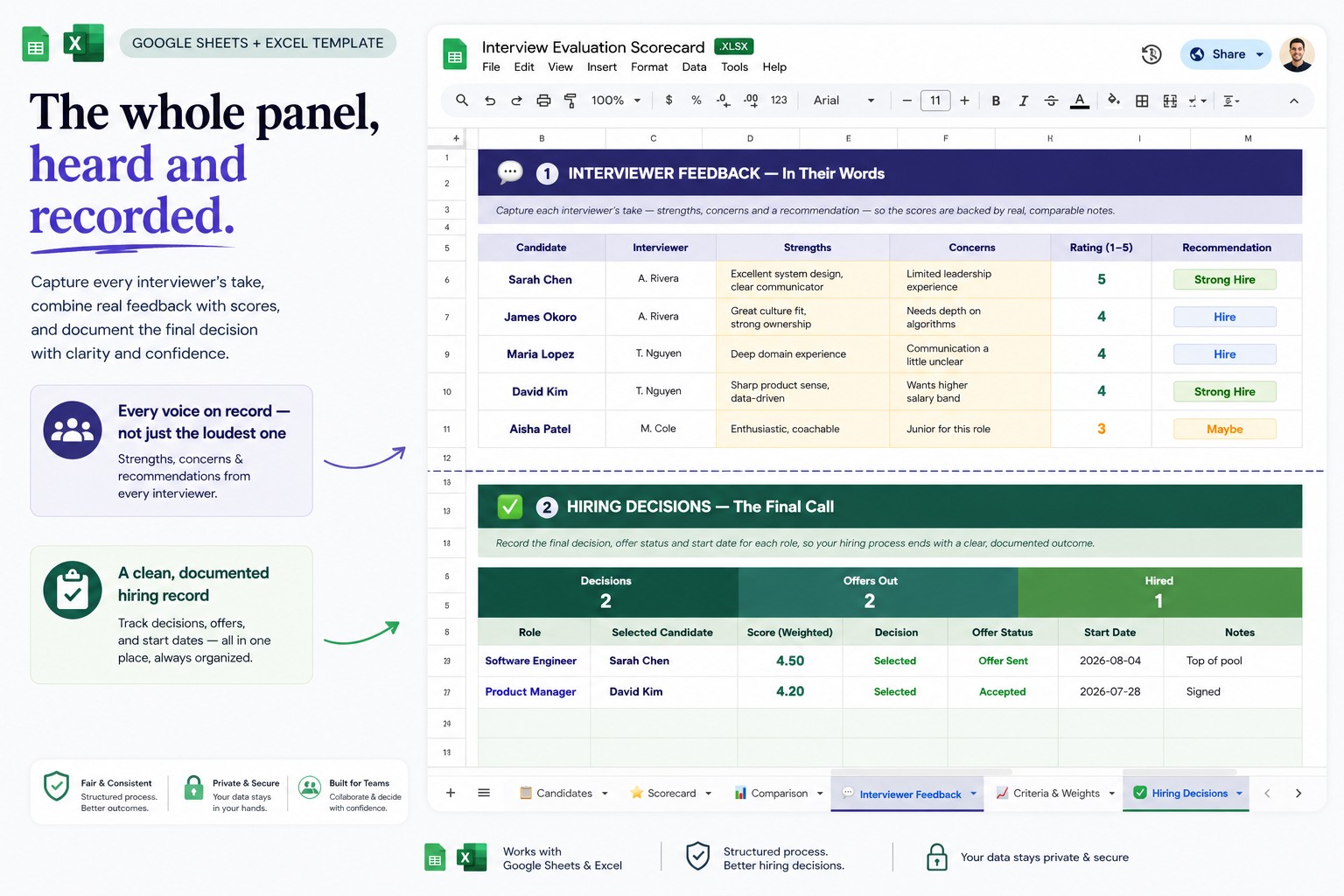
I built an interview scorecard in Google Sheets to do exactly this — define your criteria and weights, rate each candidate 1–5, and get a weighted score and recommendation automatically, with a built-in rating scale and bias-aware guidance:
👉 Interview Evaluation Scorecard for Google Sheets & Excel
Whether you use mine or build your own, stop interviewing on vibes. Decide what matters before you meet anyone, score everyone on the same criteria, and let evidence — not charisma — drive your decision. Your hiring will get fairer, more consistent, and considerably better. And the brilliant, quiet candidate you’d have overlooked will finally get a fair shot.
This reflects my own experience and is a structuring tool — not legal, HR or employment advice. The fairness and legal compliance of your hiring process are your responsibility; consult a qualified professional. What’s the best hire you almost passed on? Tell me in the comments.