Most Business Goals Die in a Notebook — Here’s How Mine Finally Stuck
You set them in January, feel great for a week, and never look again. Here’s why business goal setting fails, and the simple system that turned my goals into done.
Every year, the same ritual. I’d sit down with fresh energy, set ambitious goals for my business, write them down, and feel genuinely excited. Then a week or two would pass, the daily grind would take over, and those goals would quietly disappear into a notebook I never opened again. Come December, I’d rediscover them and realize I’d barely touched most of them — not because they were bad goals, but because I’d stopped looking at them by February. If that cycle sounds familiar, you’re in the vast majority. The problem isn’t your goals or your discipline; it’s the system, or lack of one. Here’s what I learned about business goal setting that finally made my goals stick and actually get done.
Why goals die in the notebook
The core reason most business goals fail is beautifully simple: they become invisible. You set them once, then they vanish from your day-to-day attention. Out of sight, out of mind. A goal you’re not looking at regularly has almost no influence on your behavior — it’s just a nice thought you had once. The notebook (or the doc, or the whiteboard you stop noticing) becomes a graveyard for good intentions.
This is why “set goals at the start of the year” as standalone advice basically doesn’t work. Setting the goal is the easy, fun part. Keeping it alive — visible, measured, and influencing your decisions all year — is the hard part that nobody talks about. The gap between setting a goal and achieving it isn’t usually a gap of ambition or ability. It’s a gap of attention. And attention is a system problem, not a willpower problem.
The fix: keep goals visible and measurable
What changed everything for me was moving my goals somewhere I’d actually see them regularly, in a form that showed me whether I was making progress. Not a notebook I’d close, but a living dashboard I’d return to. That single shift — from a one-time written list to a maintained, visible system — is what turned my goals from wishes into things that actually got done.
Two elements make this work. First, visibility: the goals live somewhere you return to, so they stay in your consciousness and keep influencing your decisions all year, not just in January. Second, measurability: you can see your progress toward each goal, which is both motivating and diagnostic. A goal you can measure is a goal you can manage; a goal you can’t measure is just a hope.
Progress you can see keeps you going
Here’s the psychological key. When you can see your progress toward a goal — a bar filling, a percentage climbing — something powerful happens. Progress is motivating. Watching yourself get closer to a goal makes you want to keep pushing; it creates momentum. Conversely, when you can’t see progress, goals feel abstract and effort feels pointless, so you drift away from them.
The best goal systems make progress visible automatically. You enter where you are, and the system shows you how far you’ve come and how far’s left. That turns a vague “am I even making progress?” into a clear “I’m 60% there — keep going.” Seeing the number move is what sustains effort over the long months between setting a goal and reaching it.
Status flags catch problems early
Beyond raw progress, the thing that transformed my goal-tracking was status. Not just “how far along am I,” but “am I on track, or falling behind?” A goal might be at 40% — but is that good or bad? It depends on where you should be by now. A system that flags each goal as on track, at risk, or behind tells you which goals need attention, before it’s too late to do anything.
This early warning is invaluable. Most goals aren’t missed dramatically; they’re missed by slowly falling behind, unnoticed, until it’s too late to recover. When a goal gets flagged “at risk” in, say, Q2, you have time to course-correct — put in more effort, adjust the target, or change your approach. Without that flag, you discover the miss in December, when it’s a fait accompli. Catching slips early is the difference between adjusting and failing.
Review, adjust, keep going
The final piece is regular review. Goals shouldn’t be static things you set and forget or rigid commitments you can never change. The healthiest approach is to revisit them regularly — celebrate wins, acknowledge blockers, and adjust course. Business changes over a year; goals should be able to flex with reality while still keeping you pointed in the right direction. A rhythm of review keeps your goals alive and relevant, rather than becoming outdated wishes you feel guilty about.
An honest note
One caveat, because I don’t want to oversell it: a goal system is a tool for staying focused and tracking progress — it doesn’t guarantee results, and it’s not business or financial advice. Achieving business goals still takes the actual work, good judgement, and often factors outside your control. The system keeps your goals visible and measurable so you give yourself the best chance; it doesn’t do the work for you or promise an outcome. Use it to stay on track, and consult a qualified professional for important business decisions.
If you want a system ready to go
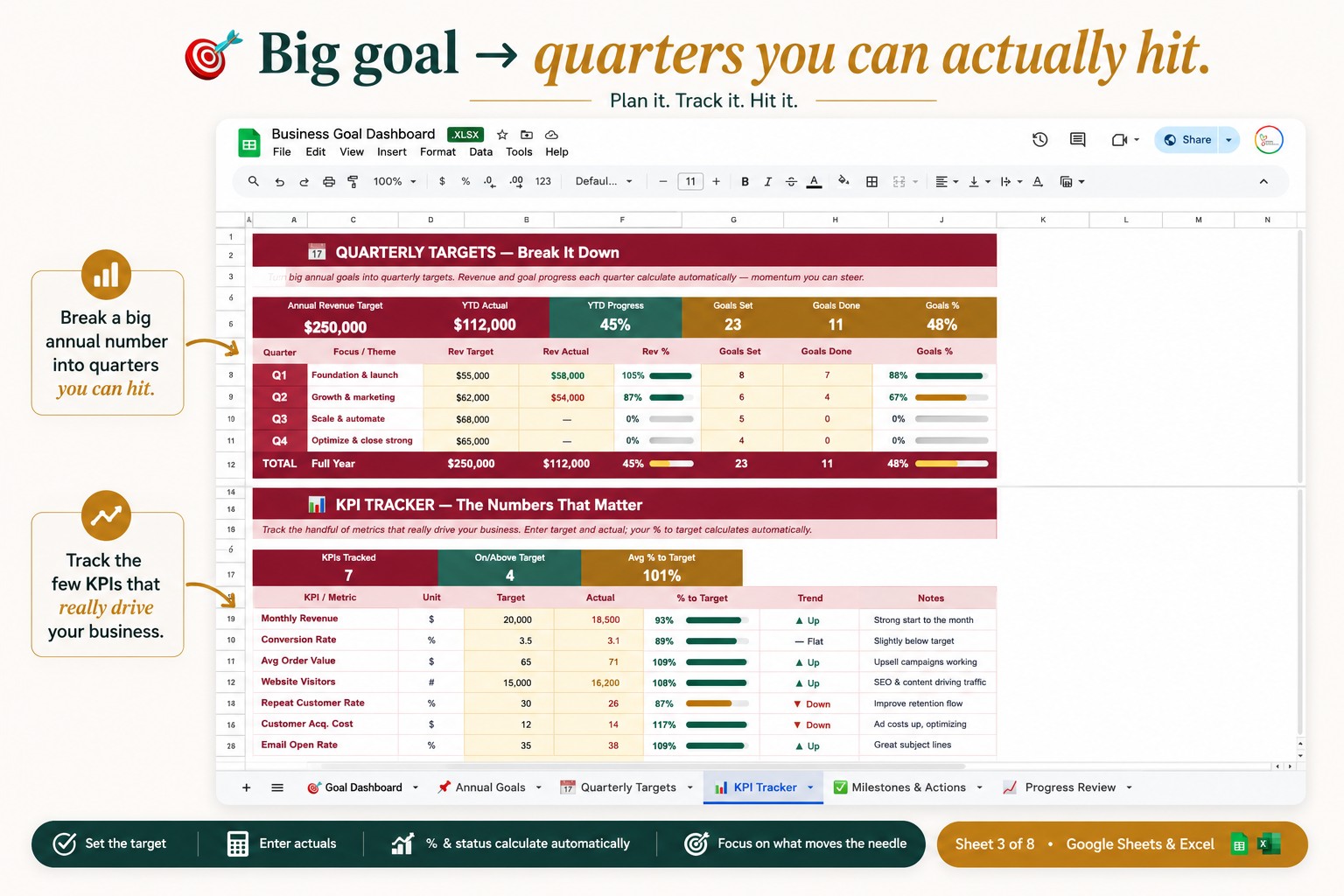
I built a business goal dashboard in Google Sheets to do exactly this — set your goals and watch progress and status update automatically, break them into quarters, track your key KPIs, and turn goals into action steps with deadlines, all on one visible page:
👉 Business Goal Dashboard for Google Sheets & Excel
Whether you use mine or build your own, get your business goals out of the notebook and into a living system you’ll actually see. The goals themselves were never the problem — keeping them visible, measurable, and reviewed is what turns another year of good intentions into the year you actually planned. Make this one stick.
This reflects my own experience and is a planning tool — not business, financial or legal advice, and it doesn’t guarantee results. Use your own judgement and consult a professional for important decisions. What business goal do you most want to make stick this year? Tell me in the comments — naming it publicly helps.