A daily report is only as good as what’s in it. Here’s exactly what goes into my construction site documentation — and why each piece matters.
I’m a believer in daily site reports — I’ve seen them settle disputes and protect margins. But “keep a daily log” is useless advice without specifics. A daily report full of the wrong things, or missing the things that matter, won’t help you when it counts. After years of refining my construction site documentation, here’s exactly what I log every working day, and why each item earns its place. If you’re going to spend five minutes a day on a record, these are the five minutes that pay off.
The daily essentials: weather, crew, work, status
The backbone of any daily report is four things, captured every single day:
- Weather. This seems minor until you’re in a weather-delay claim. A dated record of the actual conditions — rain, heat, wind, whatever stopped or slowed work — is direct evidence for weather-related delays. Log it daily, even on clear days, because the clear-day records are what make the bad-weather records credible.
- Crew on site. Who was actually working, and how many. This establishes what resources you had deployed, which matters for productivity disputes and for proving you staffed the job as agreed.
- Work completed. A plain description of what actually got done that day. This is the heart of the record — the dated story of the project’s real progress, which becomes invaluable when anyone questions the timeline.
- Status and any delays. Whether the day went to plan, and if not, what held things up. This is where you flag, in real time, anything that went wrong.
These four, logged daily, create the unbroken narrative spine of the project. Everything else hangs off them.
Labor and equipment: the resource record
Beyond the daily summary, I log labor and equipment in detail, because these are where money and disputes concentrate.
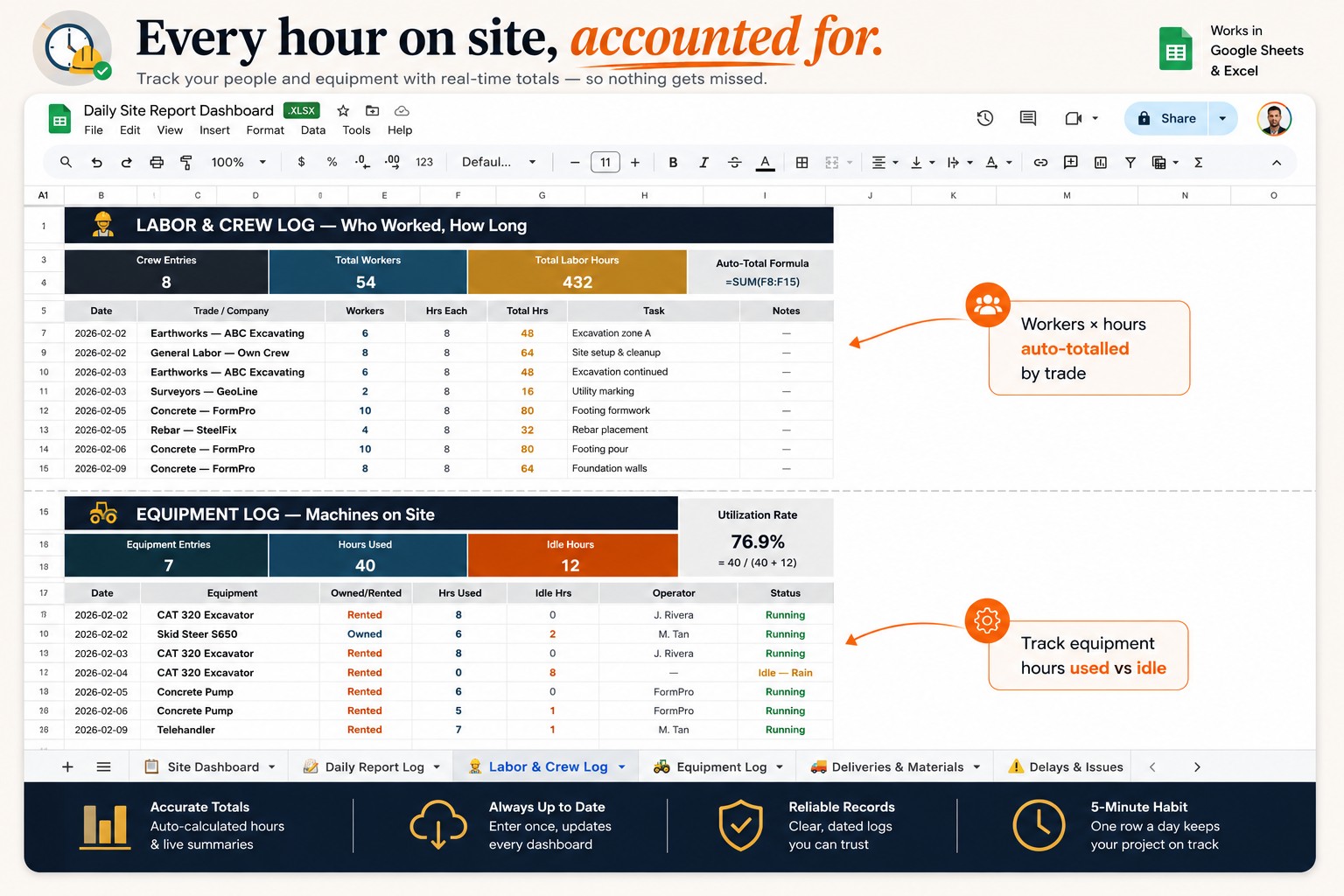
For labor, I record each trade and sub, the number of workers, and their hours — which totals automatically into labor hours by trade. This matters for two reasons: it proves how you resourced the job, and it’s the raw data behind productivity and delay analysis. If someone later claims you under-staffed, your labor log answers them.
For equipment, I log what machines were on site, hours used versus idle, and whether they’re owned or rented. Idle equipment is expensive, and idle-time records support claims when another party’s delay left your machines sitting. Equipment logs turn “we lost money waiting” into a documented, quantified fact.
Deliveries and the delay-and-issue record
Two more logs round out a complete daily record:
Deliveries and materials. Every delivery — supplier, quantity, PO number, received or pending. Late or missing materials are a classic source of delay, and a delivery log proves exactly when materials arrived (or didn’t), shifting responsibility for the resulting delay where it belongs.
Delays and issues. This is the most important entry on any bad day. The moment something goes wrong, I document it: the cause, the impact, the days lost, and how it was resolved. Logging this the same day, while the facts are fresh and before anyone’s lawyered up, is what makes it powerful. A delay you documented in real time is evidence; a delay you remembered later is just a story.
Don’t skip the safety log
The piece contractors most often leave out of a daily record is safety — and it’s a mistake. A safety log of toolbox talks, observations, near misses, incidents and inspections does double duty. It demonstrates a genuine safety program (which matters for compliance and, frankly, for keeping people safe), and it creates a record that protects you if an incident is ever questioned. Documented toolbox talks and inspections show you took your obligations seriously. In a serious dispute or investigation, that record is worth a great deal.
The principle behind all of it: capture it the day it happens
Notice the thread running through everything: capture it the same day. The value of every one of these records comes from being contemporaneous — written when it happened, not reconstructed later. That’s the discipline that turns a daily log from busywork into protection. Log the same things, every working day, the day they happen, and you build a record that speaks for you when memory can’t.
If you want it all in one system
I built my daily site reporting system in Google Sheets to capture exactly these — a daily report log plus dedicated tabs for labor, equipment, deliveries, delays and safety, all rolling up to a live dashboard, with a ready-made daily report template to copy and adapt:
👉 Daily Site Report Dashboard for Google Sheets & Excel
Whether you use mine or build your own, log these things every working day. A daily report is only as strong as what goes into it — and these are the entries that turn a routine habit into the documentation that protects your project, your timeline, and your margins.
This reflects general industry experience and is an editable record-keeping template — not legal or safety advice. It doesn’t replace your contract, safety program or insurance requirements; always follow your company’s and jurisdiction’s rules. What’s the one thing you always log that others forget? Share it in the comments.