The question that changed how I make decisions: Most people ask “what will happen?” Second-order thinkers ask “and then what?” That single additional question — applied consistently — is the difference between decisions that look smart immediately and decisions that are smart over time.
The decision that looked brilliant — until it wasn’t
A few years ago, I was running a small content project and needed to grow an audience quickly. The obvious answer was to post more frequently — daily content, consistent output, maximum volume. This was the advice everywhere I looked, and it made intuitive sense.
So I doubled my publishing frequency. Immediately, traffic went up. New followers arrived. Engagement numbers climbed. For about six weeks, the decision looked like exactly the right call.
Then the second-order effects arrived.
The quality of each piece dropped as I spread my research time thinner. The audience I attracted with high-volume output had different expectations than the audience I was trying to build. My best existing readers — the ones who had come for depth — began to disengage. And I burned out at a pace that meant I eventually published nothing for three months.
The first-order outcome — more posts, more traffic — was real. The second-order outcome — lower quality, wrong audience, burnout — dismantled everything the first order had built.
This is what second-order thinking is designed to catch: the consequences of the consequences that first-order thinking misses.
Read also: How I Upgraded My Thinking with Adler’s 4 Levels of Reading
What second-order thinking actually means
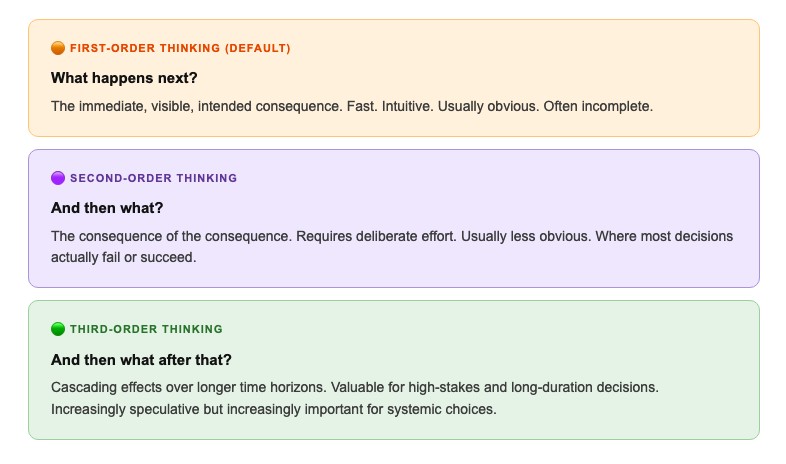
Every decision produces outcomes. Those outcomes are the first order. But those outcomes then create conditions that produce further outcomes — the second order. And those produce further outcomes still — the third order and beyond.
First-order thinking stops at the immediate, visible, intended consequence. Second-order thinking asks: given that this happens, what happens next? Third-order thinking goes one step further: given that, then what?
Howard Marks and the edge of thinking differently
The most articulate modern articulation of second-order thinking comes from Howard Marks, the co-founder of Oaktree Capital Management and one of the most respected voices in institutional investing. In his influential memo series and his book The Most Important Thing, Marks describes what he calls “second-level thinking” as the primary source of genuine investment edge.
“First-level thinking says, ‘It’s a good company; let’s buy the stock.’ Second-level thinking says, ‘It’s a good company, but everyone thinks it’s a great company, and it’s not. So the stock’s overrated and overpriced; let’s sell.'”— Howard Marks, The Most Important Thing
Marks’s insight is that in competitive environments — financial markets, business strategy, hiring — everyone is doing first-order thinking. If your analysis is the same as everyone else’s, your results will be average at best. The edge comes from seeing what others don’t — specifically, the second and third-order consequences that first-order consensus misses.
This applies far beyond investing. In any domain where decisions are competitive or where effects unfold over time, the ability to think one order further than the default is a genuine and durable advantage.
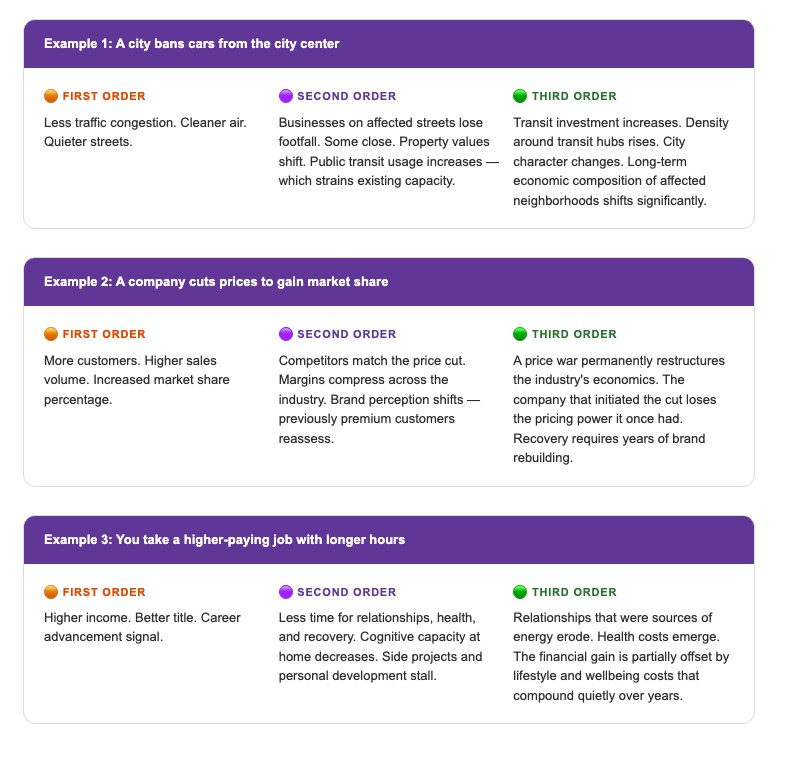
Real-world examples across business, finance, and life
Why first-order thinking is so hard to escape
If second-order thinking is so powerful, why isn’t it the default? There are three reasons, and understanding them helps explain why the bias toward first-order thinking is so persistent.
The immediate is more vivid than the downstream
The first-order consequence is concrete and often fast. The second-order consequence is abstract and often slow. Human attention is strongly biased toward what is vivid and immediate — which means the downstream effects are systematically underweighted in real-time decisions.
Second-order thinking is cognitively expensive
Genuinely tracing the downstream effects of a decision requires sustained mental effort. It is slow, effortful, and often produces uncomfortable conclusions that complicate decisions we’d rather make quickly. The path of least resistance is to stop at the first order and call it analysis.
We are rewarded for visible first-order wins
In most organizations, careers, and social environments, the first-order outcome is what gets noticed and rewarded. The second-order consequence — which may arrive months or years later, in a different department, or in a domain not obviously connected — is rarely attributed to the original decision. This misattribution creates incentives to optimize for first-order optics rather than second-order reality.
Read also: How I Learned to Solve Complex Problems in a Non-Linear World
A practical framework for thinking in orders
Here is the process I use to apply second-order thinking to any significant decision:
- State the decision and its first-order outcome clearlyWrite down exactly what you’re deciding, and what the most obvious immediate consequence is. Be specific. “If I do X, then Y happens” — no vagueness.
- Ask “and then what?” at least twiceGiven Y happens — what does that create or change? Write the answer. Then ask again: given that — what follows from there? You are building a consequence chain, not just a single step.
- Identify who else is affected and how they will respondMost decisions happen in systems with other actors. Competitors, colleagues, customers, partners. What do they do in response to your first-order action? Their response is a second-order effect you must account for.
- Look at the time dimension — what does this look like in 1 month, 1 year, 10 years?Second-order effects are often slow. A decision that is clearly good at 30 days may be clearly bad at 3 years. Map the consequence chain across different time horizons explicitly.
- Weight the orders by the stakes involvedFor low-stakes reversible decisions, first-order thinking is usually sufficient. Reserve second and third-order analysis for decisions that are high-stakes, irreversible, or have long time horizons. Not every choice requires a full consequence map.
The limits of second-order thinking
Second-order thinking is powerful but not unlimited. Three limits are worth understanding clearly.
Complexity compounds quickly. By the time you reach the fourth or fifth order, the consequence chains have branched so many times that meaningful analysis becomes impossible. The practical horizon for most decisions is second-order, occasionally third. Beyond that, you are forecasting, not reasoning.
It can produce paralysis. If applied to every decision, second-order thinking becomes a tool for infinite deferral — there is always one more consequence to consider. The discipline is knowing which decisions warrant the effort and committing to a decision when you’ve done sufficient analysis, even under residual uncertainty.
Your second-order predictions can be wrong. Thinking further ahead doesn’t guarantee accuracy. The value of second-order thinking is not that it produces correct predictions — it is that it surfaces risks and possibilities that first-order thinking ignores. You may be wrong about the downstream effects, but you are more likely to have considered them than someone who didn’t ask the question.
Conclusion: the question that separates good decisions from great ones
The content project failure I described at the start of this article cost me several months and a portion of the audience I had built. The second-order effects — lower quality, wrong audience, burnout — were predictable in retrospect. They might have been predictable in advance if I had asked the right question before acting.
That question is not “what will this achieve?” It is “what will this achieve, and then what will that create?”
The addition of three words — and then what — is the difference between first-order and second-order thinking. It is also, in decisions that matter, frequently the difference between outcomes that look smart and outcomes that are smart.
Practice this week
Pick one significant decision you are currently facing. Write the first-order outcome. Then ask “and then what?” twice. Write those answers too.
Compare what the full consequence chain looks like vs. what you were seeing before you asked the question. In my experience, something worth reconsidering appears in that comparison more often than not.