


The embarrassing truth: For years I read 20–30 books a year and could barely recall what any of them said three months later. I was consuming knowledge at volume while retaining almost none of it. This is the system I built — in stages, through failure — that finally changed the ratio. It is not complicated. But it requires doing a few things that feel counterintuitive at first.
The reading problem nobody talks about
At some point in my late twenties, I became the kind of person who read a lot of books. I tracked them in a spreadsheet. I recommended them to friends. I felt genuinely good about being a “reader.” It was part of how I thought about myself.
Then, at a dinner party, a friend asked me to explain the central argument of a book I had enthusiastically recommended to her just two months earlier.
I could not do it.
I remembered liking the book. I remembered that it was about decision-making, or behavior, or something related to psychology. I could recall the author’s name and the cover. I could not reconstruct a single coherent idea from it with any confidence.
This was not an isolated incident. It was the rule. I finished books, marked them as read, and watched the ideas leak out within weeks — sometimes days. I was not building knowledge. I was building the feeling of having built knowledge, which is an entirely different and considerably less useful thing.
It took me another two years of frustration, experimentation, and one genuinely revelatory encounter with the science of memory to understand what I was doing wrong — and to build the system that finally fixed it.
Read also: How I Learned to Solve Complex Problems in a Non-Linear World
What I was doing wrong — and the moment I realized it
The diagnosis, when it finally came, was not flattering. I was making the same three mistakes that most avid readers make, and I was making all of them simultaneously.
Mistake one: I was reading passively. I moved my eyes across the page and called it learning. I was absorbing words without generating any mental friction — no predictions, no challenges, no connections to what I already knew. Passive reading produces the feeling of understanding without the neural encoding that creates actual memory.
Mistake two: I was optimizing for quantity over depth. Finishing a book felt like an accomplishment. It produced a small dopamine hit. So I read quickly, moved on, and started the next one — treating books the way you might binge a television series rather than the way you’d study a discipline. I was maximizing throughput and minimizing retention.
Mistake three: I had no system for what happened after the last page. When I finished a book, that was it. The ideas went back to wherever ideas go when you don’t do anything with them — which, as it turns out, is mostly into the void.
The moment of reckoning came when I spent four months reading everything I could find about decision-making frameworks — and then sat down to apply those frameworks to an actual decision in my life and realized I couldn’t name a single one without consulting my reading list to remember what I’d read.
I had spent hundreds of hours and significant money acquiring knowledge that had essentially not stayed with me. That was not a reading problem. That was a system problem.
The science of why we forget everything we read
Before I describe the system, it helps to understand the mechanism. Because once you understand why forgetting happens, the solution becomes obvious.
In the 1880s, German psychologist Hermann Ebbinghaus conducted the first systematic experiments on human memory. His most influential discovery is now called the Forgetting Curve: a mathematical description of how quickly newly learned information decays if no attempt is made to reinforce it.
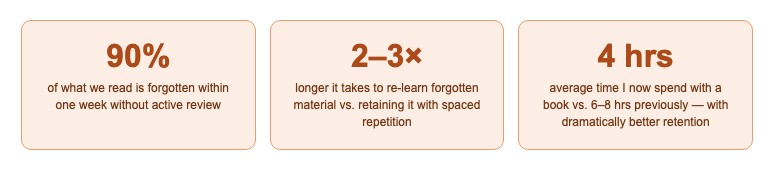
The curve is steep. Without any review, we lose approximately 50% of new information within an hour. Within a week, we retain only about 10–20%. The information does not disappear — it is encoded in long-term memory in a degraded form that makes it increasingly difficult to retrieve. The experience of “knowing I read something about this” without being able to recall the content is exactly this phenomenon.
“The spacing effect is one of the most replicable findings in cognitive psychology. Distributing study over time produces substantially better long-term retention than massing it.”— Nate Kornell & Robert Bjork, UCLA Memory Research Group
The solution Ebbinghaus identified — and which over a century of subsequent research has confirmed — is spaced repetition: reviewing material at increasing intervals over time. The first review shortly after learning. A second review a few days later. A third review a week after that. Each review resets the forgetting curve and deepens the neural encoding.
What this means practically: the problem with my reading habit was not that I was reading the wrong books or reading without intelligence. It was that I was treating a single read-through as the complete learning event — when it is, at best, the first 20% of the learning process.
Read also: How Small Actions Trigger Massive Change
Phase 1: How I read differently now — active reading
The first change I made was to how I read, before any system existed. I stopped reading passively and started reading actively — which sounds vague until I explain exactly what I changed.
The three-question method
Before I open any nonfiction book now, I spend five minutes writing answers to three questions in a small notebook I keep with every book I read:
What do I already believe about this topic? Articulating prior beliefs creates a framework that new information can attach to — and it surfaces assumptions I might otherwise not notice being challenged.
What am I specifically trying to learn or decide from this book? Reading with a question in mind produces dramatically better retention than reading without one. The brain is selective — it encodes information that feels relevant to a current goal far more deeply than information consumed without context.
How might this change something I currently think or do? This primes my reading for application — the most powerful driver of long-term retention.
Margin notes and the one rule that changed everything
I now write in every book I own. If you are someone who finds this sacrilegious, I understand — I used to be the same. I have since become completely converted.
But the specific kind of writing matters. For years I underlined sentences and called it active reading. Underlining is passive. It selects information without processing it. What works is writing, in the margin, why a passage matters — in your own words, as if explaining it to someone.
This single shift — from underlining to marginal explanation — produced the single largest improvement in my retention before I changed anything else about my system. The act of translation from the author’s language to your own is where the encoding happens.
The active reading rule I now follow
For every 30 pages I read, I must be able to explain the main idea of that section in two or three sentences from memory — without looking back.
If I can’t, I haven’t read those pages. I’ve scanned them. I go back and read them again, this time more slowly, until I can produce the summary.
This slows my reading speed by roughly 30%. My retention has improved by an amount that is not close to comparable.
Read also: From Survival to Sanctity
Phase 2: What I do immediately after finishing a book
This is the phase most readers skip entirely — and it is, I believe, where the majority of the retention gap lives.
Within 24 hours of finishing a book, I sit down and do four things, in this order, without referring back to the book:
1. The free recall dump
I open a blank document or a fresh notebook page and write everything I can remember from the book — without looking at it. Not a structured summary. A brain dump. Every idea, argument, example, anecdote, and insight I can retrieve. Whatever comes, in whatever order.
This exercise is uncomfortable. The blank page is confronting. The gaps in recall are often embarrassing. That discomfort is the point. The act of retrieval — struggling to remember — is itself one of the most powerful memory-consolidation events known to cognitive science. Psychologists call it the testing effect or retrieval practice: being tested on information, or testing yourself, produces stronger long-term retention than re-reading the same material multiple times.
2. The “so what?” filter
Once the dump is done, I go through it and mark every item with one of three labels. Insight — an idea that changed or refined how I think about something. Action — something I will do differently as a result. Reference — something worth knowing but not immediately applicable.
The Insight and Action items become the core of my review system. The Reference items go into a searchable notes archive and mostly stay there unless I need them.
3. The three-sentence summary
I write a three-sentence summary of the book: what the central argument is, why it matters, and one specific way I will apply it. This becomes the “cover note” on the book in my system — the thing I read first when I return to that book during future reviews.
4. The one question it leaves me with
Every great book leaves me with a question I didn’t have before. I write it down. These questions frequently become the starting point for the next book I choose — creating a thread of connected learning rather than a pile of disconnected titles.
Phase 3: The review system that locks ideas into long-term memory
This is where spaced repetition enters the system — and where most of the long-term value is generated.
My review schedule for every book I read follows a simple cadence:
- Day 1 Immediate — Free recall dump (Phase 2) The free recall exercise within 24 hours of finishing. This is the first review — and the most important single intervention in the entire system.
- Day 7 One week later — Review Insight & Action items only I return to the items I labeled Insight and Action during Phase 2. I read each one and ask: has anything changed in my behavior or thinking as a result? I add any new observations. This review takes 10–15 minutes per book.
- Day 30 One month later — Re-read three-sentence summary and top insights I read only the three-sentence summary and my five most important insights. I do another free recall attempt — without looking — and see how much I can reconstruct. The gaps I find tell me where my retention is weakest. This takes 5 minutes.
- Day 90 Three months later — The application review I revisit the Action items specifically and ask honestly: which of these have I actually implemented? Which are still sitting on the list? This review is part memory consolidation and part accountability — and it is often where the most valuable thinking happens.
- Ongoing Annual list review — Books that earned re-reading Once a year I go through my reading notes from the past twelve months and identify one or two books that deserve a full re-read. These are the books whose ideas have proven most useful or generative. Re-reading them with a year of additional experience produces insights that were invisible on the first pass.
My 6 reading rules — the ones that make the system work
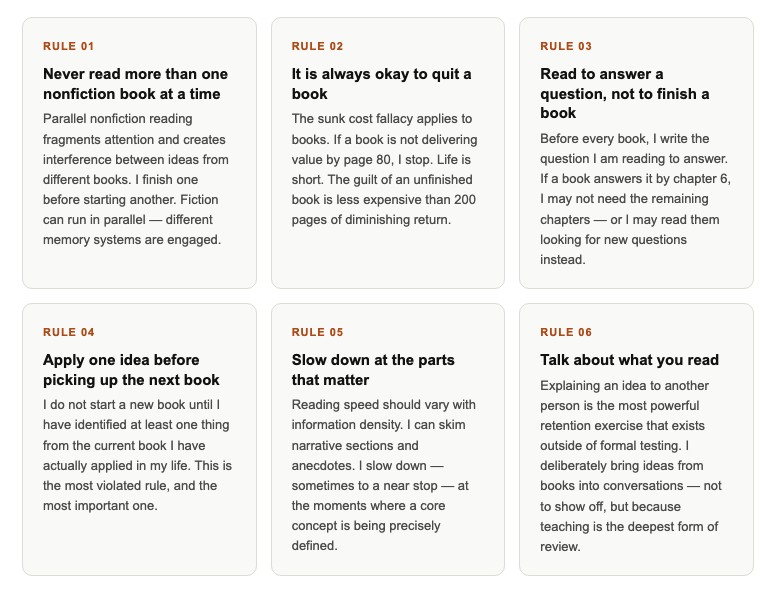
Beyond the three phases, I follow six rules that govern how I choose, read, and manage books. These are not aspirational guidelines — they are operational constraints I follow consistently, because I found through experience that violating any of them degrades the system noticeably.
The tools I use — and why most are optional
I want to address this briefly because tool discussions around reading systems have a tendency to become elaborate and discouraging. The system I have described above requires exactly three tools: a pen, a notebook, and a calendar reminder. Everything else is optional.
That said, here are the tools I personally use and why:
Physical books with margins: I have tried ebooks, Kindle highlights, and digital annotation. For deep nonfiction reading, physical books with handwritten margins consistently produce better retention for me. The motor act of writing — slower, more deliberate than typing — appears to deepen encoding.
A single notebook per book: I keep a small Leuchtturm1917 notebook with each physical book I’m currently reading. All three-question pre-reading notes, margin summaries, and post-read dumps go here. No apps required.
Readwise (optional): For books I read on Kindle, I use Readwise to resurface highlights on a daily basis. It is a good supplementary tool for the review phase, but it is not a substitute for the free recall exercise — which requires active retrieval, not passive re-reading of highlighted text.
A simple review calendar: I have recurring Google Calendar reminders for the Day 7, Day 30, and Day 90 reviews of every book I finish. Low-tech. Completely reliable.
The tool trap to avoid
The most common failure mode I see in people trying to build a reading system is spending more time designing the system than using it. Notion databases with elaborate tagging structures. Obsidian vaults with complex linking hierarchies. App ecosystems that take longer to maintain than the reading itself.
The best reading system is the one that runs with the least friction and the most consistency. A notebook and a pen that you actually use will always outperform a beautiful digital system that feels like work.
Read also: The Exact Formula for Wealth Creation
Conclusion: read less, retain more
The counterintuitive conclusion I have reached, after years of reading a great deal and retaining very little, followed by years of reading somewhat less and retaining most of it, is this:
The goal of reading is not to finish books. It is to change how you think.
| Before the system | After the system |
|---|---|
| 25–30 books per year, retained almost none | 15–18 books per year, can articulate key ideas from each |
| Read to finish, optimized for throughput | Read to answer questions, optimized for application |
| Passive underlining, no margin notes | Active marginal explanation in own words |
| No review after finishing | Structured review at Day 1, 7, 30, 90 |
| Ideas rarely applied to real decisions | At least one applied idea required before next book |
| Books as status symbols | Books as tools for thinking |
I read fewer books now than I did at my peak. My reading log looks less impressive on a spreadsheet. But the ideas I read about now actually live in my thinking — they show up in decisions, conversations, and frameworks that I reach for instinctively because they are genuinely part of how I reason.
That transition — from collecting books to using them — is the only outcome that has ever actually mattered.
Start with Phase 2. The next book you finish, before you open the next one, take twenty minutes and write down everything you can remember without looking. See what stays and what has already gone.
That gap between what you read and what remains is the space the system fills.
SEO & Publishing Metadata
Page Title (60 chars):
How I Built a Reading System That Actually Retains Knowledge
Meta Description (157 chars):
I used to finish books and forget them within a week. Then I built a reading system using spaced repetition, active notes, and one simple rule that changed everything.
Target Keywords:
reading system that workshow to retain what you readspaced repetition readingactive reading techniqueshow to remember booksreading habit systembook notes systembuilding a second brain readinghow to read more effectivelyhow to get more from bookshow to build a reading habitebbinghaus forgetting curve reading
Recommended Internal Links:
- Anchor “mental models” →
/mental-models/core-mental-models/ - Anchor “first principles thinking” →
/mental-models/first-principles-thinking/ - Anchor “cognitive biases” →
/decision-science/cognitive-biases/ - Anchor “book summaries” →
/book-summaries/
Suggested Category & Tags:
Category: Applied Thinking > Learning & Knowledge
Tags: Reading, Learning, Knowledge Retention, Spaced Repetition, Active Reading, Book Notes, Second Brain, Habit Building, Ebbinghaus, Applied Thinking
Word count: ~2,900 words | Reading time: ~13 minutes | Published: April 24, 2026

