

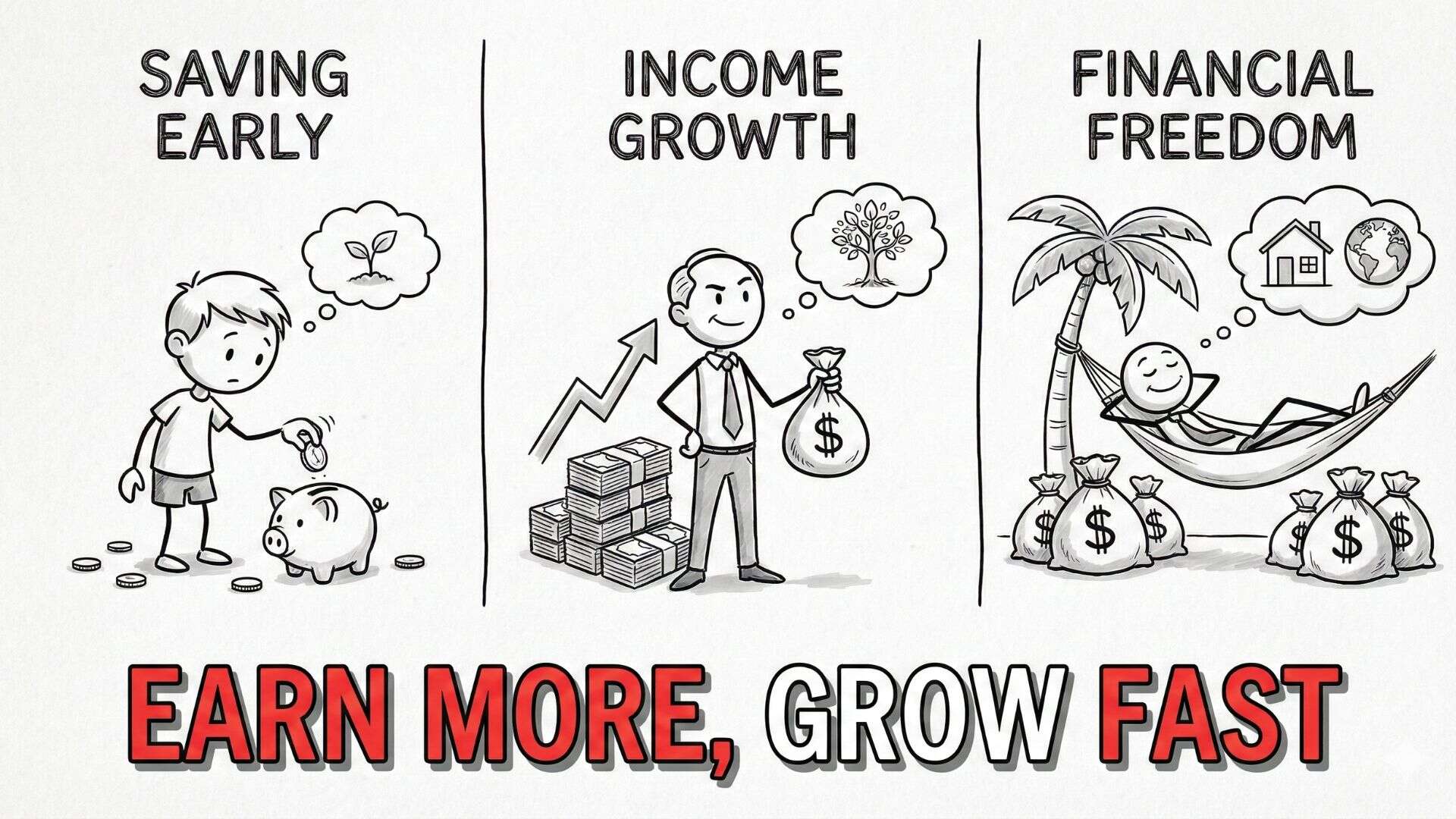
The Leverage of Human Capital: Why Income Growth Supersedes Early Frugality
In the landscape of personal finance and long-term economic planning, few concepts are as universally venerated as the “power of compounding.” The standard narrative, prevalent across both American and European financial discourse, suggests that the most critical variable for long-term wealth is the age at which one begins saving. By prioritizing early-stage frugality—foregoing small luxuries in one’s twenties to invest in a diversified index fund—an individual supposedly secures their financial future through the relentless math of exponential growth.
However, an analytical examination of lifetime earning trajectories suggests that this “savings-first” heuristic often leads to a sub-optimal allocation of resources. While the math of compound interest is indisputable, it operates on a base of capital that, for most young professionals, is statistically insignificant compared to their future earning potential. The emphasis on early saving frequently obscures a more potent causal driver of long-term outcomes: the aggressive growth of one’s primary engine of wealth, which is human capital.
When an individual prioritizes the “denominator” (spending) over the “numerator” (income) during their most formative professional years, they risk a structural misallocation of time and cognitive energy. The long-term consequences of this decision-making error are not merely financial; they manifest as career stagnation, reduced optionality, and a failure to capture the asymmetric upside of high-value skill acquisition.
2. Explanation of the Core Problem: Optimization on the Wrong Variable
The core problem lies in a fundamental misunderstanding of leverage and scale. In any financial equation, there are two primary levers: the reduction of outflows and the expansion of inflows.
Frugality—the act of saving early—is a strategy of optimization on a fixed or slow-growing base. It is a linear process with a hard floor. One can only reduce their expenses to zero; beyond that, the lever of saving ceases to function. For a young professional earning $50,000, a heroic 20% savings rate yields $10,000 annually. While compounding this $10,000 over 40 years is mathematically impressive, it pales in comparison to the structural shift of moving that individual’s income from $50,000 to $150,000 through targeted skill acquisition and career positioning.
The problem persists because the “saving early” model treats the individual as a static economic unit. It assumes that the primary variable of interest is the time the money spends in the market, rather than the velocity and volume of the capital entering the market. By focusing on the “Latte Factor”—the idea that small daily expenditures prevent wealth—individuals engage in “low-agency optimization.” They spend significant cognitive bandwidth on decisions with low marginal utility (e.g., choosing a cheaper grocery store) while neglecting the high-leverage decisions that drive income growth (e.g., relocating for a better market, acquiring a rare technical certification, or negotiating a significant raise).
Read also: How Risk Perception Shapes Financial Outcomes
3. Why the Problem Persists Despite Experience
Despite the clear mathematical advantage of income growth, the “save early” dogma remains the dominant cultural and institutional advice. This persistence can be attributed to three causal factors:
The Illusion of Control and Loss Aversion
Saving is a “certain” activity. An individual has direct, immediate control over whether they buy a coffee or put $5 in a savings account. Income growth, conversely, is probabilistic and involves external variables, such as market demand, employer behavior, and the risk of failure. Human psychology is biased toward immediate, certain rewards (loss aversion) over delayed, uncertain, but significantly larger gains. We feel the “pain” of spending $1,000 on a training course more acutely than the “potential” gain of a $10,000 raise three years later.
Simplistic Feedback Loops
The feedback loop for saving is instantaneous: the balance in the bank account goes up. The feedback loop for investing in human capital is “noisy” and delayed. It may take years of late-night study or high-pressure projects before a career pivot yields a higher salary. In the absence of immediate reinforcement, most people revert to the easier, more visible metric of the savings rate.
Historical Path Dependency
The advice to “save early” gained prominence during economic eras characterized by higher interest rates and more stable, linear career paths (e.g., the mid-to-late 20th century). In a world of 5% “risk-free” savings rates and lifetime employment, the advice was sound. In a modern, volatile, “winner-take-most” economy where skill obsolescence is rapid and income can scale non-linearly, the old heuristic has become a trap.
4. How This Problem Affects Real-World Outcomes
The prioritization of early saving over income growth creates a ripple effect across a person’s career and life stages:
- In Finance: Individuals often find themselves “asset rich but cash-flow poor” in their middle years. By over-saving in their 20s at the expense of professional development, they may reach their 40s with a modest portfolio but a stagnant salary that cannot keep pace with the rising costs of family life, housing, and eldercare.
- In Career Trajectories: There is an “opportunity cost of frugality.” If an individual chooses a low-stress, low-growth job because it allows them to maintain a low-cost lifestyle and save 15% of their income, they miss the compounding effect of professional reputation and network. Career growth is often convex; the most significant rewards accrue to those who have built the most leverage early on.
- In Decision-Making: This mindset fosters a “scarcity bias.” When the focus is entirely on cutting costs, the individual’s decision-making framework becomes defensive. They begin to view the world through the lens of “what can I afford to lose?” rather than “what can I afford to build?” This prevents them from taking the calculated risks—such as starting a business or joining an early-stage startup—that are necessary for significant wealth creation.
Read also: The Automatic Millionaire Summary: How to Get Rich Without a Budget (The David Bach Method)
5. Core Mental Model: The Convexity of Human Capital
To understand why income growth dominates, one must apply the mental model of Convexity.
In mathematics and finance, a convex payoff is one where the potential upside is significantly greater than the defined downside. Saving is concave; the most you can save is 100% of your income, and the returns are capped by the market average. Your downside is also limited, but your upside is structurally constrained by your current earnings.
Human capital, specifically through income growth, is convex. The “downside” of spending money on a high-level masterclass or moving to a high-cost-of-living city for a better job is the lost capital (the cost of the course or the rent). However, the “upside” is the permanent increase in your “floor” of earnings. Unlike a stock market investment which can fluctuate, a mastered high-value skill (e.g., specialized engineering, executive leadership, or complex sales) becomes a permanent part of your productive capacity.
By viewing oneself as an “operating company” rather than just a “savings account,” it becomes clear that the goal should be to increase the Return on Invested Time (ROIT). Early in a career, time is abundant but capital is scarce. Investing that abundant time into increasing the value of the scarce asset (the self) yields a much higher long-term “Internal Rate of Return” than saving small amounts of capital.
6. How Better Thinking Can Be Applied in Practice
Reframing financial health requires shifting from a “balance sheet” focus to a “cash flow” focus. This is not a call for reckless spending, but for strategic reinvestment.
Prioritize “Career Capital” Over “Financial Capital” Early On
In the first decade of a professional career, the objective should be to maximize the rate of learning rather than the rate of saving. If a job offers a $5,000 higher salary but $50,000 less in “implied training” or networking opportunities, the higher-paying job is actually the riskier financial move over a 30-year horizon.
Recognize the “Cost of Opportunity”
Every hour spent clipping coupons or researching the lowest-fee index fund is an hour not spent mastering a skill that could lead to a 20% increase in base pay. High-functioning decision-makers calculate the “hourly rate” of their frugality. If spending two hours to save $20 results in an “earnings rate” of $10/hour, but their professional goal is to earn $100/hour, they are effectively paying $90 for the privilege of being frugal.
Shift to “Aggressive Reinvestment”
Instead of viewing surplus income as “savings,” view it as “R&D budget.” This capital should be deployed into anything that increases the scale, efficiency, or price of one’s labor. This includes health (to maintain high cognitive output), tools (to increase efficiency), and education (to expand the skill set).
7. Common Misunderstandings or Oversimplifications
The argument for income growth is often misinterpreted as a license for “lifestyle creep”—the tendency to increase spending as income rises. This is an oversimplification. The goal is not to spend more on consumption, but to recognize that the return on investment for career-related expenditures is often higher than the return on investment of the S&P 500 when your total capital is small.
Another misunderstanding is the “False Binary.” This is not a choice between “saving nothing” and “growing income.” Rather, it is a question of marginal utility. The first 5-10% of savings provides a critical safety net (the “emergency fund”). Beyond that, the marginal utility of the next dollar saved is often lower than the marginal utility of that same dollar reinvested into the individual’s earning capacity.
Finally, critics often point out that “income growth isn’t guaranteed.” This is true, but it ignores the fact that market returns are also not guaranteed. Both are probabilistic. However, the individual has significantly more “agency” over their skill set than they do over the Federal Reserve’s interest rate decisions or global geopolitical events.
Read also: The Cognitive Architecture of Temporal Myopia: The Hidden Cost of Short-Term Financial Thinking
8. Connection to Related Thinking Frameworks
This topic integrates several other high-level mental models:
- The Pareto Principle (80/20 Rule): 80% of lifetime wealth usually comes from 20% of the years—typically the peak earning years. Maximizing the “height” of that peak is more impactful than lengthening the “tail” of early savings.
- Operating Leverage: In business, companies with high operating leverage see massive profit growth for every small increase in sales. By acquiring rare and valuable skills, an individual creates “personal operating leverage,” where their income can grow exponentially while their effort remains linear.
- Option Theory: Early in a career, you want to buy “call options”—opportunities with limited downside and huge upside. Frugality is a defensive play; income growth is an offensive play that builds a portfolio of career options.
9. Conclusion: The Long-Term Perspective
The obsession with “saving early” is a testament to the human desire for certainty and a clear, manageable script. It is far easier to tell a 22-year-old to stop buying toast than it is to guide them through the complex, messy process of becoming a high-value economic actor in a globalized economy.
However, when we zoom out to a 40-year time horizon, the causal weight of income growth becomes undeniable. A 10% increase in lifetime earnings potential far outweighs the benefit of a 10% increase in the savings rate of a entry-level salary.
Long-term reasoning requires us to view our younger selves not as “savers,” but as “assets under development.” The most significant compounding does not happen in a brokerage account; it happens in the mind, the reputation, and the skill set of the individual. By focusing on the expansion of the numerator—our ability to create value—we build a financial foundation that is not just larger, but more resilient to the inevitable fluctuations of the global economy.

