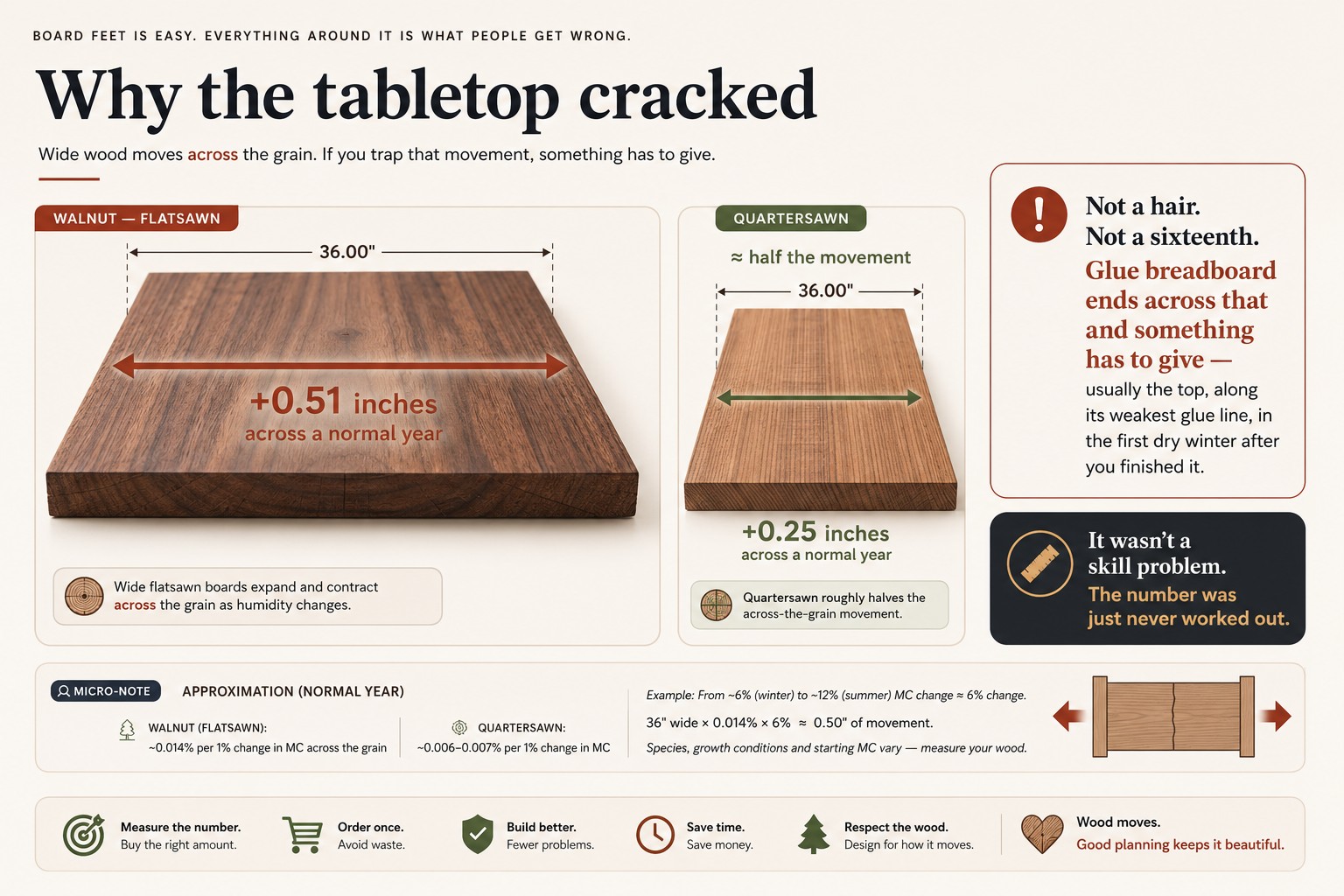
A 36-Inch Walnut Top Moves Over Half an Inch Across a Normal Year
Not a hair. Not a sixteenth. And if you glue something rigid across it, the top will split — usually in the first dry winter after you finished it.
Here is the most common way a well-made piece of furniture fails. Somebody builds a dining table. The joinery is good, the surfaces are flat, the finish is even, and it looks superb. Then the heating comes on in November, the air in the house dries out, and a crack opens along a glue line in the top. And the maddening part is that it wasn’t a skill problem. The joinery genuinely was fine. Wood movement is simply a number that never got worked out — and once you’ve worked it out, it changes what you’re willing to glue.
The scale is bigger than people expect
Wood takes on and gives up moisture with the air around it, and when it does, it changes size — barely along its length, and substantially across the grain.
For a 36-inch-wide top in a species like walnut, across the seasonal swing of an ordinary heated house, that comes out at something over half an inch.
That’s the figure worth sitting with, because almost everybody’s intuition is smaller. People imagine a sixteenth, maybe an eighth — an amount a tight joint could absorb. Half an inch is a different category of problem. Nothing in a glued assembly absorbs half an inch. Something has to give, and the thing that gives is the weakest glue line in the panel.
Two examples of how that plays out:
Breadboard ends glued across the full width. The end runs long-grain across the top’s cross-grain. The top wants to move; the breadboard doesn’t. In dry conditions the top shrinks against a fixed end and splits.
A tabletop screwed rigidly to an apron. Same story. The top tries to shrink, the frame holds it, and the top loses.
Neither failure is a mistake in execution. Both are a design decision made without the number.
Flatsawn, quartersawn, and why one costs more
The other input people underestimate is how the board was sawn.
Quartersawn stock moves roughly half as much across its width as flatsawn from the same species. Same tree, same wood, very different behaviour — because of the orientation of the growth rings relative to the face.
That single fact is the reason quartersawn costs more, and it’s worth knowing when you’re standing at the lumber rack deciding whether the premium is justified. For a narrow drawer front, probably not. For a wide top in a house with aggressive heating, it may be the cheapest decision you make all year.
Species matters too, and the spread between them is real. Comparing the same 36-inch panel across a table of species — flatsawn and quartersawn side by side — is a genuinely useful thing to look at before you choose your material, rather than after you’ve bought it.
Don’t fight it. Let it move.
The good news is that this problem has been solved for centuries, and the solutions are all variations on the same idea: hold the wood, but let it slide.
- Buttons or figure-8 fasteners to attach a top to a base. Both hold the top down firmly while allowing it to expand and contract across its width.
- Breadboard ends pegged through elongated slots, and glued only in the middle few inches. The centre is fixed; the outer pegs can travel in their slots as the top moves.
- Panels sitting loose in their grooves — never glued in. A frame-and-panel door works precisely because the panel floats.
Notice the pattern. None of these try to stop the movement. Every one of them accommodates it. Any joint that resists movement across a wide panel is, over a long enough period, a joint that will lose.
Use the number for scale, then leave more room
One honest caveat about any movement calculation, including mine.
Published shrinkage coefficients are approximations, and they vary between sources. Actual movement in your workshop depends on your climate, how your house is heated, the finish you applied, how the board was sawn, and the individual piece of wood — which has its own history and its own moisture content.
So the right way to use a calculated figure is to establish the scale of the problem: are you designing around half an inch, or around a hair? That distinction changes your joinery. The precise decimal doesn’t.
And then, having calculated it, leave more room than the number suggests. A slot slightly longer than required costs you nothing. A slot slightly shorter costs you the top. Nobody has ever regretted allowing extra room for movement.
It’s worth adding the two things that reduce the problem at source: let lumber acclimatize in the space where the piece will live before you build with it, and build for the environment the piece will actually occupy rather than the one your shop happens to be in.
An important note
To be clear: this is a general explanation and a way of organizing your own calculations. It is not training, safety, engineering, structural, health, or professional advice, and it guarantees no outcome. All species, dimensions and figures mentioned are illustrative examples. Wood-movement coefficients are commonly published approximations that vary between sources and depend on climate, heating, finish, how the board was sawn and the individual piece — use them to understand scale, and always allow more room than the calculation suggests. Woodworking machinery causes serious and permanent injuries: obtain proper instruction, read and follow the manual for every tool, use the guards and safety devices supplied, and comply with the workshop, electrical and health-and-safety rules that apply where you are.
If you want the number in front of you
I built a wood movement calculator into my woodworking planner in Google Sheets — panel width, species coefficient and seasonal moisture swing, with eleven species in a live table showing flatsawn and quartersawn side by side so you can see what a 36-inch panel does in each before you choose your stock:
👉 Woodworking Planner, Cut List & Board Feet Calculator for Google Sheets & Excel
Whether you use mine or a published table, do the arithmetic before you fasten anything wide. It takes a minute, it’s the difference between a table that lasts a generation and one that cracks the first winter, and it’s the sort of failure that has nothing to do with how well you can cut a joint. Measure once. Order once. 🪵
This reflects my own perspective and describes a calculation tool — NOT training, safety, engineering or structural advice, and it guarantees no outcome; coefficients are approximations that vary by source and conditions, so allow more room than any calculation suggests. Get proper instruction for any machine you’re not confident with. Have you had a top crack on you? Tell me in the comments — I suspect you’re in good company.