You’re Not Paid to Mow. You’re Paid for a Day.
Ask anyone on a mowing route what they charge an hour and they’ll tell you seventy. On site, they’re right. The mower just isn’t running for most of the gap between one lawn and the next.
A $28 lawn that takes twenty-five minutes genuinely is about $67 an hour while the mower is running. That’s the number most operators carry in their heads, and it’s not wrong — it’s just measuring the wrong thing. Because you aren’t selling twenty-five-minute slots. You’re selling days, and a day includes every minute spent in the van getting from one job to the next. In a worked example, ten jobs bring in $401. On-site time is five hours thirty-seven — which looks like $71.39 an hour. Add eighty-three minutes of driving and the same day is seven hours, and $57.29 an hour. That’s fourteen dollars an hour, every hour, disappearing into something nobody bills for. Understanding lawn care route density is how you get it back.
Why the driving disappears
Two reasons, and they compound.
It isn’t billable, so it isn’t counted. You invoice for the lawn, not for getting there. So the mental accounting treats the drive as free — a cost of doing business rather than a chunk of the working day being consumed at zero dollars an hour.
It’s fragmented. Nobody spends eighty-three minutes driving in one go. It’s eight minutes here, twelve there, six to the next one. Each individual hop feels trivial, and nothing ever adds them up. Which is exactly the pattern that makes a cost invisible — small, frequent, and never totalled.
The result is a rate in your head that’s roughly 25% higher than the one you’re actually earning. And a 25% gap between what you think you make and what you make is not a rounding error; over a season it’s the difference between a route that pays properly and one that just keeps you busy.
The low earners aren’t bad customers
Here’s the part that changes how people think about their customer list.
When you calculate a real hourly rate per job — price divided by on-site time plus the drive to get there — some jobs come out well below the others. The instinct is to conclude that those customers are underpriced, or awkward, or not worth having.
Usually they’re none of those things. They’re badly placed.
In the worked example, a perfectly nice customer twenty-six minutes off the route earns $43.64 an hour, while six houses clustered in one village earn $62.71. Same work. Same skill. Same mower. The entire difference is geography — twenty minutes of driving that appears on no invoice and in nobody’s pricing.
That reframe matters because it points at a completely different fix. If the problem were the price, you’d raise prices. If the problem is placement, the answers are about route shape — and those are usually easier and less confrontational than a price rise.
Density is the whole game
Once you see it that way, one number starts to dominate: how tightly clustered your customers are.
Six houses on one street produce the same revenue as twelve scattered across town, with roughly half the driving. That’s not a small efficiency — it’s most of the difference between the two hourly rates above.
Grouping your customers by area, and looking at how many you have and what each area is worth per visit, tells you two useful things at once. Which parts of your route are dense and genuinely profitable, and which are thin and quietly expensive to serve.
And it answers the question every operator asks eventually: where should I advertise?
The answer is next door to someone you already visit. A new customer three doors from an existing one is worth roughly double one across town, for exactly the same price — because they arrive with almost no additional driving attached. Targeting a few streets you already serve is the highest-return marketing available in this trade, and it costs a stack of flyers.
Most operators advertise by area at random, or wherever they can, and end up with a route that’s wide and thin. Deliberately thickening the areas you’re already in produces a fundamentally better business without a single price change.
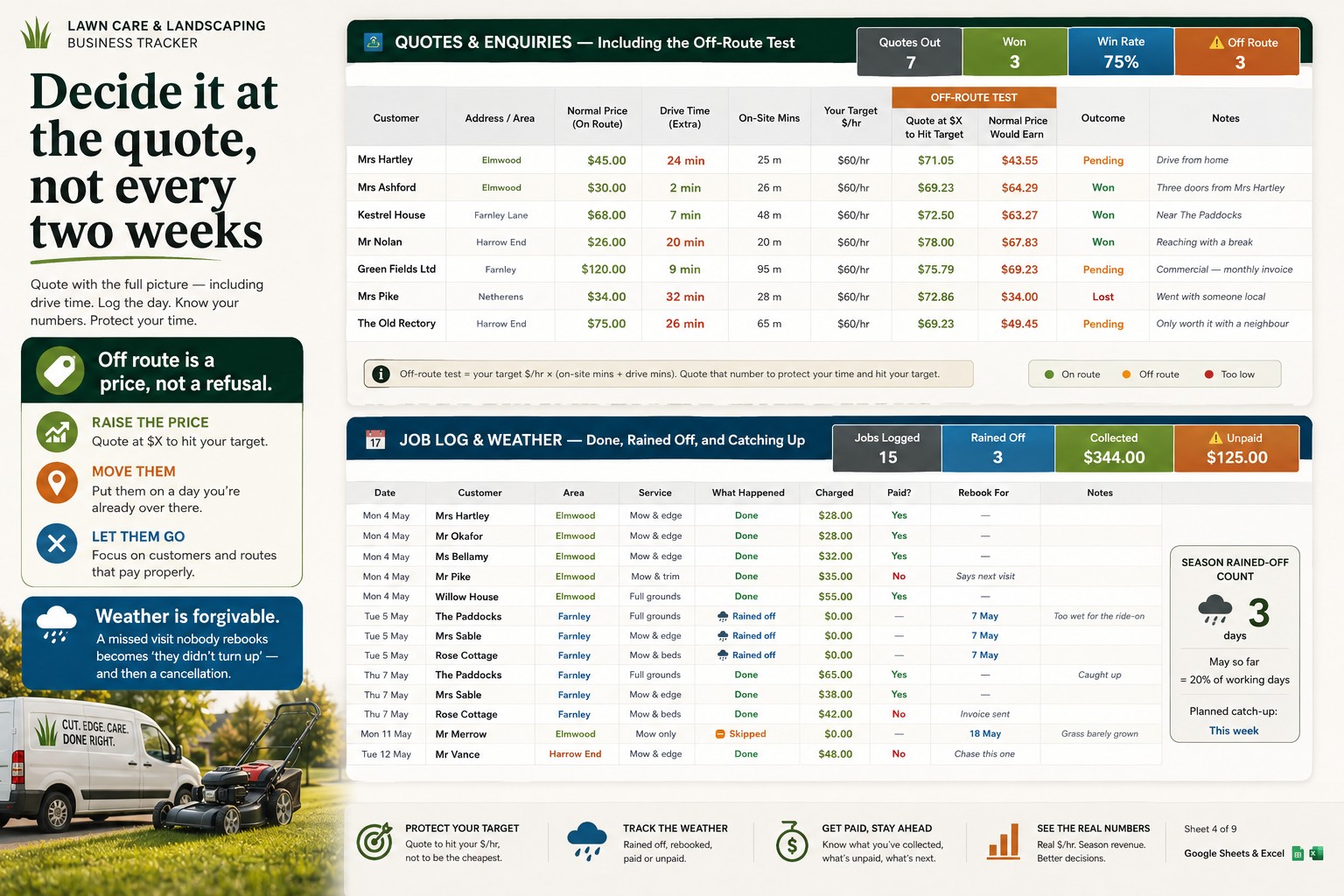
Off route is a price, not a refusal
The natural next question is what to do about the customers who are already badly placed. And I’d push back on the obvious answer.
Dropping them isn’t automatically right. A job twenty-five minutes away can be excellent work — if it’s priced at a level that pays for the journey. The problem isn’t distance; it’s distance charged at the same rate as the house next door to your last job.
So there are three honest options for an off-route customer:
Raise the price so the drive is paid for. Often this is fine — customers who are genuinely inconvenient to reach frequently know it.
Move them to a day you’re already over that way, so the drive is shared with other work rather than made for one lawn.
Let them go, and fill the time closer to home — which is only a real option if you know a nearby prospect exists, which is another argument for density.
What you shouldn’t do is charge your normal rate and quietly resent it every two weeks. That’s the outcome that happens by default, and it’s the only one that’s bad for everybody.
The best moment to make this call is at the quote, before you’ve said yes — because that’s the one moment when adjusting the price is normal rather than awkward.
Log the weather properly
One operational thing that’s worth more than it looks. Rain days are unavoidable, and customers understand them.
What customers don’t forgive is a visit that never gets rebooked. “Rained off” is a reasonable explanation; three weeks of grass and no contact becomes “they didn’t turn up,” and that becomes a cancellation.
So log every visit as done, rained off, or skipped — and put the rebook date in the same day, while you’re still thinking about it. It takes seconds and it protects the relationship. Counting your rained-off days across a season is also genuinely useful for planning: most operators substantially underestimate how many they lose.
An important note
To be clear: this is a general perspective on organising your own numbers. It is not business, tax, accounting, legal, insurance, health and safety, or horticultural advice, and it guarantees no outcome. All figures mentioned are illustrative examples — prices in particular vary enormously by country and area and are not recommendations. Requirements for running a grounds-maintenance business differ by country and region and are yours to establish: public liability and employer insurance, waste-carrier registration for green waste, certification to buy and apply professional pesticides, fertilizers and herbicides, machinery training, PPE, and restrictions on hedge and tree work during bird nesting seasons or under preservation orders. Establish what applies where you work before you trade, and consult a qualified accountant about the tax treatment of your income.
If you want the driving priced for you
I built a lawn care and landscaping tracker in Google Sheets that puts both rates side by side — your on-site rate and your real rate once drive time is counted — with a real hourly rate per job, the percentage of your day spent in the van, customers grouped by area with a density table, and an off-route test on every quote before you commit:
👉 Lawn Care & Landscaping Business Tracker for Google Sheets & Excel
Whether you use mine or a notebook in the cab, time the drives for one week. Add them to the on-site hours and divide your takings by the total. The number will be lower than the one in your head — and knowing which stops caused it is the difference between working faster and working better. Tighten the route. Then price it. 🌿
This reflects my own perspective and describes a tracking tool — NOT business, tax, insurance, health and safety or horticultural advice, and it guarantees no outcome; figures are illustrative, not recommendations. Licensing, insurance, pesticide certification and seasonal restrictions differ by country and region — establish what applies to you. What’s your worst off-route customer costing you? Tell me in the comments.