You Priced the Shoot. Did You Price the Editing?
The wedding paid $2,400. It also took 118 hours. Here’s the arithmetic almost no photographer does — and why the fee that felt generous turns out not to be.
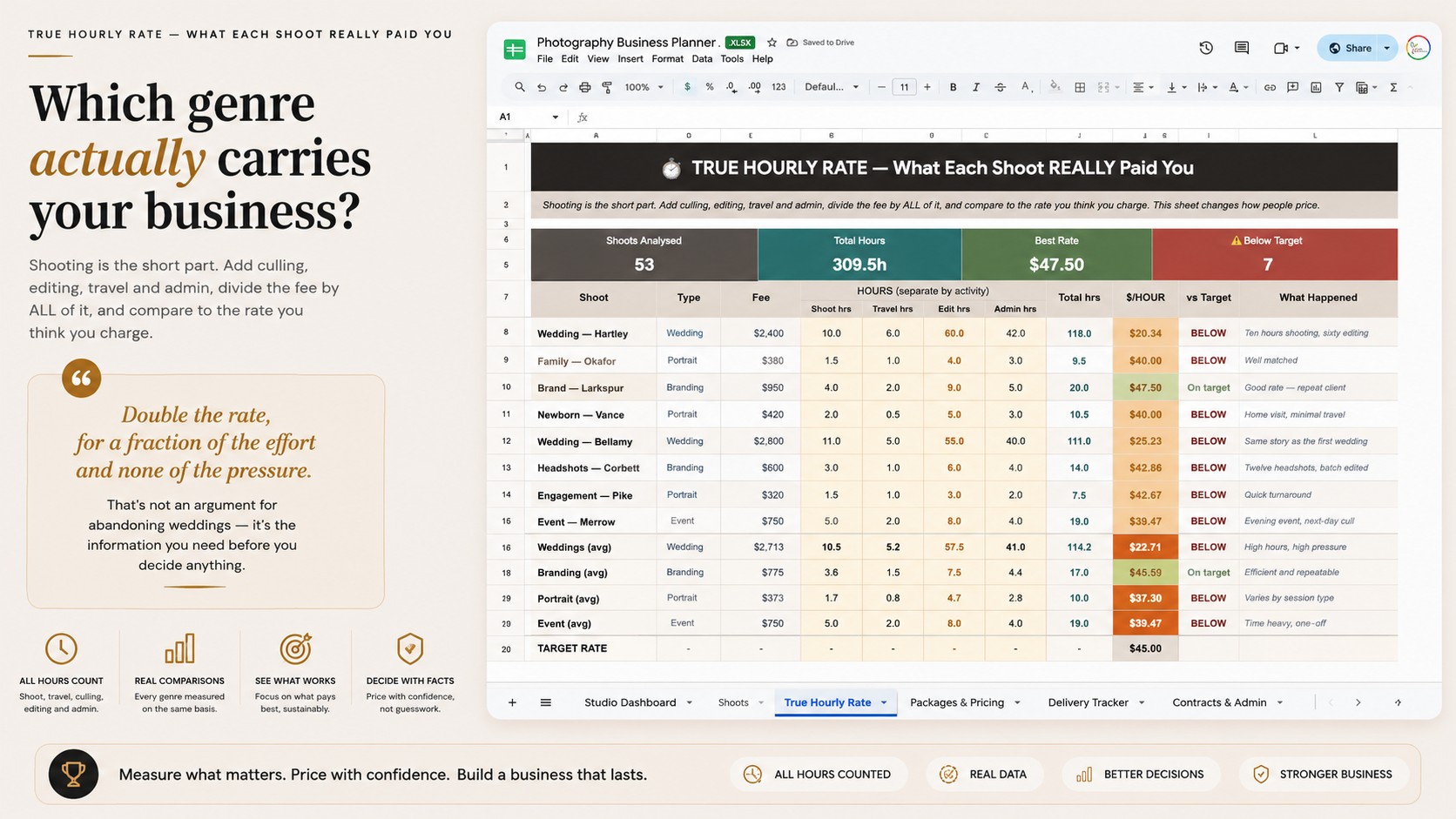
The wedding paid $2,400. By anyone’s reckoning that’s a good day’s work, and it felt like one at the time. It also took 118 hours. Ten of them holding a camera. Six driving. Sixty culling and editing. And forty-two on the emails, the timeline planning, the contract, the invoice chasing, and four separate conversations about whether Uncle Martin would be in the family groupings. Divide $2,400 by 118 and you get $20.34 an hour. That isn’t an unusual number in this industry — it’s an ordinary one — and most photographers have genuinely never worked it out. Getting photography pricing right starts with counting all four categories of hours, not just the one you were holding a camera for.
The fee looks generous next to the wrong number
The reason this arithmetic stays hidden is that the comparison people make is instinctively reasonable. You look at the fee, you look at the shoot, and $2,400 for a day’s shooting sounds like a strong rate. It is a strong rate — for a day’s shooting.
The problem is that a day’s shooting isn’t what you sold. What you sold was a day’s shooting plus everything that surrounds it, and the surrounding work is several times larger than the part that feels like the job.
Four categories, and almost every pricing conversation counts only the first:
Shooting. The hours with a camera in your hands. Visible, memorable, and the smallest of the four on most jobs.
Travel. Real hours, entirely unpaid unless you priced them in. Two hours each way to a venue is a quarter of a working day gone before you take a frame.
Culling and editing. Usually the largest single category by a wide margin, and the one clients have absolutely no visibility of. Nobody who books you imagines sixty hours at a screen.
Admin. Enquiries, quotes, contracts, timeline planning, questions, invoicing, chasing payment, delivery. Death by a thousand fifteen-minute tasks, all of which happen because you took the job.
Add the four and divide the fee. That figure is your true hourly rate, and it’s usually a fraction of what you think you charge.
Why editing hours specifically get lost
Editing is the category that distorts everything, and it does so for a structural reason: it happens after the fee is agreed and away from the client.
When you quote, you’re imagining the shoot. The editing is abstract and in the future, so it gets mentally discounted. Then it arrives, weeks later, in evenings and weekends, spread out enough that it never feels like a block of work — it just feels like the ongoing texture of being a photographer.
And it scales with things nobody negotiates over. Deliver four hundred images instead of two hundred and you’ve roughly doubled the largest cost in the job — for a fee that didn’t move, and for a client who almost certainly wouldn’t have noticed the difference. That’s an important realisation, because it points at a lever most photographers never consider pulling.
The number that makes the case better than any pep talk
There’s a lot of encouragement in this industry to “value yourself” and “charge your worth.” I’ve never found that especially useful, because it’s an argument about feelings and most photographers already feel uncomfortable about their prices.
A true hourly rate is different. It’s arithmetic. When you see that a job you were proud of paid you $20 an hour against a target of $45, there’s no self-belief involved — there’s just a gap, and three honest levers to close it:
- Raise the price. The obvious one, and the hardest.
- Reduce the delivered image count. Cutting the largest cost in the job, usually without meaningfully affecting what the client receives.
- Edit faster — a tighter cull, better presets, a firmer definition of “done.”
Choosing none of them is also a decision. But it should be a decision you’re making knowingly, not one that happens to you every season because nobody did the division.
Track it for a season before you change anything
One practical note: don’t reprice off a single job. Log the four hour figures for every shoot across a season and let the pattern emerge. Jobs vary enormously — a difficult client, a long drive, a heavy delivery — and one outlier isn’t a business.
You’ll also find your estimates were optimistic. That’s not a personal failing; it’s near-universal, and it’s exactly why measuring beats assuming. Once you have real numbers from real jobs, every pricing decision you make afterwards rests on something solid instead of a feeling.
And be honest in the logging, including the admin. The fifteen-minute email exchanges are the easiest to leave out and, in aggregate, one of the biggest categories on the sheet.
An important note
To be clear: this is a general perspective on costing your own work. It is not business, financial, tax, accounting, insurance, contractual, or legal advice, and it guarantees no outcome. Any figures mentioned are illustrative examples — they are not benchmarks or recommended prices, and rates vary enormously by market, experience and location. Nothing here creates contracts, model releases or licences. Copyright, model and property releases, usage licensing and the rules on photographing children differ substantially by country and by whether work is commercial or personal — use properly drafted documents for your jurisdiction and consult a qualified accountant and lawyer about your own business.
If you want the arithmetic done for you
I built a photography business planner in Google Sheets that does this for every session — enter the fee and four hour figures (shoot, travel, editing, admin) and it calculates the true hourly rate with an on-target or BELOW verdict against the rate you set, then totals it across the year:
👉 Photography Business Planner for Google Sheets & Excel
Whether you use mine or a calculator, do the division for your last three jobs. Count the travel, count the editing, count the admin. The fee was never the problem — it’s everything around it that nobody counts, and you can’t price work you haven’t measured. Count the hours nobody counts. 📸
This reflects my own perspective and describes a costing tool — NOT business, financial, tax or legal advice, and it guarantees no outcome; figures are illustrative, not benchmarks, and rates vary enormously by market. Photographers: how many hours does a wedding really take you, all in? Tell me in the comments.