“I Have a Bit Extra This Month. Where Should It Go?”
It’s the question you face every single month, and answering it badly — or not at all — is how debt payoff quietly stalls. Here’s how to decide once, and build a plan that survives your worst months.
Most debt payoff advice concentrates on the big decision: which method, what order, snowball or avalanche. But the decision you actually face isn’t annual — it’s monthly, and it’s much smaller. You’ve got a bit spare. Maybe forty dollars, maybe two hundred. Where does it go? Split across everything? At whichever card feels most urgent? At the one with the scariest balance? And in the moment of not being sure, the honest answer is often that it goes nowhere in particular — it drifts back into general spending, and another month passes. Answering the extra debt payment question in advance, so it never has to be decided again, is one of the most practical things you can do. Here’s how, and how to keep the plan alive when a month goes wrong.
Before anything else
As always with debt: if you’re struggling to make even the minimum payments, please speak to a free, reputable debt advice service in your country before doing anything else. They can negotiate with creditors, get interest frozen, and protect you in ways no spreadsheet can — and going early gives you far more options. There’s genuinely no shame in it. Everything below is for people who can meet their minimums.
Why spreading it around feels fair and works badly
The instinct, faced with several debts, is to spread extra money across all of them. It feels fair and it feels productive.
It’s the least effective option. Split across five debts, an extra amount barely moves any single balance, so nothing clears — and nothing clearing means no minimum is ever freed up. You lose the compounding effect entirely, and you also lose the psychological one: no debt disappears, so it feels like nothing is happening, for months.
Concentration is what works. Pay minimums on everything, then send every spare dollar to exactly one debt until it’s gone. Then move to the next, carrying the freed-up minimum with you. Your attack payment grows each time a debt falls — the first takes ages, the last collapses quickly.
That’s the mechanism behind both common methods. They differ only in which debt you point at first.
Decide the order once, then stop deciding
Here’s the practical value of choosing a method: it removes a monthly decision.
Once you’ve picked snowball (smallest balance first) or avalanche (highest rate first), the order is fixed. Every month, there’s exactly one debt getting your extra, and you don’t have to think about it, weigh it up, or feel uncertain. When money is spare, you already know where it goes.
That sounds small. It isn’t. Decision fatigue is a real reason people stall — not because they don’t want to pay debt down, but because a fuzzy decision made every month under mild stress eventually gets deferred. A plan that names the target debt each month converts a judgement call into an instruction.
And whichever method you choose, make it one you’ll finish. If avalanche saves modestly but snowball’s early wins are what will keep you going, snowball is the better plan for you. A plan you abandon saves nothing at all.
Seeing what the extra actually buys
The other reason people don’t make extra payments is that the benefit feels abstract. Forty dollars against a five-figure debt seems futile — a drop in an ocean.
It isn’t, and the way to prove it to yourself is to see what different extra amounts do to your timeline. Run your numbers at $0, $50, $100, $200, and see the months-to-debt-free and total-interest figures for each.
The results are usually startling, for two reasons. First, extra payments hit the principal directly, which reduces the interest charged next month, which means more of your next payment hits principal too. Second, the earlier a debt clears, the sooner its minimum joins the attack. Both effects compound, so a modest extra amount can remove a surprising number of months.
That’s what makes it worth finding. “You should pay extra” is unpersuasive. “An extra $50 a month gets me out four months sooner and saves this much interest” is a specific trade you can actually evaluate — and often decide is worth a couple of cancelled subscriptions.
It’s also the right way to think about windfalls. A tax refund or a bonus put straight against the target debt doesn’t just reduce a balance; it pulls the whole timeline forward. Seeing how many months it removes is a much better motivator than the vague virtue of “putting it toward debt.”
Build a plan that survives a bad month
Here’s what actually kills debt payoff plans, in my view: not choosing the wrong method, and not the maths. It’s the bad month — the one where something breaks, you can only pay minimums, and you feel like you’ve failed.
That feeling is the danger, not the missed payment. What follows is usually a shame spiral: you stop looking at the plan, stop logging anything, and three months later you’ve quietly abandoned something that was working fine.
Two things prevent it.
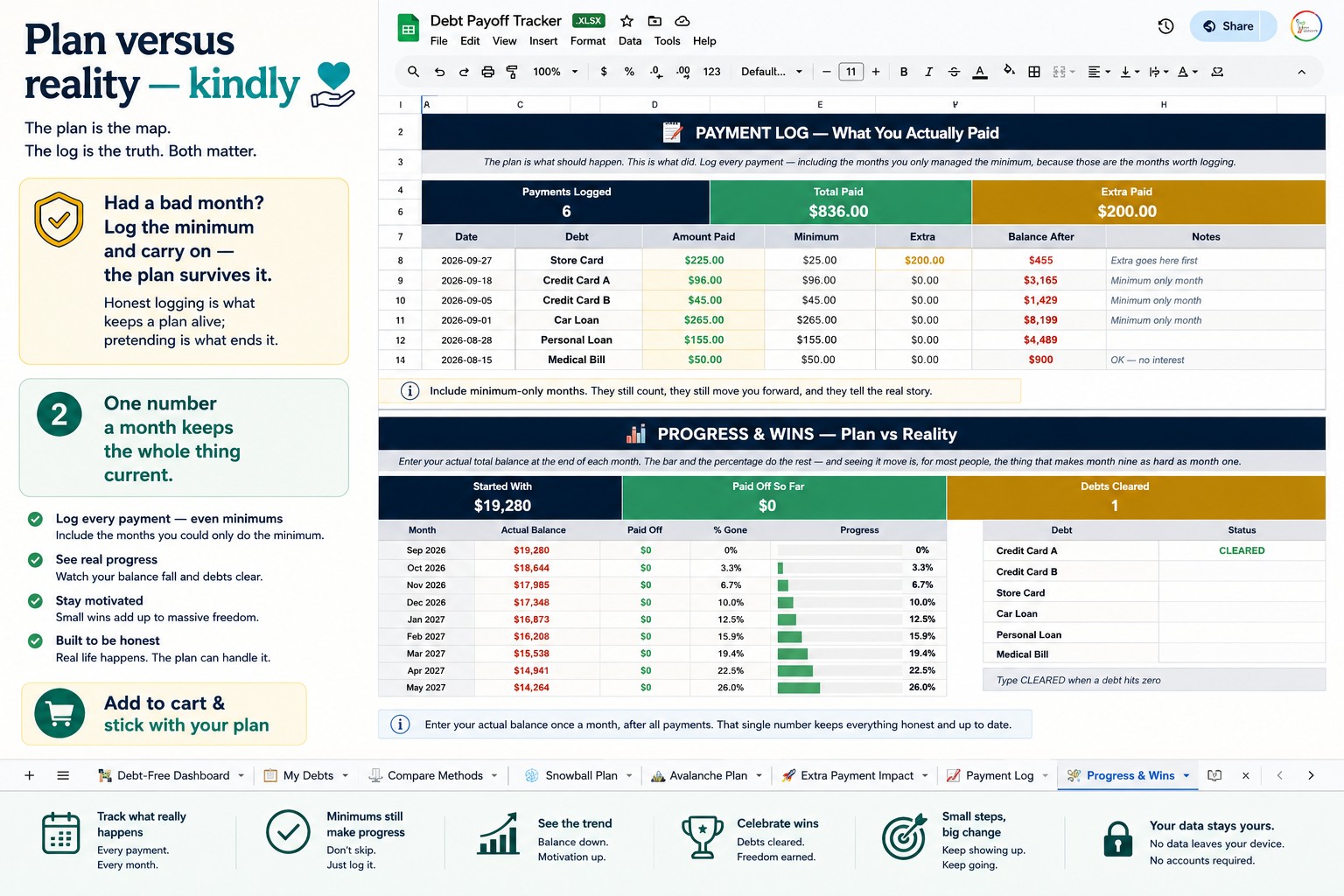
Log honestly, including the minimum-only months. A payment log that shows what you actually paid — with the bad months in it — stays useful. One that only records good months becomes fiction, and fiction gets abandoned. Writing down “minimums only, difficult month” is a completely legitimate entry.
Expect it in advance. Over two or three years, some months will be minimum-only. That’s not failure; it’s the normal shape of a long project. A plan that assumes perfection breaks the first time life happens. One that expects imperfection just… continues.
When you resume, you don’t start over. You carry on, the date moves by a month or so, and that’s the whole consequence. Recalculate if you like, and keep going.
Progress you can see
The last piece is visibility. Debt payoff is long, and the middle is invisible — you’re paying, the number moves slowly, and nothing feels like it’s happening.
A progress bar, a percentage cleared, and a count of debts you’ve killed all do the same job: they make effort visible over a timescale where it otherwise isn’t. Combined with a date that moves closer, they’re what carry you through the slow middle to the fast end.
One number a month is enough to keep it all current. That’s the whole maintenance cost.
An important note
To be clear: this is a general explanation and a way of organising your own figures. It is not financial, debt, credit, tax, legal, or professional advice; it is not a debt solution or a regulated debt-management service; and it guarantees no outcome. Any figures are illustrative. Payoff calculations assume rates, minimums and extra payments stay as entered — real agreements vary, minimums usually fall as balances drop, promotional rates end, and fees aren’t modelled, so results are estimates that will differ from your lender’s. Rules on credit, default, insolvency and debt collection differ by country. If you’re struggling to meet minimum payments, contact a free and reputable debt advice service, and consult a qualified financial adviser before making decisions about your debts.
If you want the decision made for you
I built a debt payoff tracker in Google Sheets where every month of the plan names the one debt that gets your extra — so that decision is answered in advance — plus an extra-payment impact table showing what $0 to $500 does to your months and interest, and a payment log built to record the minimum-only months honestly:
👉 Debt Payoff Tracker for Google Sheets & Excel
Whether you use mine or a notebook, decide your order once and stop re-deciding. Send every spare dollar to one debt, log the bad months honestly, and keep going. The plan doesn’t need you to be perfect — it just needs you to still be there next month. Not a list. A plan. 💳
This reflects my own perspective and describes a planning tool — NOT financial, debt or credit advice, not a debt solution, and it guarantees no outcome; results are estimates. If you’re struggling to meet minimum payments, please contact a free, reputable debt advice service. What got you back on track after a bad month? Share it in the comments — someone needs to hear it.