Your Company Average Is Hiding Your Biggest Problem
A reassuring overall engagement score can conceal a team that’s quietly leaving. Here’s why segmenting your employee survey results is essential — and the anonymity trap to watch for.
Imagine your annual engagement survey comes back with an overall satisfaction score of 3.5 out of 5. Not amazing, not alarming — “room for improvement,” you tell yourself, and move on. Here’s the problem: that 3.5 average could be hiding one team scoring a delighted 4.6 and another scoring a miserable 2.3. The company looks “fine” while an entire team is quietly falling apart — and heading for the exit. Averages are comforting and dangerous in exactly equal measure. Learning to read your employee survey results by segment, not just in aggregate, is what turns a survey from a vanity metric into an early-warning system. Here’s how, and the important trap to avoid.
Averages hide as much as they reveal
The fundamental issue with a single company-wide number is that it blends together very different realities into one misleading figure. An average is, by definition, the middle of a range — and it tells you nothing about how wide that range is or where the extremes sit. A comfortable-looking average can sit on top of a company where some teams are thriving and others are in crisis, and the two cancel out into a number that describes no one’s actual experience.
This is dangerous because it breeds false comfort. Leadership sees “3.5, okay-ish” and relaxes, while a specific team is having a genuinely bad time — disengaged, overworked, poorly managed, or all three — and is on the verge of resignations. The aggregate number actively conceals the exact problem you most need to find. The teams quietly leaving are invisible in the average, right up until they’re gone.
Segment to find the real story
The fix is to break your results down by segment — most importantly, by team or department. When you look at each team’s score separately, the picture transforms. The blended 3.5 resolves into a range: this team is thriving, that team is struggling, this one is middling. Now you can see where things are actually good and actually bad, instead of a mush in the middle.
This is where a survey earns its keep. Finding the team scoring 2.3 lets you investigate before those people leave — talk to their manager, understand what’s going wrong, and intervene. Without segmentation, you’d never have known until the resignations started. Segmented results turn your survey into an early-warning system that points you at the specific place that needs attention, rather than a vague sense that you should “improve engagement” everywhere.
You can segment other useful ways too — by category (is it pay that’s low, or recognition, or workload?), and by comparing over time. But team-level breakdown is usually where the most urgent, actionable insight hides.
The category dimension: what, not just where
Alongside which team, segment by which topic. A single satisfaction score tells you people are unhappy but not why. Breaking results into categories — leadership, workload, growth, recognition, culture, pay, and so on — tells you what specifically to fix. An overall 3.5 that turns out to be “great on culture, terrible on recognition” points you at a precise, addressable problem. Rating each category (thriving, healthy, needs watching, needs action now) makes your biggest issue jump out and tells you where to spend your limited energy first.
The combination is powerful: segmenting by team tells you where to look, and segmenting by category tells you what to fix. Together they replace “engagement is a bit low” with “the support team’s recognition scores need urgent attention” — which is something you can actually act on.
The anonymity trap you must not fall into
Here’s the crucial catch, and it’s a serious one. Segmenting results is powerful, but it collides directly with the anonymity you promised your team — and getting this wrong is worse than not segmenting at all.
The danger: if you break results down into small enough groups, you can accidentally identify individuals. If a team has only three people and you report that team’s results separately, you’re getting dangerously close to exposing what specific individuals said — especially combined with open comments. The moment employees realize their “anonymous” answers can be traced to them, honest feedback dies and trust is broken, perhaps for years.
The rule of thumb that protects you: never report separately on a group too small to preserve anonymity — a common guideline is a minimum of around five responses before you break out a segment’s results. Below that, roll those responses into a larger group. Yes, this means you sometimes can’t get team-level detail for very small teams — and that’s the correct trade-off. Protecting the anonymity you promised matters more than the granularity you’d like. Never sacrifice trust for a data cut.
An important note
To be clear: this is general guidance on reading survey results — not HR, legal, or employment advice. You are responsible for how you collect, store, and handle employee data, including protecting anonymity and complying with any privacy laws that apply to you (such as GDPR). Never store identifying information alongside individual responses if you promised anonymity, and be conservative about reporting on small groups. Consult a qualified professional where needed.
If you want segmentation with guardrails built in
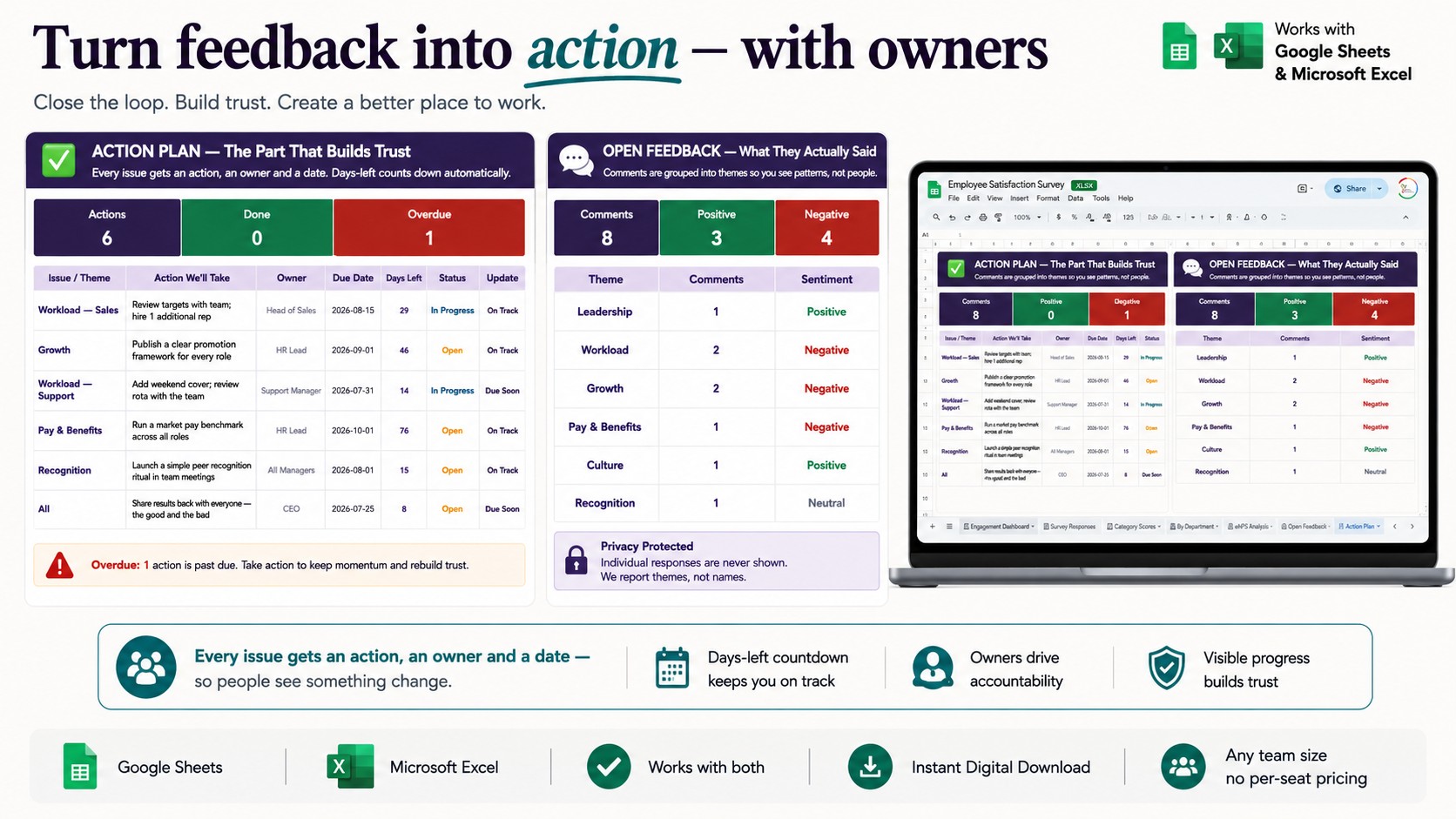
I built department breakdowns and category scoring into my employee survey dashboard in Google Sheets — see each team’s and each category’s scores separately, with the biggest problems flagged — and it includes built-in anonymity guardrails that warn you against reporting on groups too small to stay anonymous:
👉 Employee Satisfaction Survey Dashboard for Google Sheets & Excel
Whether you use mine or build your own, never trust a single company-wide average. Break your results down by team and by category to find where the real problems live — while carefully protecting the anonymity that makes honest answers possible. The team quietly heading for the door is invisible in your overall score. Segmenting is how you find them in time to do something about it.
This reflects my own perspective and is an organizing tool — not HR, legal or employment advice; protect anonymity and comply with any privacy laws that apply to you. Has a segmented result ever revealed a problem your overall numbers hid? Tell me in the comments.