

Never Judge a Job Offer on Salary Alone
The bigger salary isn’t always the better offer. Here’s how to compare total compensation properly — and see what a job is really worth.
When an offer arrives, there’s one number everyone’s eyes go to: the salary. It’s the headline, it’s what you tell people, it’s what feels like “the offer.” But the salary is only part of what a job actually pays you — sometimes a surprisingly modest part. When I first compared two offers properly, side by side, the one with the lower salary turned out to be worth more once everything was counted. Learning to think in total compensation rather than base pay changed how I evaluate jobs entirely. Here’s how to do it.
Salary is the headline, not the whole story
The salary number is seductive because it’s simple, it’s the biggest single figure, and it’s what gets compared socially. But your actual compensation is base salary plus everything else the job gives you — and “everything else” can be worth a great deal.
Two offers with the same salary can be worth substantially different amounts once you account for what surrounds them. And two offers with different salaries can flip in ranking once you count everything. Judging on base pay alone means you might well pick the worse offer while feeling good about the bigger number. That’s an expensive way to feel good.
What actually goes into total compensation
To compare offers honestly, you need to count what each package actually contains. Broadly:
- Base salary — the headline. Real, but not the whole picture.
- Bonus — target bonus or commission, if any. Worth understanding how likely it is, not just its maximum.
- Benefits the employer pays for — health coverage, retirement contributions or matching, and other insurances. These have real monetary value; if one employer contributes meaningfully more than another, that’s money in your pocket, even though it never appears on your payslip.
- Paid time off — more PTO is more paid days. That’s genuinely part of your compensation, and it’s easy to overlook.
- Everything else with value — allowances, stipends, learning budgets, and so on.
Add these up for each offer and you get a much truer picture of what each job pays you. The exercise is often eye-opening: a lower-salary job with strong benefits and generous leave can beat a higher-salary job that’s thin on everything else.
The things you can’t put a number on (but shouldn’t ignore)
Some of the most important differences between offers resist a dollar figure, and it would be dishonest to pretend otherwise. Flexibility and remote work can be worth an enormous amount to your actual life. A commute costs you time and money every day. Job security, the quality of the manager you’d work for, the learning you’d get, and the career doors a role opens — these can dwarf a modest salary difference over time.
So the goal isn’t to reduce a job to a single number. It’s to make sure that the financial comparison is honest, so that when you weigh the unquantifiable stuff, you’re doing it against real figures rather than a misleading headline. Know what each offer is really worth financially, then factor in the life you’d actually be living.
Comparing offers side by side changes the decision
The practical move is simple: lay your offers out next to each other, with every component listed, and total them. Doing this on paper (or in a sheet) rather than in your head is what makes the difference — because the components are many and our intuitions about them are bad. We anchor hard on the salary and mentally discount everything else.
Seeing it laid out breaks that anchoring. Suddenly the offer you were “obviously” going to take is a real comparison rather than a foregone conclusion. Even if you end up choosing the same job, you’ll do it knowing what you’re actually choosing, and knowing what you might negotiate.
It’s also a negotiation tool
There’s a bonus benefit: understanding total compensation gives you more room to negotiate. If an employer can’t move much on base salary, other components might be flexible — a signing bonus, extra leave, a better title, a learning budget, flexibility. Candidates who only think in salary miss all of this and leave value on the table.
Knowing the full picture lets you ask for what actually matters to you, rather than fixating on one number that the employer may have less room to move on than you think.
One important note
To be clear: this is a way of thinking about and organizing an offer comparison — it’s not career, financial, tax, or legal advice, and it guarantees no outcome. The value of benefits varies by situation and country, and the right choice depends on your circumstances, priorities, and what you value in your life. Do your own research, and if a decision has significant financial implications, consider talking to a qualified professional. And remember that the right job for you isn’t always the highest-paying one.
If you want a comparison ready to go
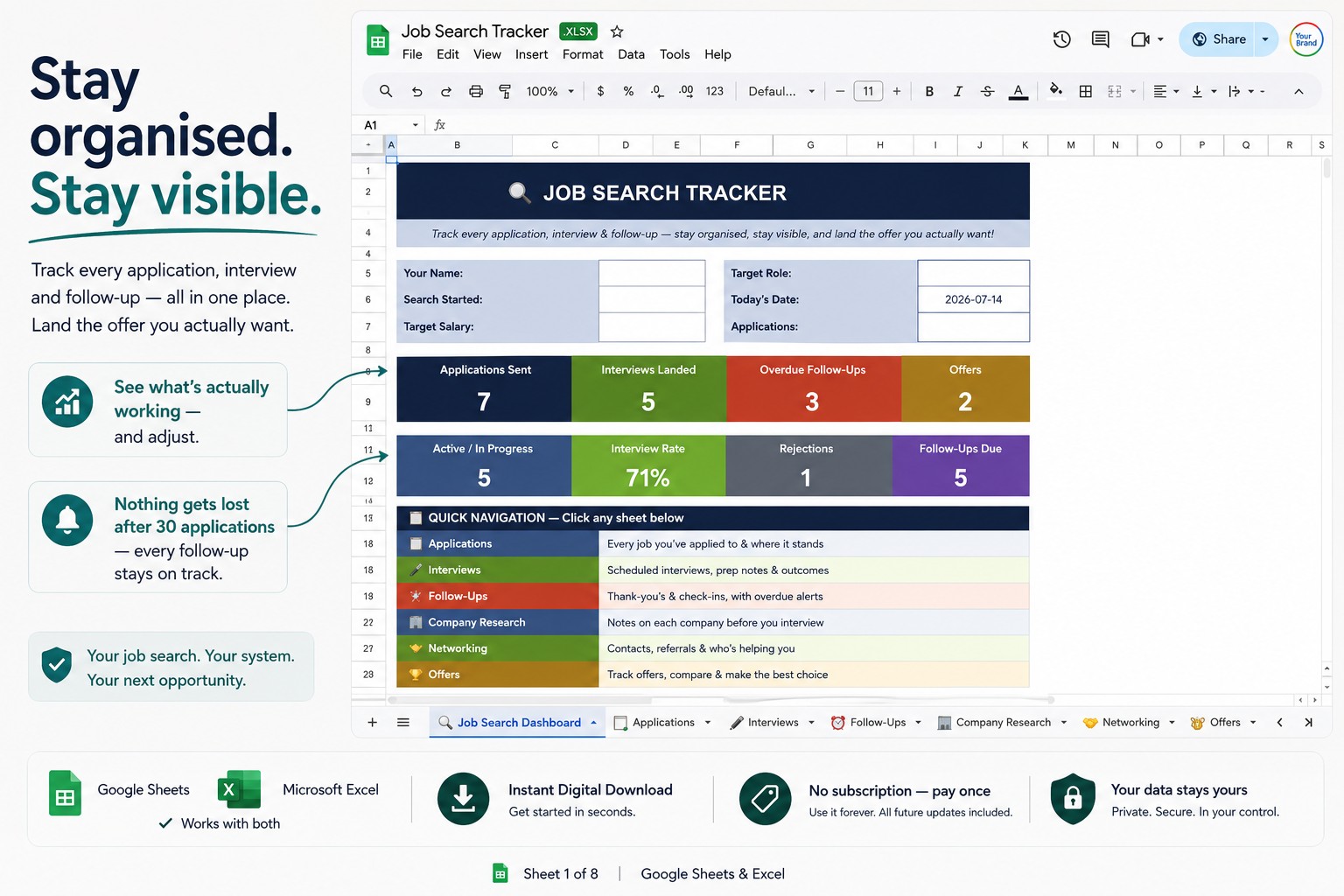
I built an offer comparison into my job search tracker in Google Sheets — enter base salary, bonus, benefits and PTO for each offer, and total compensation calculates automatically, so you can compare what each package is really worth side by side:
👉 Job Search Tracker for Google Sheets & Excel
Whether you use a tool or a piece of paper, don’t judge an offer on the headline. Add up everything each job actually gives you, weigh the things that don’t have a price tag, and choose with your eyes open. The best offer is rarely the one with the biggest number — it’s the one that’s genuinely worth the most to your life.
This is my own perspective and an organizing tool — not career, financial, tax or legal advice, and it guarantees no outcome. Consider your own circumstances and consult a professional for significant financial decisions. Have you ever turned down a higher salary for a better overall package? I’d love to hear why in the comments.

