The Follow-Up Almost Every Candidate Skips
It’s the easiest way to stay visible in a job search — and hardly anyone does it. Here’s why job search follow up matters, and how to do it without feeling like a pest.
Thirty applications into a job search, everything blurs together. Which company did you apply to three weeks ago? Did you ever send that thank-you note? Was the recruiter from the second interview the one who mentioned the salary band, or was that someone else? A job search gets messy fast — and in that mess, one small, high-value habit almost always gets dropped: the follow-up. Job search follow up is the step most candidates skip, and it’s one of the cheapest ways to stay visible and be remembered. Here’s why it matters and how to do it well.
Before anything else: this is hard, and it’s not you
I want to say this before the tactics, because it matters more than any of them. Job searching is genuinely difficult. It is slow, often demoralizing, and full of silence you can’t control. If you’re in the middle of one right now — especially if you’re job hunting after a layoff, or you’ve been at it a while — please hear this: a quiet week says nothing about your worth. Rejections and non-responses are overwhelmingly about timing, budgets, internal candidates, and a hundred other things that have nothing to do with you as a person.
Nothing in this article is about “hustling harder” or blaming yourself for a tough market. It’s about the small things that are actually within your control — because in a process where so little is, the things you can control are worth doing well.
Following up is a real advantage — because nobody does it
Here’s the practical reality: most candidates simply don’t follow up. They apply and wait. They interview and wait. And in the waiting, they become one of many indistinguishable names.
A polite, well-timed follow-up does a few things at once. It puts your name back in front of someone at a moment when they may actually be making decisions. It signals genuine interest — which employers notice, because so many candidates seem passive. And it demonstrates exactly the kind of proactive, organized behavior that makes someone want to work with you.
None of this guarantees anything — nothing in a job search does. But it costs you a few minutes, and it’s an edge available to almost everyone that almost nobody uses. That’s a rare combination.
The thank-you note: small, easy, weirdly rare
The single highest-value follow-up is the post-interview thank-you. It’s brief, it’s easy, it’s expected by many interviewers — and a surprising number of candidates never send one.
A good thank-you does more than say thanks. It’s a chance to reiterate your interest, reference something specific from the conversation (which proves you were listening and makes you memorable), and briefly reinforce why you’d be a good fit. It’s a free extra touchpoint with someone who’s currently deciding about you.
The reason people don’t send them isn’t usually laziness — it’s that the interview ends, life resumes, and the moment passes. A day or two later it feels too late, so it never gets sent. Which is exactly why it’s worth making it a scheduled task rather than a good intention. Book it right after the interview, and it happens.
Checking in on applications, respectfully
The other follow-up worth doing is the polite check-in on an application that’s gone quiet. This is where people get nervous — nobody wants to be the pest who keeps emailing.
Here’s the balance. A single, polite check-in after a reasonable amount of time is entirely appropriate and very unlikely to annoy anyone. What’s not appropriate is repeated messaging, pressure, or anything that puts a person on the spot. Respectful persistence is a good look; hounding is not. And if you get a clear “no” or a request to stop, respect it fully.
Knowing when to check in is where a bit of organization helps. If you can see how many days it’s been since you applied, the decision stops being an anxious guess (“is it too soon? is it too late?”) and becomes a simple call. Which brings me to the real problem.
The actual problem is that you can’t remember
Here’s the honest truth about why follow-ups get skipped. It’s not that candidates think follow-ups are worthless. It’s that a busy job search — dozens of applications at different stages, interviews, contacts — is genuinely impossible to hold in your head. So things get forgotten. The thank-you you meant to send. The application you meant to nudge. The contact who offered to refer you.
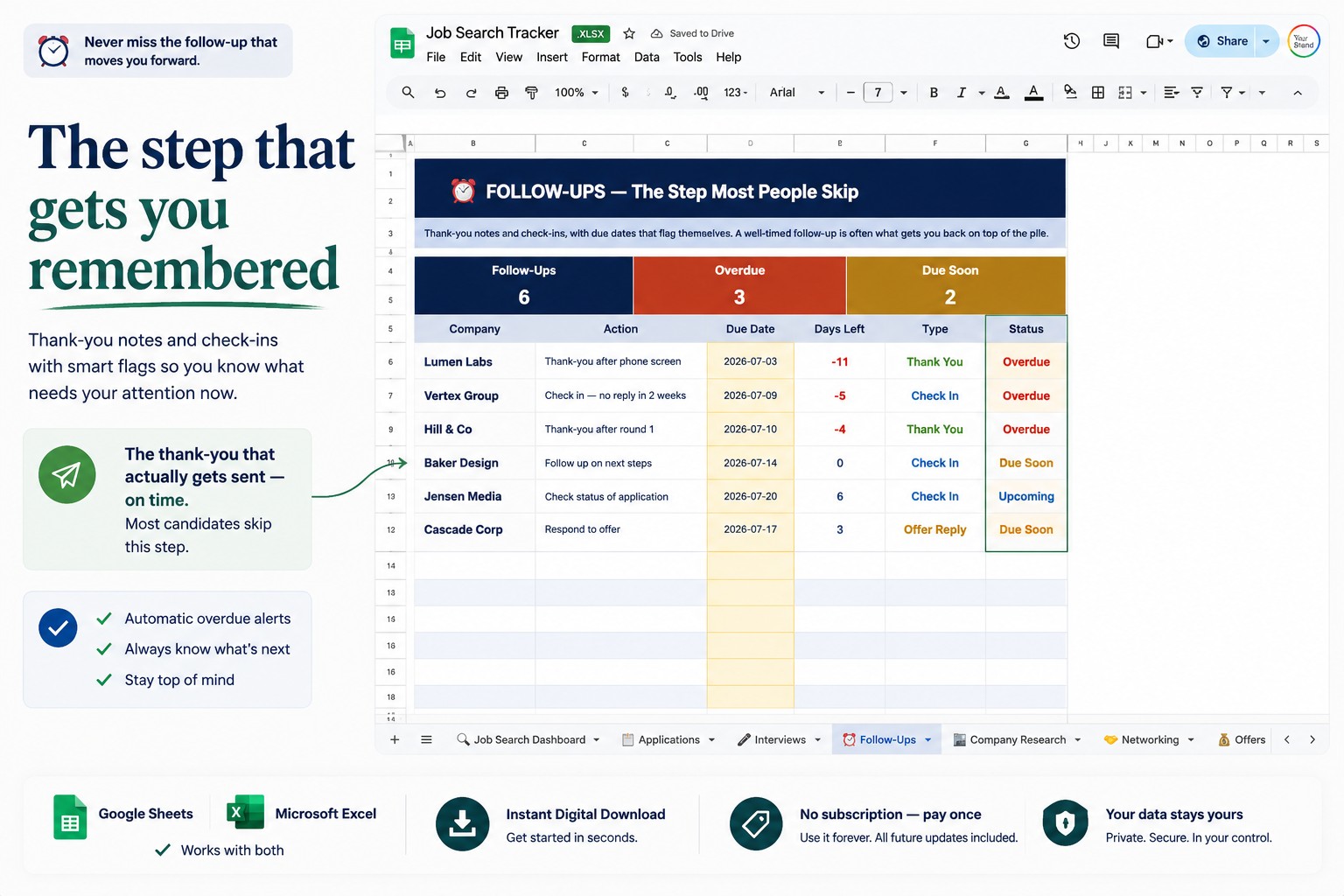
That’s a memory problem, not a motivation problem. And memory problems are solved with systems, not willpower. When every follow-up has a date attached, and something flags what’s due, they actually get done — because you’re not relying on remembering during one of the more stressful periods of your life.
Track the process, not your worth
One last reframe, because job searching does a number on people’s confidence. Tracking your search — applications, interviews, follow-ups, your interview rate — has a quiet psychological benefit: it lets you see your effort and your process as separate from the outcome. On a hard week, you can look at what you actually did rather than how you feel. And it lets you spot practical things worth adjusting.
But please hold it lightly. The numbers are there to help you organize and improve, not to become another stick to beat yourself with. A low response rate in a tough market is information about the market, not a verdict on you.
If you want a system that remembers for you
I built a job search tracker in Google Sheets to handle exactly this — every application with days-since-applied calculating itself, interviews with a countdown, and follow-ups that flag themselves the moment they’re due, plus company research, networking, and offer comparison:
👉 Job Search Tracker for Google Sheets & Excel
Whether you use a tool or a notebook, book your follow-ups as actual dated tasks. It’s the step almost everyone skips, it costs almost nothing, and it’s genuinely within your control — which, in a process full of things that aren’t, matters more than you’d think. And be kind to yourself while you’re doing it. This is hard, and you’re doing better than you think.
This is my own perspective and an organizing tool — not career, legal, financial or employment advice, and it guarantees no outcome. If your job search is taking a toll on you, please lean on people you trust for support. What’s the follow-up that once got you an interview? Share it in the comments — someone reading might need the nudge.